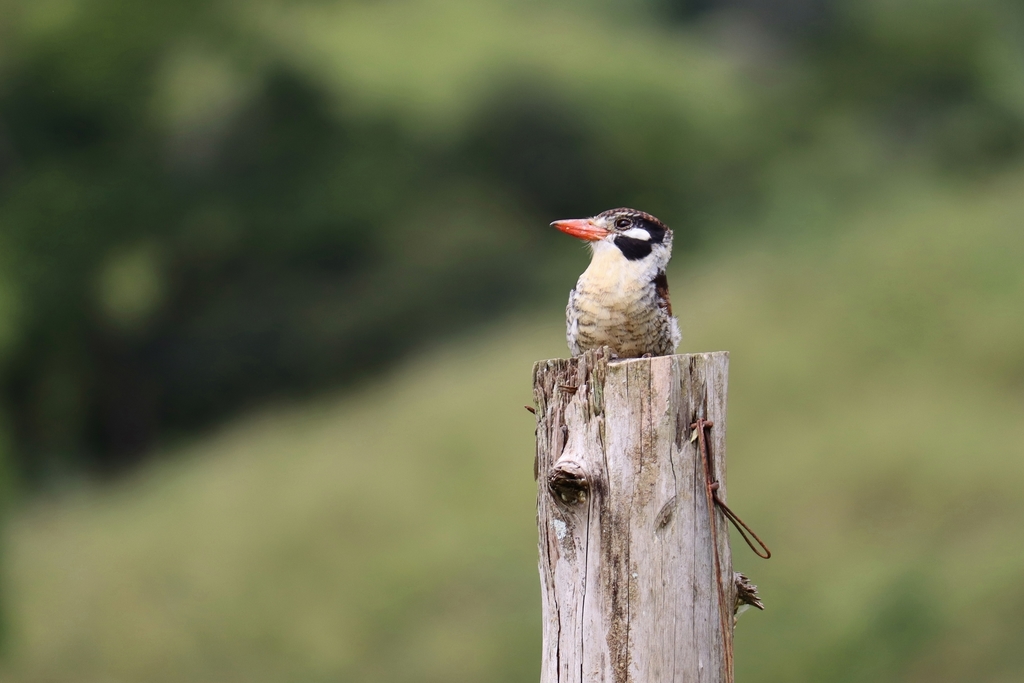
White-eared Puffbird
Photo © Conrado Pável de Oliveira
Photo © Conrado Pável de Oliveira — CC BY 4.0 — Source: iNaturalist photo #188900386Identification
The white-eared puffbird is a distinctive round, plump bird measuring 21–22 cm in length and weighing between 48–64 g. Like other puffbirds, it is characterized by its compact body shape and notably narrow tail—an adaptation related to its sit-and-wait feeding strategy. The most striking feature is the medium-sized white ear patch that gives the species its common name, surrounded by a contrasting dark ear patch.
The bird's plumage is fairly subtle. Its crown is dark brown with fine barring, while the back and wings are medium brown with dark rufous speckles and bars. The upper breast is white, extending to a narrow-to-medium white collar around the neck, with white and black flecking on the lower breast. The tail is dark brown and slightly graduated, marked with narrow, widely spaced buffy bars and a pale tip. Its orange bill, tipped with black, adds another identifying feature to this compact puffbird.
Range & Habitat
The white-eared puffbird is found across a large portion of central and eastern South America, ranging from eastern Peru and central Brazil south through Bolivia and Paraguay to northeastern Argentina. The species occupies a diverse range of woodland and forest habitats, including tropical and subtropical dry forests, subtropical and tropical moist forests, gallery forests along watercourses, and tropical savanna. It has also adapted to heavily degraded former forest areas.
Within this broad range, the species shows regional preferences. In southeastern Brazil, it is centered on the Cerrado region and the southeast Atlantic coast from northern Bahia south to the Paraná–Santa Catarina border. The species covers much of the eastern and northern Pantanal and southern areas of the Caatinga. In Peru, where it is rare and local, it favors dry forests and scrub in river valleys between 1,000 and 2,200 meters elevation. The species also inhabits the Amazon Basin headwaters and river systems across its northern range.
Behaviour & Diet
The white-eared puffbird is a sit-and-wait predator, a feeding strategy that explains its compact, rounded body shape. It hunts opportunistically for a diverse array of prey items, including arthropods and small vertebrates. Its vertebrate prey includes lizards, amphibians (even poisonous frogs), and small marsupials, which are commonly captured on the ground.
The bird's invertebrate diet is particularly varied, encompassing social wasps, beetles, homopterans, lepidopterans, and other large insects, many caught in mid-air often along streams. It also takes non-volant prey such as insect larvae, millipedes, centipedes, scorpions, velvet worms, and even crabs. This opportunistic approach to feeding allows the species to exploit a wide range of food sources across its varied habitats.
Best Time & Places to See It
The white-eared puffbird is most reliably observed in the Cerrado region of southeastern Brazil and in the Pantanal, where it is more regularly encountered than in other parts of its range. In Peru, where the species is rare and local, birdwatchers should focus on the dry forest and scrub habitats of the Mantaro, Apurímac, and Urubamba valleys. The species can also be found in suitable habitat throughout its broad range in Bolivia, Paraguay, and northeastern Argentina, as well as in Amazon Basin headwater regions.
As with many puffbirds, locating this species requires patience and attention to its preferred microhabitats. Searching along streams and in open woodland areas where insects are active may increase chances of encounter. The bird's sit-and-wait hunting behavior means it may remain perched for extended periods, making it potentially rewarding to scan suitable habitat slowly and carefully.
Photography Tips
The white-eared puffbird's compact size and relatively sedentary hunting behavior present both challenges and opportunities for photographers. The distinctive white ear patch is the key identifying feature and should be the focus of your compositions—approach from angles that highlight this characteristic marking. The bird's dark crown and the contrast between its white collar and darker back also make appealing compositional elements.
This species often hunts from low to mid-story perches, particularly along streams and in open woodland, making it accessible to ground-level and eye-level photography. Use patient stalking techniques and look for birds perched on exposed branches where they scan for prey. Early morning and late afternoon light will enhance the subtle browns and rufous tones of the plumage and illuminate the white ear patch effectively. A moderate telephoto lens will help you maintain distance while capturing the bird's characteristic round silhouette and diagnostic features in detail.
Emas National Park
Brazil
+333 birds+23 mammals
Across the high plateaux of central Brazil, where the cerrado grasslands roll toward distant horizons under an immense sky, Emas National Park anchors one of South…
VIEW NATIONAL PARKSerra do Cipó National Park
Brazil
+379 birds+5 mammals
Where granite escarpments rise above the Atlantic Forest transition zone in southeastern Brazil, Serra do Cipó National Park unfolds across a landscape of dramatic ridges, cascading…
VIEW NATIONAL PARKItatiaia National Park
Brazil
+519 birds+12 mammals
Where granite peaks pierce the Atlantic rainforest canopy in southeastern Brazil, Itatiaia National Park rises as one of the country's oldest and most ecologically vital protected…
VIEW NATIONAL PARKSerra da Bocaina National Park
Brazil
+441 birds+5 mammals
Where the escarpment of the Serra da Bocaina rises sharply from the Atlantic coastal plain, tropical rainforest cloaks steep mountainsides that climb toward peaks exceeding 2,000…
VIEW NATIONAL PARKIguaçu National Park
Brazil
+387 birds+17 mammals
Where the Paraná Plateau plunges toward the Atlantic watershed, six thousand square kilometers of subtropical rainforest cling to steep gorges and river valleys in this corner…
VIEW NATIONAL PARKIlha Grande National Park
Brazil
+233 birds
Across the subtropical plateaus and Atlantic forest remnants of southern Brazil, a vast protected landscape spanning nearly 4,600 square kilometers safeguards one of the continent's most…
VIEW NATIONAL PARKSão Joaquim National Park
Brazil
+222 birds+9 mammals
Where the southern Brazilian highlands rise above the Atlantic Forest, São Joaquim National Park protects nearly 1,000 square kilometers of montane terrain that shifts between temperate…
VIEW NATIONAL PARKSerra dos Órgãos National Park
Brazil
+446 birds+13 mammals
Granite peaks thrust skyward through the Atlantic Forest canopy in the mountains immediately north of Rio de Janeiro, their bare rock faces rising above a landscape…
VIEW NATIONAL PARKChapada dos Guimarães National Park
Brazil
+450 birds+1 mammals
Where weathered sandstone plateaus rise above the cerrado grasslands of central Brazil, Chapada dos Guimarães National Park protects 624 square kilometres of ecological transition zone that…
VIEW NATIONAL PARKChapada dos Veadeiros National Park
Brazil
+324 birds+6 mammals
Where granite plateaus rise above the cerrado savanna in central Brazil, Chapada dos Veadeiros National Park unfolds across 6,665 square kilometres of some of the world's…
VIEW NATIONAL PARKPantanal Matogrossense National Park
Brazil
+322 birds+17 mammals
Where the flooded forests of central Brazil meet vast seasonally inundated grasslands, Pantanal Matogrossense National Park sprawls across nearly 2,900 square kilometers of one of the…
VIEW NATIONAL PARKSerra do Gandarela National Park
Brazil
+333 birds+3 mammals
Where granite massifs rise through Atlantic Forest in southeastern Brazil's highlands, Serra do Gandarela National Park protects nearly 1,000 square kilometres of montane terrain that few…
VIEW NATIONAL PARKBrasília National Park
Plano Piloto, Brazil
+338 birds+15 mammals
Cerrado grassland and scattered woodland sweep across the central Brazilian plateau where this national park sprawls across more than a thousand square kilometres of the Federal…
VIEW NATIONAL PARKAraucárias National Park
Brazil
+231 birds+3 mammals
Where the southern Brazilian highlands rise into cool temperate forest, Araucárias National Park protects one of the Atlantic Forest's most distinctive ecosystems across 506 square kilometres…
VIEW NATIONAL PARKMapinguari National Park
Brazil
+354 birds
Vast tracts of western Amazonian rainforest blanket the remote terrain of this 56,827 square kilometre national park in Amazonas state, where seasonal rivers wind through dense…
VIEW NATIONAL PARKCampos Gerais National Park
Brazil
+143 birds
Where rolling plateaus rise above the Atlantic forest escarpment in Paraná's interior, Campos Gerais National Park unfolds across 539 square kilometers of highland grassland and forest…
VIEW NATIONAL PARKBahuaja Sonene National Park
San Pedro de Putina Punco, Peru
+602 birds+8 mammals
Where the Madre de Dios and Heath rivers converge in southeastern Peru rises one of South America's most biodiverse wilderness regions: a vast protected realm of…
VIEW NATIONAL PARKIguazú National Park
Puerto Iguazú, Argentina
+346 birds+15 mammals
Where the Paraná Plateau plunges toward the Atlantic watershed, nearly 800 square kilometers of subtropical rainforest drape across Misiones Province in a landscape carved by millennia…
VIEW NATIONAL PARKNo community photos yet. Log in to add the first one.
No community observations of this species yet.