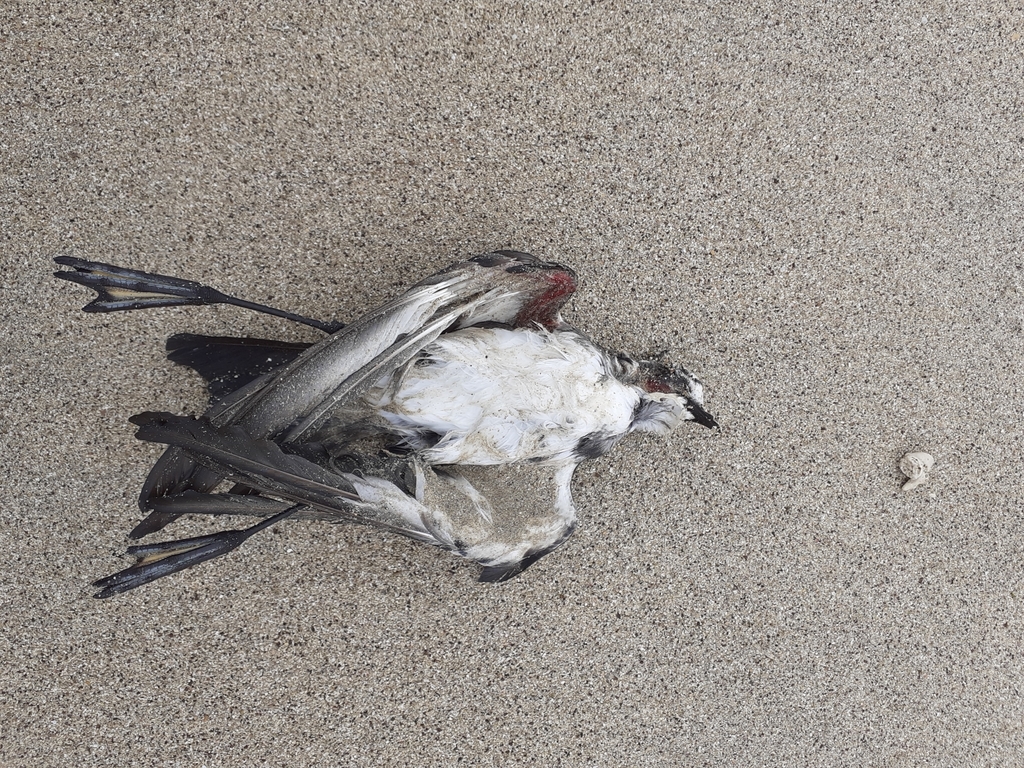
White-faced Storm Petrel
Photo © On Lee Lau
Photo © On Lee Lau — CC BY 4.0 — Source: iNaturalist #99516681Identification
The white-faced storm petrel is a small seabird measuring 19 to 21 centimetres in length with a wingspan of 41 to 44 centimetres. Its most distinctive feature is the striking white face with a black eye mask, reminiscent of a phalarope, combined with its pale brown to grey back, rump and wings. The flight feathers are black, while the underparts are white—a characteristic that sets it apart from other north Atlantic petrels. Dark bill, tarsi, toes and claws complete the picture. The bird's grey-brown dorsal plumage makes it relatively easy to identify at sea from a distance.
Both males and females display similar plumage with no seasonal variation, though females are slightly larger in tarsus, wing and tail lengths by around 1–3%, while males have proportionally deeper bills. Juveniles resemble adults but often show larger light fringes on their upperpart feathers and may appear greyer or browner depending on their moult stage. Subtle subspecific variations exist across its range, particularly in rump colour, tail shape and overall dimensions.
Range & Habitat
The white-faced storm petrel is widely distributed across both hemispheres, with six recognised subspecies breeding in island colonies from subtropical to subantarctic regions across the Atlantic, Indian and south-western Pacific Oceans. Major populations are found around the coastal and open ocean waters of southern Australia, New Zealand, Tristan da Cunha, Cabo Verde, the Canary Islands and the Selvagens Islands. The Selvagens Archipelago holds the world's largest concentration, with an estimated 61,000 breeding pairs recorded in 1996, including 36,000 on Selvagem Grande alone.
This species favours isolated islets for nesting, burrowing on both rocky slopes and flat sandy areas where vegetation such as hollyhock and grasses help stabilize the soil. Outside the breeding season, the white-faced storm petrel is strictly pelagic, spending most of its time far from land at sea.
Behaviour & Diet
The white-faced storm petrel is strictly pelagic outside the breeding season, making it a challenging bird to observe from land except during severe storms when individuals may be pushed to headlands. It is highly gregarious but notably does not follow ships. Like most petrels, its walking ability is limited to a short shuffle to the burrow, reflecting its adaptation to life at sea.
At breeding colonies, this species is strictly nocturnal to avoid predation by gulls and skuas, even avoiding landing on clear moonlit nights. Birds nest in dense colonies in rock crevices and burrows, with both parents sharing incubation duties in shifts lasting 4 to 6 days. A single white egg is laid in late October or November, with incubation periods averaging about 56 days in New Zealand colonies and about 52 days in other regions.
Best Time & Places to See It
The breeding season offers the most reliable opportunity to observe white-faced storm petrels, though accessing remote breeding islands remains challenging. September and October mark the beginning of the breeding period when birds return to their colonies to prepare nesting burrows. Peak activity occurs from late October through November when eggs are laid, and continues through the incubation period. Visiting breeding colonies during these months—such as those in New Zealand, the Selvagens Islands, or Tristan da Cunha—offers the best chance of encounters, though nocturnal behaviour limits daytime observations.
For seabirders willing to venture into open ocean waters around these island groups during the breeding season, pelagic boat trips may yield sightings. The bird's distinctive white face and pale dorsal plumage make it relatively identifiable at sea from a distance compared to other petrels.
Photography Tips
Photographing white-faced storm petrels presents unique challenges due to their small size, nocturnal breeding habits and pelagic lifestyle. At breeding colonies, plan visits during twilight hours when birds are most active entering and leaving burrows, though low light will require high ISO settings and fast lenses. The species' preference for moonless nights and dense burrows in remote locations means successful photography often requires patience and careful planning around lunar cycles.
At sea, the white-faced storm petrel's grey-brown dorsal plumage and white underparts provide reasonable contrast in good light conditions. A fast shutter speed is essential to freeze the bird's rapid, erratic flight patterns. The distinctive white face and black eye mask are key identifying features worth capturing, so close approaches on pelagic trips are valuable when weather permits.
Parque Nacional de Galápagos
Santo Tomás, Ecuador
+139 birds+23 mammals
Volcanic peaks and weathered lava fields dominate this remote archipelago in the Pacific, where the interplay of cold ocean currents and tropical latitude creates an ecological…
VIEW ISLAND & ARCHIPELAGOFitzgerald River National Park
Fitzgerald River National Park, Australia
+209 birds+11 mammals
Where granite peaks rise above windswept heathlands and pristine river systems carve through untamed wilderness, one of Australia's most biodiverse landscapes unfolds across the southwestern corner…
VIEW NATIONAL PARKBen Boyd National Park
Eden, Australia
+255 birds+47 mammals
Where the temperate forests of the far south coast meet towering sea cliffs, Ben Boyd National Park unveils one of New South Wales' most dramatic coastal…
VIEW NATIONAL PARKGreat Otway National Park
Australia
+255 birds+42 mammals
Temperate rainforest and wet eucalyptus woodland cloak the ridges and gullies of Victoria's Great Otway National Park, where persistent moisture and mild year-round temperatures sustain a…
VIEW NATIONAL PARKNo community photos yet. Log in to add the first one.
No community observations of this species yet.