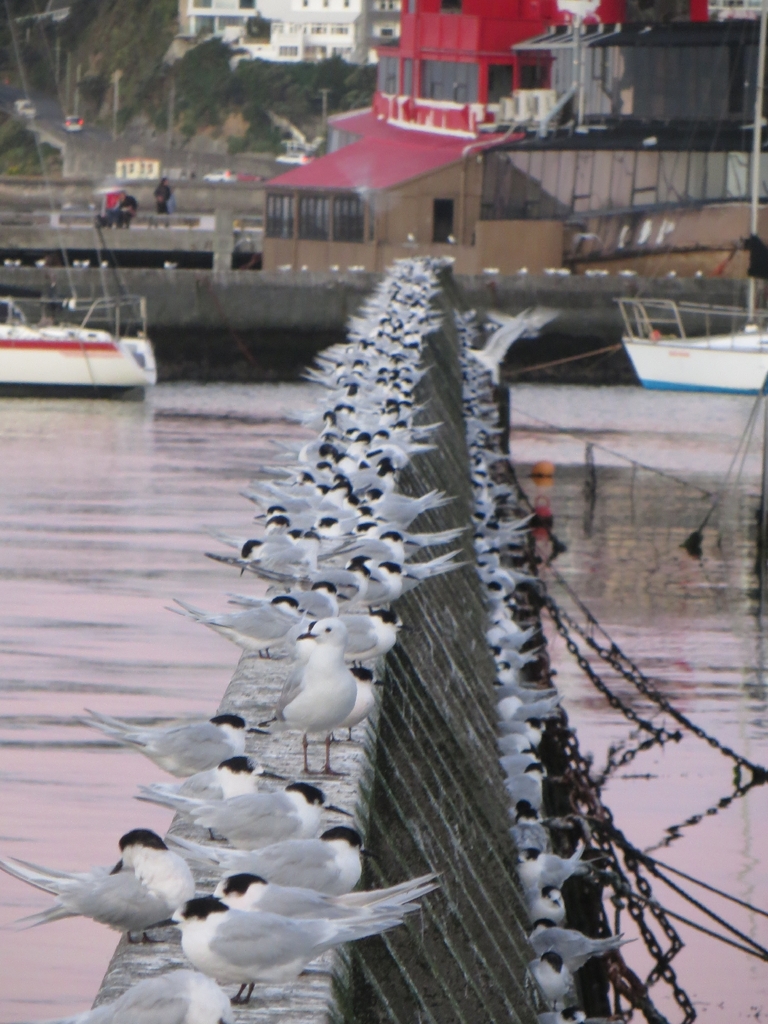
White-fronted Tern
Photo © kiwialli
Photo © kiwialli — CC BY 4.0 — Source: iNaturalist #355868002The white-fronted tern (Sterna striata), also known as tara, sea swallow, black-billed tern, kahawai bird, southern tern, or swallow tail, was first described by Johann Friedrich Gmelin in 1789. A medium-sized tern with an all-white body including underwing and forked tail, with pale grey hues on the mantle and upper side of the wing. In breeding adults a striking black cap covers the head from forehead to nape, leaving a small white strip above the black bill. This is the most abundant tern in New Zealand. It can be observed feeding on shoaling fish along the entire coastline and many of the smaller outlying islands. Breeding occurs from October to January on rocky cliffs, offshore islands and along the coast where pairs will nest on shingle, sand, shell or rock. Flocks may contain hundreds of breeding pairs that will nest in close proximity to one another. Large numbers of juveniles and some adults migrate to the south-east coast of Australia and parts of Tasmania in the autumn, with small numbers establishing breeding colonies on Flinders and Cape Barren Islands in the Bass Strait. Due to mammalian predators introduced to New Zealand, such as ferrets and stoats, the white-fronted tern has…
Sydney Harbour National Park
Sydney, Australia
+203 birds+26 mammals
Where Sydney Harbour's sheltered waters meet the sandstone headlands of New South Wales, a mosaic of coastal heathland, eucalyptus woodland and rocky shores creates one of…
VIEW NATIONAL PARKRoyal National Park
Sydney, Australia
+296 birds+46 mammals
Where sandstone ridges plunge toward the Tasman Sea, Royal National Park unfolds across 343 square kilometres of southeastern Australian coastal wilderness. The park's defining character emerges…
VIEW NATIONAL PARKMorton National Park
Australia
+253 birds+57 mammals
Across nearly 4,800 square kilometers of New South Wales's Southern Tablelands, rugged sandstone plateaus rise above sheltered valleys where cool-climate eucalypt woodland meets grassy heath and…
VIEW NATIONAL PARKBribie Island National Park
Brisbane, Australia
+284 birds+20 mammals
Across tidal flats and shallow waterways north of Brisbane, Bribie Island National Park spreads across nearly four hundred square kilometres of subtropical coastal wilderness—a patchwork of…
VIEW NATIONAL PARKWilsons Promontory National Park
Australia
+210 birds+21 mammals
Where granite headlands plunge toward Bass Strait, Wilson's Promontory National Park sprawls across nearly 1,300 square kilometers of southeastern Victoria's most rugged coastal wilderness. The park's…
VIEW NATIONAL PARKGreat Sandy National Park
Australia
+306 birds+40 mammals
Where coastal dunes rise inland from the Queensland coastline, Great Sandy National Park encompasses a landscape of remarkable ecological diversity shaped by subtropical humid conditions year-round.…
VIEW NATIONAL PARKBouddi National Park
Gosford, Australia
+147 birds+17 mammals
Sandstone ridges rise sharply from the Tasman Sea along the central New South Wales coast, their weathered faces etched by millennia of salt spray and storm…
VIEW NATIONAL PARKBen Boyd National Park
Eden, Australia
+255 birds+47 mammals
Where the temperate forests of the far south coast meet towering sea cliffs, Ben Boyd National Park unveils one of New South Wales' most dramatic coastal…
VIEW NATIONAL PARKGreat Otway National Park
Australia
+255 birds+42 mammals
Temperate rainforest and wet eucalyptus woodland cloak the ridges and gullies of Victoria's Great Otway National Park, where persistent moisture and mild year-round temperatures sustain a…
VIEW NATIONAL PARKNo community photos yet. Log in to add the first one.
No community observations of this species yet.