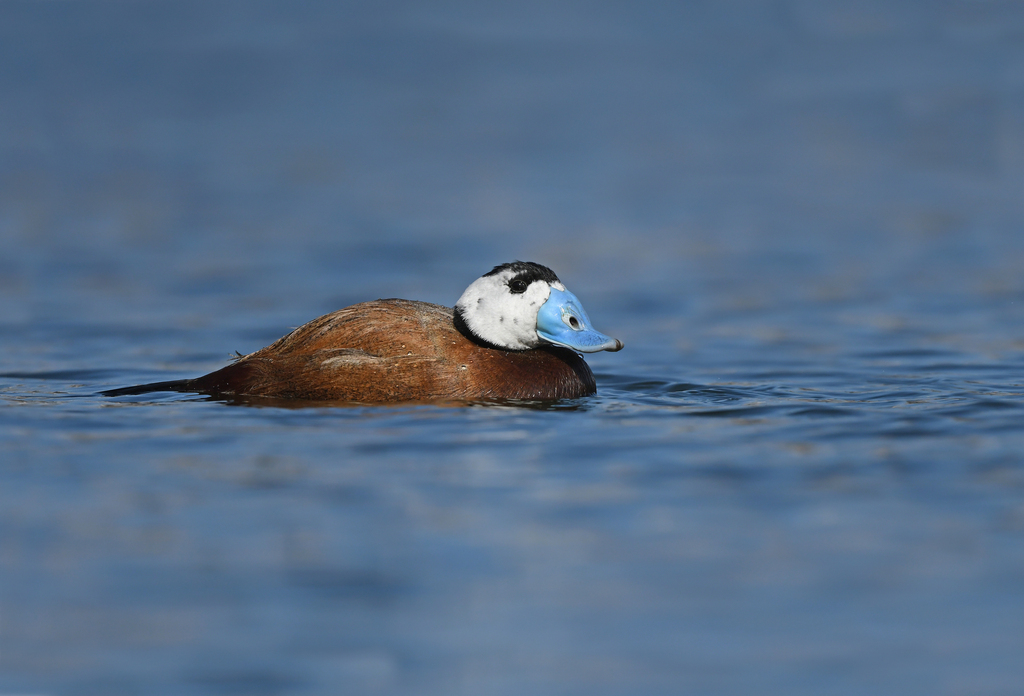
White-headed Duck
Photo © Christoph Moning
Photo © Christoph Moning — CC BY 4.0 — Source: iNaturalist #269095991Identification
The white-headed duck is a small diving duck, measuring 43–48 cm in length and weighing 580–750 g. Males are unmistakable, with a largely white head topped by a black cap, a striking blue bill, and grey-reddish body plumage. Females are more subdued, displaying grey-brown bodies with white faces and darker bills, caps, and cheek stripes. The species' name refers directly to this distinctive white head, making males relatively easy to identify in the field.
Range & Habitat
The white-headed duck is found across Spain, North Africa, Western Asia, and Central Asia, with larger populations concentrated in western and central Asia. The species breeds in large tracts of open water including lakes, ponds, and artificial water bodies that feature dense stands of aquatic plants. These marginal vegetation zones are essential, providing both shelter and suitable nesting sites for breeding birds. Occasionally, individuals are reported well north of their established breeding range, though such records may sometimes represent escapes from waterfowl collections.
Behaviour & Diet
True to its classification as a diving duck, the white-headed duck feeds by diving and swimming underwater. It is omnivorous, though vegetable matter predominates in its diet, supplemented by animal matter. Notably, this species is reluctant to take flight, preferring to swim away when faced with a perceived threat rather than becoming airborne. This behaviour, while characteristic of the species, may make them more vulnerable to disturbance in their wetland habitats.
Best Time & Places to See It
The white-headed duck is best sought in its core breeding areas across Spain and central Asia, particularly in regions with large shallow lakes and reed-fringed wetlands. Observers should focus on open-water areas with dense marginal vegetation, where birds can feed and find shelter. Due to the species' reluctance to fly, patience and careful approach are rewarded—scanning open water with binoculars is often more effective than attempting to flush birds into flight.
Photography Tips
Photograph males in good light to capture the brilliant white head contrasting with the black cap and the distinctive blue bill. Early morning and late afternoon light will enhance the blue tones of the bill and bring out the subtle grey-reddish body plumage. Since these ducks prefer to swim away from threats rather than fly, position yourself with the sun at your back and approach slowly along the water's edge. A longer lens is recommended to avoid startling birds and to achieve detailed shots of the head markings that make this species so visually distinctive.
S’Albufera Natural Park
Platja de Muro, Spain
+253 birds+6 mammals
Where Mediterranean lagoons meet the Balearic coast, S'Albufera stretches across nearly 1,600 hectares of wetland and dune systems that rank among Europe's most ecologically vital shallow-water…
VIEW NATURAL PARKL’Albufera Natural Park
València, Spain
+321 birds+18 mammals
Where shallow lagoons meet Mediterranean coastal marshland, L'Albufera Nature Park unfolds as one of Spain's most vital wetland complexes. This protected landscape, designated under IUCN Category…
VIEW NATURAL PARKDoñana National Park
Hinojos, Spain
+300 birds+13 mammals
Where the Guadalquivir River delta spreads into the Atlantic, vast marshes, cork woodlands, and coastal dunes converge to create one of southwestern Europe's most biodiverse wetland…
VIEW NATIONAL PARKTablas de Daimiel National Park
Daimiel, Spain
+246 birds+6 mammals
Where the Guadiana River spreads into a labyrinth of shallow lagoons and reed beds across the sun-baked plains of central Spain, Tablas de Daimiel National Park…
VIEW NATIONAL PARKCabo de Gata-Níjar Natural Park
San José, Spain
+274 birds+11 mammals
Where volcanic ridges plunge toward the Mediterranean, Cabo de Gata-Níjar Nature Park unfolds across one of Europe's most arid coastlines, a landscape sculpted by tectonic violence…
VIEW NATURAL PARKDelta de l’Ebre Natural Park
Eucaliptus, Spain
+341 birds+18 mammals
Where the Ebro River spreads into a vast labyrinth of shallow lagoons, reed beds, and brackish marshes before surrendering to the Mediterranean, one of southern Europe's…
VIEW NATURAL PARKDanube Delta Biosphere Reserve
Tulcea, Romania
+277 birds+27 mammals
Where the Danube surrenders to the Black Sea, a vast labyrinth of channels, reed beds, and freshwater lakes sprawls across nearly 13,400 square kilometers of eastern…
VIEW NATIONAL PARKKerkini Lake National Park
Serres, Greece
+291 birds+18 mammals
Where the Strymon River widens into a sprawling freshwater lake hemmed by the Rhodope Mountains, Kerkini National Park unfolds across northern Greece as one of southeastern…
VIEW NATIONAL PARKNo community photos yet. Log in to add the first one.
No community observations of this species yet.