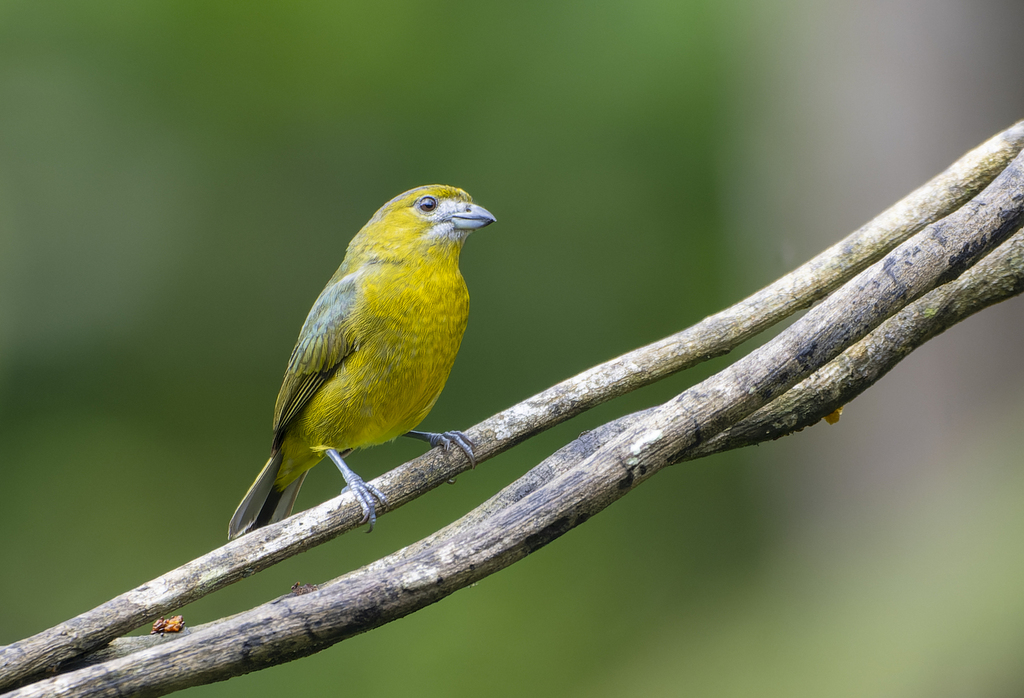
White-lored Euphonia
Photo © David F. Belmonte
Photo © David F. Belmonte — CC BY 4.0 — Source: iNaturalist photo #351112950Identification
The white-lored euphonia, also known as the golden-bellied euphonia, is a tiny finch measuring just 9 to 10 cm in length and weighing a mere 11 to 16 grams. Despite its diminutive size, it is quite distinctive, featuring a thick bill and striking sexual dimorphism. Males are far more colorful than females, making identification easier in the field.
Adult males display an olive forecrown with a thin dusky border, grayish crown and nape, and ashy-whitish lores and cheeks. Their upperparts are predominantly olive-green with a bluish-gray gloss, while their most eye-catching feature is their bright yellow underparts with a clear yellow belly and undertail coverts. Females are considerably duller, with gray underparts tinged with olive-yellow on the sides and flanks. Both sexes have a dark brown iris, blackish bill, and horn-gray legs.
Range & Habitat
The white-lored euphonia is found across mainland South America, absent only from Argentina, Chile, Paraguay, and Uruguay. Two subspecies divide the range: the nominate subspecies occupies western and southern territories from southeastern Colombia through Ecuador and Peru into northern Bolivia and across Amazonian Brazil south of the Amazon River; the subspecies E. c. nitida inhabits the northern Amazon basin from eastern Colombia through Venezuela and the Guianas to northern Brazil.
This species favors the canopy and edges of humid várzea and terra firme forests, as well as shady clearings with mature trees and secondary growth. It reaches elevations up to 1,200 meters in Colombia and Peru, 900 meters in Venezuela and Brazil, and 600 meters in Ecuador, making it accessible to travelers at various altitudes across its range.
Behaviour & Diet
The white-lored euphonia is a resident species that feeds primarily on mistletoe fruits and other small fruits, supplementing its diet with occasional insects. It typically forages in pairs or small groups, sometimes joining mixed-species feeding flocks. In forests, it remains mostly in the canopy, though at forest edges and in clearings it descends to forage in shrubs and small trees.
Males are vocal performers, typically singing from high, open perches while bobbing their bodies and twitching their tails. Their song is a lively jumble of varied notes—chits, spitz sounds, and whistles—delivered in sputtering bursts lasting several minutes with pauses between bouts. The species also produces various calls, including buzzy and smacking notes that aid in identification even when the bird remains hidden in the canopy.
Best Time & Places to See It
The white-lored euphonia is rated as fairly common to common throughout its range, with populations described as "common to frequent" in Brazil and Venezuela, and fairly common in Colombia and Peru. It occurs in numerous protected areas across South America, offering multiple opportunities for wildlife travelers. The species is a year-round resident, so it can be seen in any season, though breeding activity appears to peak in August and September in parts of its range.
Look for this euphonia in humid lowland and foothill forests throughout the Amazon basin and adjacent regions. Its presence in many protected areas makes it a reliable species for birders and naturalists exploring South American rainforests.
Photography Tips
Photographing the white-lored euphonia presents both challenges and rewards. The species' preference for the high canopy means patience and a good telephoto lens are essential. However, males' habit of singing from exposed perches while bobbing provides excellent photo opportunities if you can locate a singing male. Early morning hours, when birds are most active vocally, offer the best chances for encounters.
The striking yellow underparts of males and the contrasting gray and olive tones of females provide good color contrast for photography. Focus on capturing males in their characteristic singing posture with body bob and tail twitch, as these behavioral displays are as photogenic as the birds themselves. In forest edge habitats and clearings where the species feeds lower in vegetation, photography opportunities improve considerably compared to dense canopy searches.
Yasuní National Park
Aguarico, Ecuador
+601 birds+43 mammals
Where the western Amazon basin converges with Ecuador's Orellana Province, lowland rainforest reaches toward the horizon in an unbroken canopy of staggering botanical density. Yasuní National…
VIEW NATIONAL PARKSumaco Napo-Galeras National Park
Loreto, Ecuador
+563 birds+4 mammals
Where Ecuador's Amazon transitions into cloud forest, a massive shield volcano rises from the emerald lowlands of Orellana Province, anchoring one of the continent's most biodiverse…
VIEW NATIONAL PARKNatural la Paya National Park
Puerto Leguízamo, Colombia
+262 birds+4 mammals
Where the Amazon's western reaches fold into the Andes foothills, La Paya National Park sprawls across more than 8,500 square kilometers of pristine Amazonian rainforest in…
VIEW NATIONAL PARKNatural Sierra de la Macarena National Park
Vista Hermosa, Colombia
+566 birds+15 mammals
Across nearly 20,000 square kilometres of Colombia's Meta Department, the terrain rises from lowland savanna into Andean foothills through a mosaic of gallery forests, palm-fringed wetlands,…
VIEW NATIONAL PARKAmacayacu National Park
Leticia, Colombia
+567 birds+25 mammals
Where the Rio Amazonas curves through the tri-border region where Colombia, Peru, and Brazil converge, Amacayacu National Park sprawls across more than 5,250 square kilometres of…
VIEW NATIONAL PARKViruá National Park
Brazil
+389 birds+6 mammals
Across the northern frontier of Roraima, where the forest canopy rises from ancient Amazonian lowlands, Viruá National Park protects nearly 3,700 square kilometres of terra firme…
VIEW NATIONAL PARKSerra do Pardo National Park
Brazil
+153 birds
Vast upland forests and weathered plateaus define this 7,129-square-kilometre protected expanse in the heart of Pará's remote interior, where ancient bedrock and swollen rivers have carved…
VIEW NATIONAL PARKAmazônia National Park
Brazil
+439 birds+6 mammals
Where the Rio Amazonas and its tributaries weave through the heart of Pará state, a vast tapestry of rainforest stretches across 23,611 square kilometers of unbroken…
VIEW NATIONAL PARKJaú National Park
Brazil
+354 birds+3 mammals
Vast floodplain forests and blackwater rivers define this remote corner of western Amazonas, where the Rio Negro and its tributaries have carved an intricate mosaic of…
VIEW NATIONAL PARKPacaás Novos National Park
Brazil
+279 birds+1 mammals
Across the border between Rondônia and Amazonas, vast tracts of humid tropical forest rise and fall in gentle undulations, carved by clear-flowing rivers that feed into…
VIEW NATIONAL PARKAnavilhanas National Park
Brazil
+468 birds+8 mammals
Across the Rio Negro in central Amazonas, an archipelago of over a thousand islands rises from the world's largest rainforest river system, creating a labyrinth of…
VIEW NATIONAL PARKCampos Amazónicos National Park
Amazonas, Brazil
+434 birds+7 mammals
Sprawling across the southwestern Amazon basin in Amazonas state, this 27,263-square-kilometre national park encompasses some of the region's most pristine lowland rainforest, where terra firme forest…
VIEW NATIONAL PARKSerra do Divisor National Park
Brazil
+448 birds+10 mammals
Where the western Amazon meets the Andes foothills, Serra do Divisor National Park sprawls across one of South America's most biodiverse and least accessible frontiers. Spanning…
VIEW NATIONAL PARKYanachaga–chemillén National Park
Palcazu, Peru
+639 birds+6 mammals
Where the eastern slopes of Peru's central cordillera plunge into cloud forest, Yanachaga–Chemillén National Park protects nearly three thousand square kilometres of montane wilderness that few…
VIEW NATIONAL PARKManu National Park
Manu, Peru
+892 birds+26 mammals
Across the eastern slopes of the Peruvian Andes, tropical rainforest descends into the Amazon basin with a complexity that few terrestrial ecosystems match. Manu National Park…
VIEW NATIONAL PARKBahuaja Sonene National Park
San Pedro de Putina Punco, Peru
+602 birds+8 mammals
Where the Madre de Dios and Heath rivers converge in southeastern Peru rises one of South America's most biodiverse wilderness regions: a vast protected realm of…
VIEW NATIONAL PARKTingo Maria National Park
Mariano Dámaso Beraún, Peru
+423 birds
Where the eastern slopes of the Peruvian Andes descend toward the Amazon basin, the landscape fractures into a maze of limestone ridges, humid gorges, and cloud-wrapped…
VIEW NATIONAL PARKCordillera Azul National Park
Pampa Hermosa, Peru
+322 birds+1 mammals
Where the eastern Andes descend into the western Amazon basin, Cordillera Azul National Park sprawls across nearly 38,000 square kilometres of some of Peru's most pristine…
VIEW NATIONAL PARKNo community photos yet. Log in to add the first one.
No community observations of this species yet.