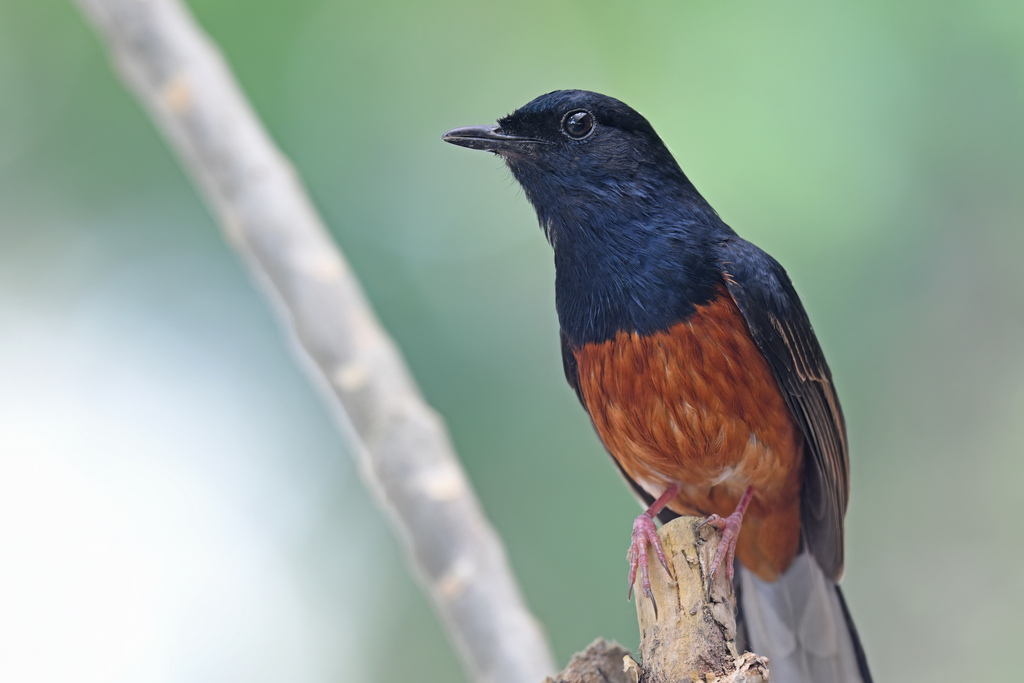
White-rumped Shama
Photo © Nathan Ruser
Photo © Nathan Ruser — CC BY 4.0 — Source: iNaturalist photo #581603339Identification
The white-rumped shama is a striking small passerine, 23–28 cm in length and weighing 28–34 g. Males are unmistakable: glossy black plumage contrasts sharply with a rich chestnut belly, and distinctive white feathers mark the rump and outer tail. Females are considerably duller, with greyish-brown colouration throughout, typically smaller than males. Both sexes share a black bill and pink feet. Juveniles resemble females but display a blotchy or spotted chest, aiding separation from adults.
Range & Habitat
Native to the Indian subcontinent and Southeast Asia, the white-rumped shama inhabits densely vegetated scrub and secondary forests, with a particular preference for bamboo thickets and dense undergrowth. Nine recognised subspecies occur across this range, from the Malabar Coast of India and Nepal through to south China, Indochina, and the Indonesian archipelago including Sumatra, Borneo, and Java. The species has been introduced beyond its native range, notably to Hawaii (Kauai in 1931, Oahu in 1940) and Taiwan, where it is now considered invasive. In Hawaii, populations favour valley forests and ridge habitats in lowland broadleaf forests.
Behaviour & Diet
Despite their popularity in captivity, white-rumped shamas are shy and somewhat crepuscular in the wild, though highly territorial. Males defend territories averaging 0.09 ha during breeding season, though each sex may occupy separate territories outside the breeding period. Breeding in South Asia occurs mainly from April to June, with clutches of four or five eggs laid in tree hollows. Courtship involves males pursing females with shrill calls and elaborate tail-flicking displays followed by synchronised flight patterns. The female alone constructs the nest from roots, leaves, ferns, and stems; incubation lasts 12–15 days and nestlings fledge after approximately 12.4 days. In the wild, they feed exclusively on insects.
Best Time & Places to See It
In their native Asian range, the breeding season from April to June offers the best opportunity to locate these vocal birds, as territorial males are most active and conspicuous. Dense undergrowth in bamboo forests and secondary growth across India, Nepal, Southeast Asia, and the Indonesian islands should be thoroughly searched. In Hawaii, where they are established residents, valley forests and ridge habitats in the southern Koolaus provide reliable sightings year-round.
Photography Tips
The male's striking black and chestnut plumage demands fast shutter speeds to capture the glossy texture and vibrant colours accurately. Position yourself in shaded forest undergrowth where birds forage, using patient stalking rather than active pursuit. Early morning and late afternoon light, when these somewhat crepuscular birds are most active, offer optimal opportunities. Focus on the characteristic white rump and fanned tail during territorial or courtship displays—these diagnostic features make compelling compositional elements. Females and juveniles require more careful approach and may reward persistence with intimate portraits in their preferred low-level habitat.
Kanha Tiger Reserve
Bako National Park
Bandhavgarh National Park
Bandipur National Park
Banke National Park
Bardiya National Park
Chitwan National Park
Doi Inthanon National Park
Gunung Mulu National Park
Nothing matches these filters.
No community photos yet. Log in to add the first one.
No community observations of this species yet.