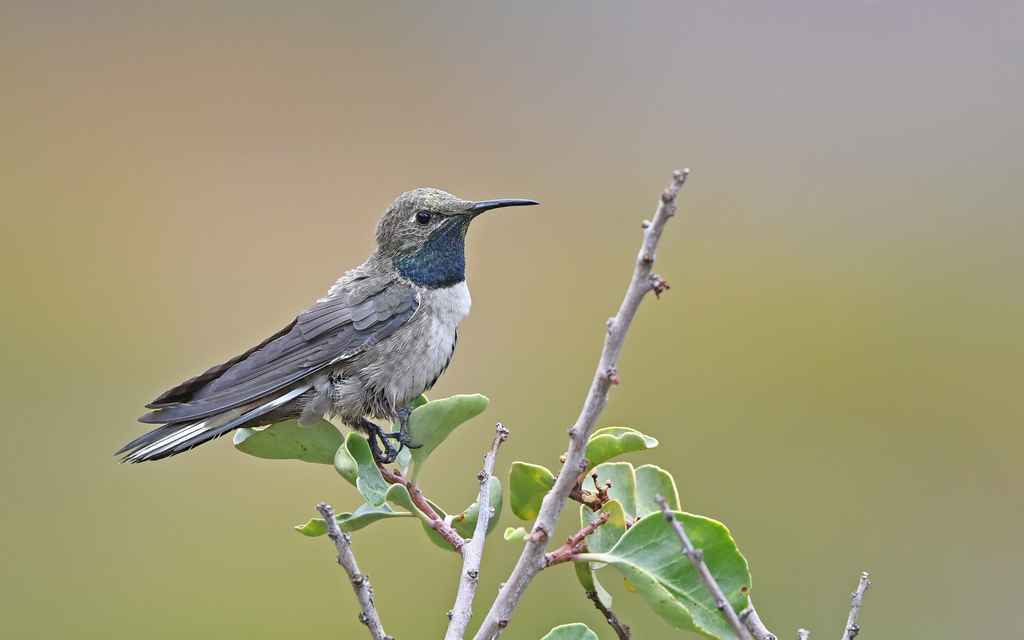
White-sided Hillstar
Photo © Christoph Moning
Photo © Christoph Moning — CC BY 4.0 — Source: iNaturalist photo #393175913Identification
The white-sided hillstar is a small hummingbird, measuring 13 to 15 cm in length and weighing just 7.9 to 8.4 grams. Both sexes share drab brown upperparts, but males are far more striking below, displaying a brilliant shiny green gorget bordered in black that contrasts sharply with a white breast and belly. A distinctive wide blue-black stripe runs down the centre of the male's belly into the vent area. The somewhat rounded tail is bronzy black with white at the base of the outer feathers. Females are duller overall, with pale throats finely speckled with dark markings and greenish-black tails; their outer tail feathers show much white at both bases and tips. Both sexes possess a medium-length, slightly decurved black bill. Juveniles appear greyer than adults, with males showing a dark blue-green gorget at an early age.
Range & Habitat
This species inhabits the high Andes, ranging from central Bolivia's Cochabamba Department southward through Chile to the Biobío Region and into Argentina as far south as Santa Cruz Province. The white-sided hillstar favours puna grasslands dotted with dwarf shrubs, cacti, and Puya plants, typically at elevations between 1,200 and 4,000 metres, though it occasionally ventures even higher towards the snow line.
Behaviour & Diet
The white-sided hillstar exhibits altitudinal migration, with most individuals leaving Chile during the Austral winter, though some simply descend to lower elevations. Occasional movement further north into Bolivia has been recorded in late winter and early spring. While specific details about this species' feeding ecology remain limited, it is believed to share similar habits with the closely related Andean hillstar: it feeds primarily on nectar from flowering shrubs, cacti, and trees, typically perching rather than hovering while feeding. It also gleans small arthropods from vegetation and occasionally captures them in flight.
Breeding occurs in November and December, when pairs construct distinctive large cup nests glued to vertical rock faces in well-protected locations. Clutch size is two eggs. The species produces a repeated short "tsit" call and engages in fast twittering vocalizations during chasing and display interactions.
Best Time & Places to See It
The white-sided hillstar is generally common throughout its range, which spans several protected areas. The austral spring and summer months (November to February) are optimal for observation, particularly before the species' winter exodus from the Chilean portions of its range. The puna grasslands of Bolivia, Chile, and Argentina where it resides offer excellent opportunities for viewing this striking hummingbird.
Photography Tips
Photographers should position themselves near flowering shrubs and Puya plants in puna habitats, where birds perch to feed rather than hovering. Early morning light will best illuminate the male's brilliant green gorget and contrasting black border. The bird's small size and high-altitude habitat demand fast shutter speeds and patience. Look for birds along vertical rock faces during breeding season (November–December), as nest sites may reveal regular feeding routes and perching spots ideal for portrait photography.
Torres del Paine National Park
Torres del Paine, Chile
+143 birds+10 mammals
Where granite spires pierce the Patagonian sky, Torres del Paine commands one of South America's most dramatic landscapes. Across 4,106 square kilometres of southern Chile, jagged…
VIEW NATIONAL PARKLaja National Park Lagoon
Antuco, Chile
+123 birds+1 mammals
Where the Andes descend into the Biobío Region's temperate forests, a vast lagoon fills the caldera of the extinct Antuco volcano, cradled by steep native woodland…
VIEW NATIONAL PARKPuyehue National Park
Puyehue, Chile
+110 birds+4 mammals
Across the volcanic spine of the Los Lagos Region, where the Andes descend toward temperate rainforest, Puyehue National Park encompasses nearly 2,600 square kilometers of one…
VIEW NATIONAL PARKVicente Pérez Rosales National Park
Puerto Varas, Chile
+109 birds+8 mammals
Where the Andes descend toward the temperate rainforests of Chile's Lake District, nearly 4,641 square kilometers of pristine wilderness unfolds across Vicente Pérez Rosales National Park.…
VIEW NATIONAL PARKCerro Castillo National Park
Coyhaique, Chile
+89 birds+3 mammals
Granite peaks and windswept steppe converge across this vast Patagonian landscape, where the Andes' eastern flank drops into terrain sculpted by ice age glaciers and relentless…
VIEW NATIONAL PARKPatagonia National Park
Cochrane, Chile
+133 birds+8 mammals
Where the Andes meet the Patagonian steppe, vast grasslands and shrublands sweep across rolling terrain carved by ancient glaciation, their contours softened by distance and dramatic…
VIEW NATIONAL PARKParque Municipal Llao Llao
San Carlos de Bariloche, Argentina
+73 birds+1 mammals
Where the Andes meet the Patagonian lakes, granite peaks rise above temperate rainforest in a landscape of startling contrasts. Parque Municipal Llao Llao, sprawling across 23…
VIEW NATIONAL PARKLos Cardones National Park
Argentina
+193 birds+6 mammals
Where the Andes descend into northwestern Argentina, Los Cardones National Park sprawls across nearly 1,200 square kilometres of one of South America's most distinctive high-altitude desert…
VIEW NATIONAL PARKNahuel Huapi National Park
Argentina
+124 birds+11 mammals
Where the Andes descend toward Patagonia, vast glacial lakes cut through a landscape of southern beech forest and granite peaks, creating one of South America's most…
VIEW NATIONAL PARKLanín National Park
Argentina
+128 birds+7 mammals
Where the volcanic spine of the Andes plunges into Patagonian steppe, Lanín National Park sprawls across nearly 4,700 square kilometers of one of Argentina's most visually…
VIEW NATIONAL PARKLos Alerces National Park
Argentina
+84 birds+3 mammals
Where the temperate rainforests of southern Patagonia sweep down towards crystalline lakes, Los Alerces National Park unfolds across nearly 3,000 square kilometres of one of South…
VIEW NATIONAL PARKNo community photos yet. Log in to add the first one.
No community observations of this species yet.