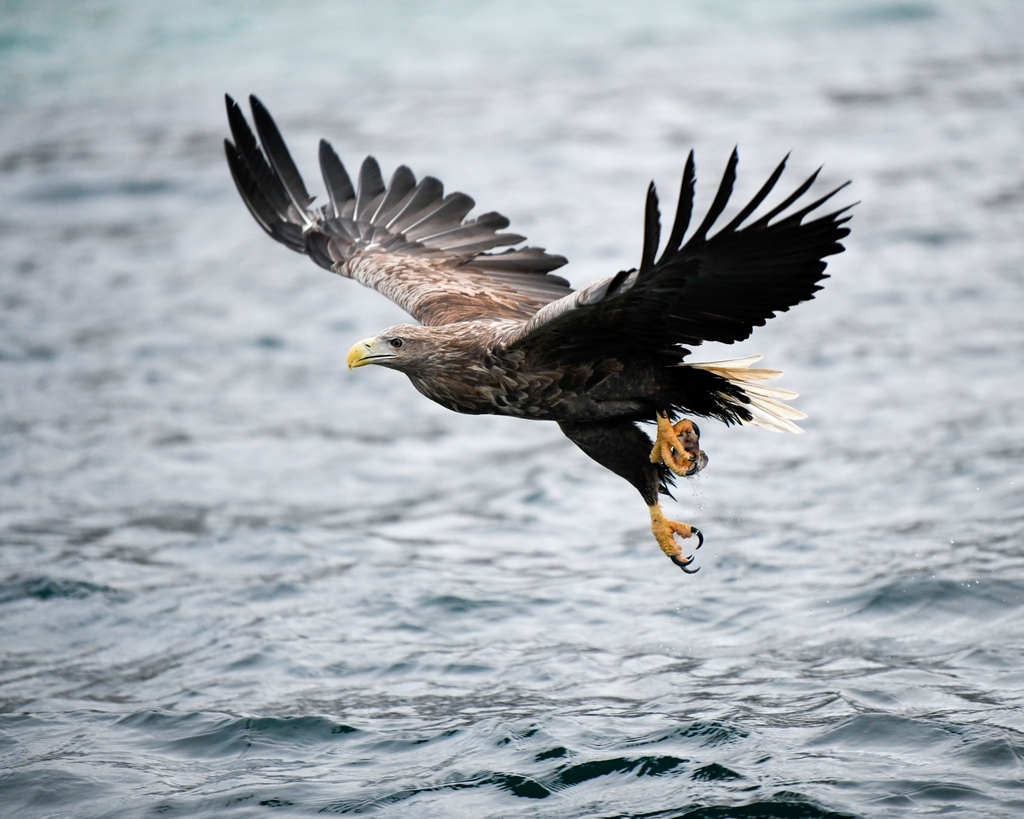
White-tailed Eagle
Photo © Charlotte Kirchner
Photo © Charlotte Kirchner — CC BY 4.0 — Source: iNaturalist photo #253487281Identification
The white-tailed eagle is a large bird of prey, sometimes known as the "sea eagle," and belongs to the family Accipitridae alongside hawks, kites, and harriers. One of up to eleven members in the genus Haliaeetus, it is also referred to as the white-tailed sea-eagle, and sometimes by the Anglo-Saxon names ern or erne. Other regional names include the gray sea eagle and Eurasian sea eagle. As its name suggests, the species is distinguished by its white tail, which sets it apart from related sea eagles and other raptors across its range.
Range & Habitat
The white-tailed eagle is widely distributed across temperate Eurasia, breeding from as far west as Greenland and Iceland to as far east as Hokkaido, Japan. However, populations may be scarce and thinly distributed due to historical pressures including habitat alteration and wetland destruction. The species was considered endangered or extinct in several countries following a century of systematic persecution from the early 1800s through World War II, compounded by pesticide poisoning and nesting failures that have persisted since the 1950s.
White-tailed eagles live most of the year near large bodies of open water, including coastal saltwater areas and inland freshwater lakes, wetlands, bogs, and rivers. They require old-growth trees or ample sea cliffs for nesting, and depend on an abundant food supply of fish and water birds. Some populations have recovered well thanks to governmental protection, habitat conservation, regulation of poaching and pesticide use, and careful reintroduction programs.
Behaviour & Diet
Both a powerful apex predator and an opportunistic scavenger, the white-tailed eagle feeds primarily on fish and birds, particularly water birds. The species forms a close ecological pair with the bald eagle of North America, occupying a similar niche on opposite sides of the Atlantic. White-tailed eagles are adapted for hunting and scavenging over the open water habitats they frequent year-round.
Best Time & Places to See It
The white-tailed eagle's preference for large bodies of open water makes it most accessible near coastal areas and inland freshwater lakes, wetlands, and river systems across its wide Eurasian range. Since the species remains near water throughout the year, it can be sought in these habitats across seasons. Areas with recovering populations, particularly those benefiting from reintroduction and protection programs, offer the best opportunities for sightings.
Photography Tips
Photographers should position themselves near open water bodies where these eagles hunt and forage. The species' large size and preference for exposed perches on old-growth trees and sea cliffs offer good visibility for distant photography. Patient observation near productive fishing waters will increase opportunities to capture the eagle in flight or at rest, revealing the distinctive white tail that identifies this impressive raptor.
The Classic Tour – 3 hours – all year round
Nothing matches these filters.
Altai Tavan Bogd National Park
Åsnens National Park
Avesnois Regional Nature Park
Baikal National Park
Bardenas Reales
Bavarian Forest National Park
Białowieża National Park
Biebrza National Park
Bory Tucholskie National Park
Nothing matches these filters.
No community photos yet. Log in to add the first one.
No community observations of this species yet.