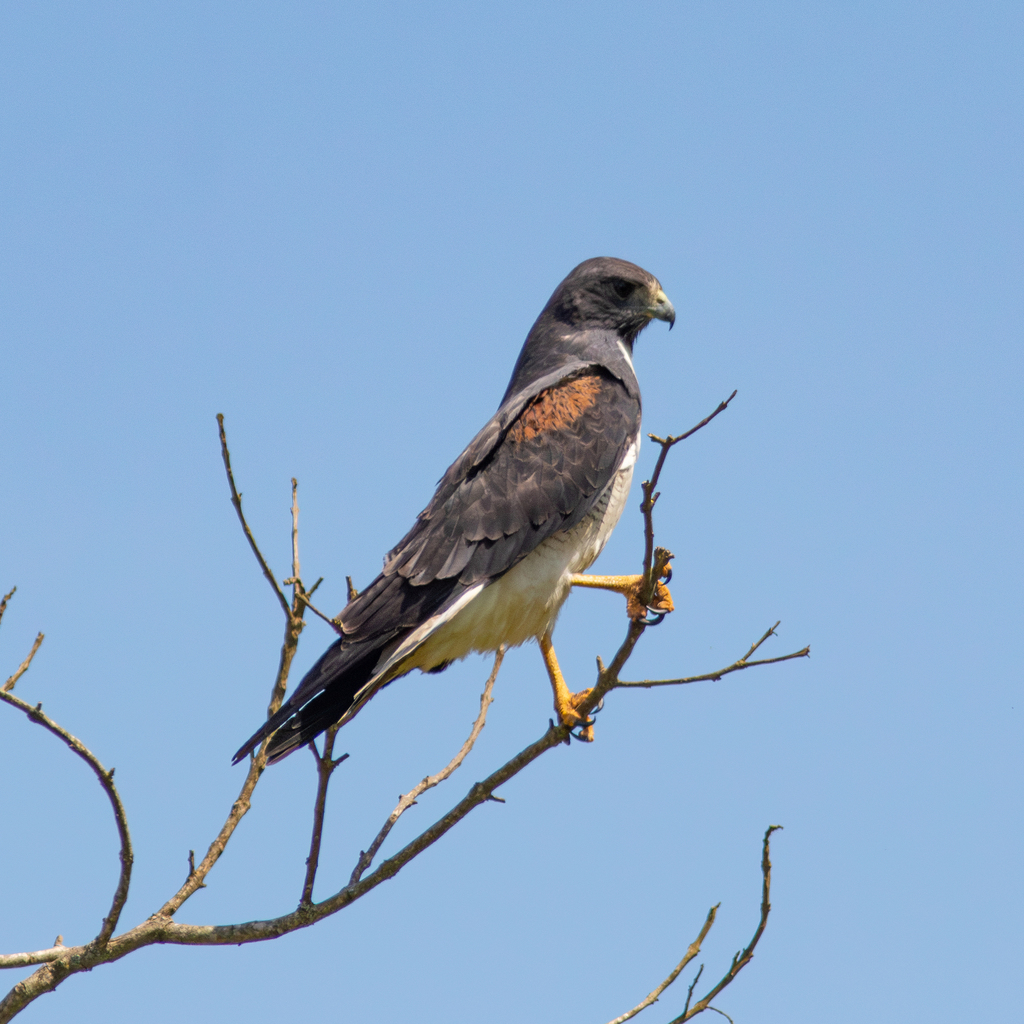
White-tailed Hawk
Photo © Henrique Bitencourt
Photo © Henrique Bitencourt — CC BY-SA 4.0 — Source: iNaturalist photo #585338153Identification
The white-tailed hawk is a large, stocky raptor measuring 44–60 cm in length with a wingspan of 118–143 cm. Adults are distinctive: grey above and white below, with a characteristic rusty-red shoulder patch visible when perched with closed wings. The short white tail with a narrow black band near the tip is conspicuous in flight. The underwing is whitish with indistinct brownish barring. Adults have a hazel iris, pale green cere, black beak with horn-colored base, and yellow feet with black talons.
Immature birds are considerably darker, sometimes appearing nearly black in poor light, and lack the rusty shoulder patch. They show a conspicuously spotted black-and-white wing lining and a brown tail with dark bars that gradually becomes greyish with a hazy dark band as they mature. Young birds in the Southern Hemisphere winter are sometimes confused with red-backed hawks.
Range & Habitat
The white-tailed hawk ranges from coastal Texas and the Rio Grande Valley south to central Argentina, and occurs throughout many Caribbean islands including the Lesser Antilles, Trinidad, and Tobago. This is a non-migratory species, though some populations may move regionally when food becomes scarce. It shows a strong preference for arid open or semi-open regions up to 2,000 feet in elevation, with few trees to obstruct flight. The species rarely occurs in areas with heavy rainfall and is not considered globally threatened despite habitat fragmentation in some regions.
Behaviour & Diet
The white-tailed hawk hunts by hovering and observing its surroundings for prey, gliding to new locations when nothing is found. Diet varies by region: rabbits dominate in southern Texas, while large lizards (12 inches or more) are preferred in the Dutch West Indies. The species also takes cotton rats, snakes, frogs, arthropods such as grasshoppers, cicadas, and beetles, small birds including passerines and quails, and occasionally chickens. It also feeds on carrion and is known to gather with other birds at brushfires to catch fleeing prey. In tropical regions, white-tailed hawks rank among the main predators of marmosets.
The species is vocal, producing a high-pitched cackling call—ke ke ke—with a tinkling quality reminiscent of goat bleats or laughing gulls. Breeding pairs build stick nests, often from thorny plants, positioned 5–15 feet or higher in trees or yuccas. Eggs are white, lightly spotted with brown or lavender, with one to three eggs (usually two) per clutch. Nests are reused annually and can reach up to 3 feet across over time.
Best Time & Places to See It
Year-round resident throughout its range, the white-tailed hawk is best observed in open and semi-open habitats with minimal tree cover. Look for it in arid regions of southern Texas, the Rio Grande Valley, and throughout Central and South America to central Argentina. Caribbean locations including the Lesser Antilles and Trinidad and Tobago also offer reliable viewing opportunities. The species commonly perches on bushes, trees, telephone poles, or stands on the ground, making it relatively accessible for observation.
Photography Tips
The white-tailed hawk's soaring behavior and hovering hunting technique provide excellent photography opportunities. Position yourself in open habitat where the bird's silhouette against the sky will showcase the distinctive white tail and black terminal band. The rusty shoulder patch is best captured when the bird is perched with wings closed. Immature plumage, though darker and less striking than adults, offers unique contrasts, particularly the spotted black-and-white wing lining visible in flight. Early morning and late afternoon light will enhance detail in the underwing barring and highlight the hazel iris and yellow feet of perched birds.
Araucárias National Park
Bahuaja Sonene National Park
Baru Volcano National Park
Brasília National Park
Calilegua National Park
Campos Amazónicos National Park
Campos del Tuyú National Park
Carlos Botelho State Park
Chapada Diamantina National Park
Nothing matches these filters.
No community photos yet. Log in to add the first one.
No community observations of this species yet.