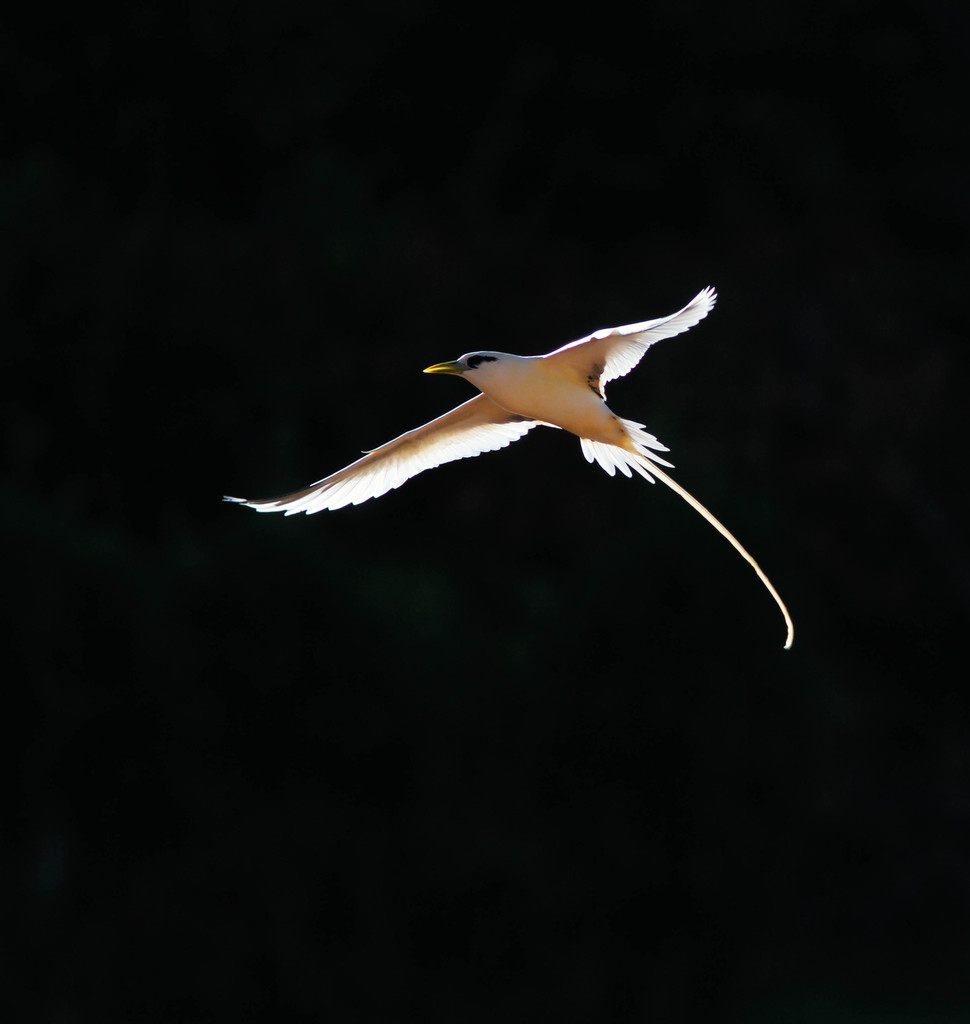
White-tailed Tropicbird
Photo © Tero Linjama
Photo © Tero Linjama — CC0 1.0 — Source: iNaturalist #63651485Identification
The white-tailed tropicbird is a striking seabird that lives up to its name with predominantly white plumage and an unmistakable long tail. Adults measure 71–80 cm in length, but their extremely long central tail feathers effectively double their total length, making them appear far more elongated than their modest body size suggests. The wingspan ranges from 89–96 cm. Key identifying features include a distinctive black band across the inner wing, a black eye-mask, and an orange-yellow to orange-red bill. Males tend to have proportionally longer tail streamers than females. Juveniles are duller, lacking the elegant tail plumes, sporting a greenish-yellow bill instead, and displaying finely barred plumage on the back.
Range & Habitat
This is the smallest member of the tropicbird family and the only species found across multiple tropical ocean basins: the Atlantic, western Pacific, and Indian Oceans. The white-tailed tropicbird nests on tropical islands throughout its range, with populations extending as far north as Bermuda, where local residents affectionately call it the "longtail." Six recognized subspecies occupy different regions, including populations across the tropical Indian Ocean, the western Pacific, the Caribbean, and isolated island colonies at Ascension Island, Fernando de Noronha, Christmas Island, and Europa Island in the Mozambique Channel. While breeding is confined to islands, these birds disperse widely across open ocean when not nesting and are occasionally spotted far from their typical range.
Behaviour & Diet
White-tailed tropicbirds are specialist hunters that feed primarily on flying fish, squid, and crabs, typically hunting in pairs. They employ a dramatic hunting technique, diving from heights up to 20 meters to catch prey—a method similar to that of gannets. Flying fish are captured in mid-air, while other prey are caught at or near the water surface. The birds often hover above the ocean before swallowing their catch and taking off again. Despite their ocean-dwelling lifestyle, they are surprisingly poor swimmers. These birds breed on tropical islands, laying a single egg directly onto the ground or a cliff ledge, rather than building a nest. Unusually, they do not follow a yearly breeding cycle; instead, they can breed again just 5 months after an unsuccessful nesting attempt or 10 months after successfully raising a chick, depending on climate and site availability. Their distinctive call is a high, piercing screech: keee-keee-krrrt-krrt-krrt.
Best Time & Places to See It
White-tailed tropicbirds can be observed year-round in tropical ocean regions, though breeding seasons vary by location and individual breeding cycles. Birdwatchers and wildlife travelers should focus on tropical island breeding colonies, particularly in the Caribbean, Bermuda, and across the Indian and Pacific Oceans. The species has recently begun nesting on Little Tobago alongside red-billed tropicbirds, offering an opportunity to compare tropicbird species. Spotting them at sea requires patience and offshore travel, though their distinctive silhouette and white plumage make them relatively conspicuous when present.
Photography Tips
Photographers should look for this species hovering over clear tropical waters, where the white plumage and striking black wing markings create strong contrast. The dramatic plunge-diving behavior offers dynamic action shots. Approach slowly from a distance, as these birds can be wary. The long tail streamers are a signature feature—try to capture them fully extended in flight for the most compelling images. Early morning light often works best for highlighting the white plumage and orange-yellow bill details. Breeding colonies on islands provide excellent opportunities for close-range photography of perched birds, nesting behavior, and interactions between pairs.
Hawaiʻi Volcanoes National Park
Hawaiʻi County, United States
+84 birds+2 mammals
Where volcanic slopes descend toward the Pacific across more than five thousand square kilometers, Hawaiʻi Volcanoes National Park presents one of Earth's most dynamic laboratories of…
VIEW NATIONAL PARKSydney Harbour National Park
Sydney, Australia
+203 birds+26 mammals
Where Sydney Harbour's sheltered waters meet the sandstone headlands of New South Wales, a mosaic of coastal heathland, eucalyptus woodland and rocky shores creates one of…
VIEW NATIONAL PARKWest Bali National Park
Gerokgak, Indonesia
+240 birds+8 mammals
Across West Bali's northwestern reaches, where the Indian Ocean meets volcanic slopes and limestone cliffs plunge toward turquoise shallows, sprawls a protected realm of roughly 325…
VIEW NATIONAL PARKBiscayne National Park
Miami-Dade County, United States
+263 birds+7 mammals
Coral reefs and mangrove shallows dominate this marine sanctuary where the Florida Keys meet the Atlantic, creating a mosaic of shallow seagrass meadows, patch reefs, and…
VIEW NATIONAL PARKDry Tortugas National Park
Monroe County, United States
+211 birds+1 mammals
Seventy miles west of Key West, where the Gulf of Mexico surrenders to the Atlantic, lies a constellation of low coral keys that rise barely above…
VIEW NATIONAL PARKHaleakalā National Park
Maui County, United States
+66 birds+4 mammals
Ascending from sea level to over 10,000 feet across a mere thirty miles, Haleakalā National Park commands one of the Pacific's most dramatic elevation gradients, where…
VIEW NATIONAL PARKNational Park of American Samoa
Leusoaliʻi, United States
+31 birds+1 mammals
The volcanic ridges of American Samoa rise steeply from the Pacific, their slopes cloaked in tropical rainforest that cascades down to a coast where reef systems…
VIEW NATIONAL PARKVirgin Islands National Park
Cruz Bay, United States
+119 birds+3 mammals
Coral reef and mangrove ecosystems define the tropical maritime landscape of this national park, where St. John's mountainous spine rises sharply from turquoise bays fringed with…
VIEW NATIONAL PARKMerritt Island National Wildlife Refuge
Brevard County, United States
+341 birds+19 mammals
Brackish marshes and palmetto scrub define this wildlife sanctuary spanning the coastal lowlands of central Florida, where the Atlantic tide meets freshwater systems in a dynamic…
VIEW WILDLIFE SANCTUARYPea Island National Wildlife Refuge
Dare County, United States
+356 birds+15 mammals
Where the Outer Banks taper toward the Atlantic, a sliver of barrier island creates a microcosm of coastal ecology. Pea Island National Wildlife Sanctuary spans over…
VIEW WILDLIFE SANCTUARYKīlauea Point National Wildlife Refuge
Kilauea, United States
+79 birds+1 mammals
At the northernmost tip of Kauai, where the Pacific trades collide with volcanic rock, Kīlauea Point National Wildlife Sanctuary crowns a dramatic headland overlooking one of…
VIEW WILDLIFE SANCTUARYMidway Atoll National Wildlife Refuge
United States
+91 birds+1 mammals
Straddling the international date line roughly midway between North America and Asia, this atoll sanctuary rises from the North Pacific as a cluster of coral and…
VIEW WILDLIFE SANCTUARYNo community photos yet. Log in to add the first one.
No community observations of this species yet.