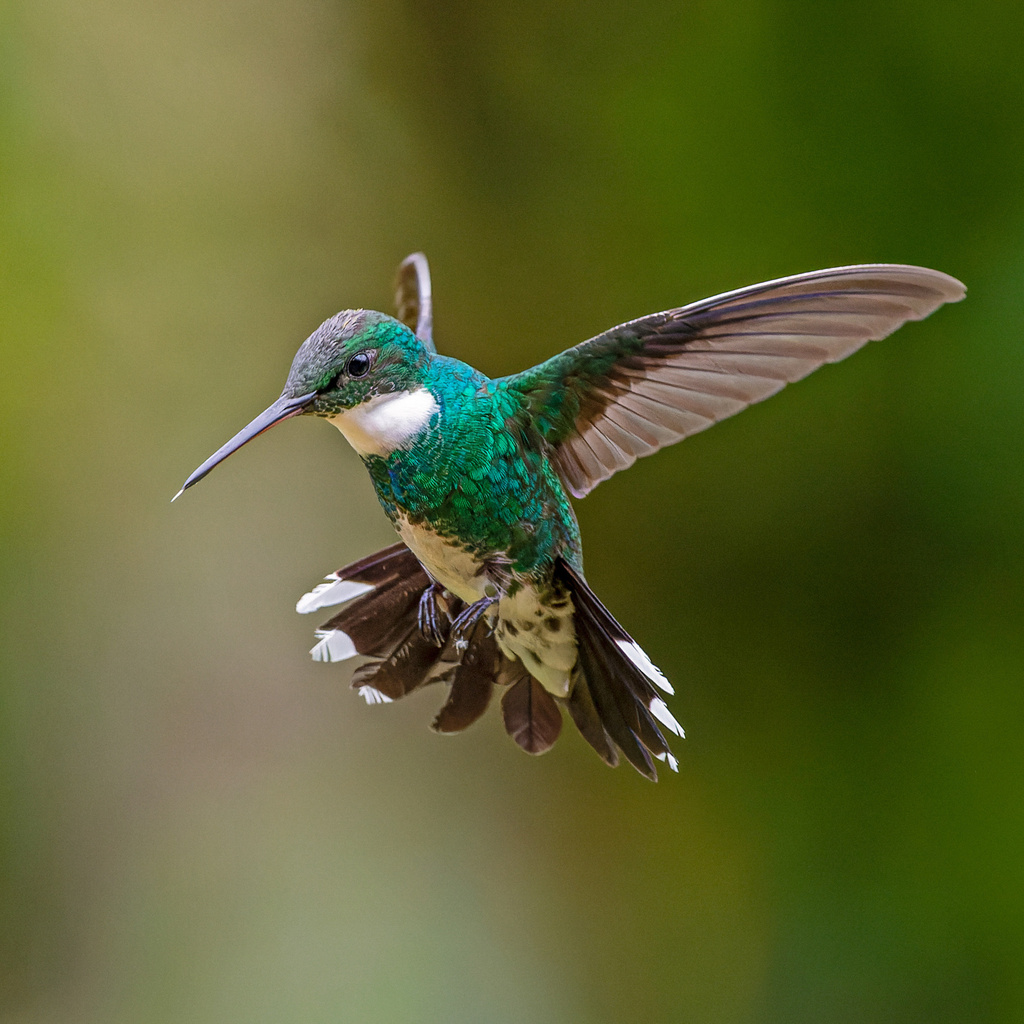
White-throated Hummingbird
Photo © Paulo Mascaretti
Photo © Paulo Mascaretti — CC0 1.0 — Source: iNaturalist #147882585Identification
The white-throated hummingbird is a small emerald hummingbird measuring 10 to 11.5 cm in length, with males weighing 5 to 8 g and females around 4.5 g. Both sexes display the species' most distinctive feature: a brilliant white throat that contrasts sharply with their otherwise gleaming green plumage. Males are particularly striking, with golden- to bronze-green upperparts and brilliant green cheeks and breast. Their tail feathers are golden-green to brilliant green on the inner feathers, with outer tail feathers blackish-green bearing white bands near the tip. The belly is predominantly white with golden-green sides and flanks. The bill is medium-length and straight, with a blackish upper mandible and red lower mandible tipped in black.
Females are noticeably duller and less glittery than males, though they retain the characteristic white throat. Juveniles can be distinguished by their grayish-brown underparts with reduced white markings and brownish tips to the tail feathers, making them appear less vibrant than adults.
Range & Habitat
This species is endemic to southeastern South America, occurring in eastern Paraguay, southeastern Brazil from Minas Gerais and Espírito Santo southward, Uruguay, and northeastern Argentina. It is generally found from near sea level to 1,000 m in elevation, though occasional records exist up to 2,100 m. The white-throated hummingbird inhabits semi-open to open landscapes including forest edges, marshes, scrublands, parks, and gardens—showing a remarkable adaptability to human-modified environments.
Behaviour & Diet
Though primarily sedentary, this species exhibits some local dispersal movements. The white-throated hummingbird is an active forager, feeding on nectar from a remarkably wide variety of native and introduced plants across at least 10 plant families. Bromeliads appear to be especially favored, including species such as Quesnelia testudo and Tillandsia aeranthos. Beyond nectar, the species supplements its diet by hawking insects from perches. During its breeding season from October to March, females construct delicate cup nests from plant down and moss bound together with spiderweb and decorated with lichen on the exterior. These nests are typically placed on horizontal branches of shrubs or small trees. Females incubate their two-egg clutches for approximately 14 days, with fledging occurring 20 to 25 days after hatching.
The white-throated hummingbird is highly vocal, producing a distinctive song consisting of 4 to 10 high-pitched, buzzy notes with emphasis on the first note, transcribed as 'bzeeeee-bzee-bzee-bzee-bzee'. It also utters dry chips and a high-pitched descending metallic rattle.
Best Time & Places to See It
The breeding season from October to March offers the best opportunities to observe territorial and nesting behavior. The species is especially common in the southeastern portion of its range, where it has adapted particularly well to human-modified habitats including parks and gardens. Its presence in these accessible locations makes it a rewarding subject for nature travelers. Less information is available about populations at the western margin of the species' range, making these areas potentially interesting for dedicated observers.
Photography Tips
The white-throated hummingbird's striking white throat provides excellent contrast for photography, particularly when backlighting reveals the brilliant green plumage. Patience near flowering plants and bromeliads during the breeding season will yield opportunities to photograph feeding and territorial behavior. Gardens and parks within the species' range offer more accessible shooting locations than remote forest habitats. Early morning light best showcases the metallic green tones and the luminous white throat patch. The bird's relatively small size and active foraging behavior reward photographers using fast shutter speeds and continuous autofocus tracking.
Tijuca National Park
Brazil
+317 birds+13 mammals
Where the Atlantic forest rises steeply from Rio de Janeiro's urban edge, Tijuca National Park encompasses a landscape of dramatic granite peaks, cascading waterfalls, and closed-canopy…
VIEW NATIONAL PARKSerra do Cipó National Park
Brazil
+379 birds+5 mammals
Where granite escarpments rise above the Atlantic Forest transition zone in southeastern Brazil, Serra do Cipó National Park unfolds across a landscape of dramatic ridges, cascading…
VIEW NATIONAL PARKItatiaia National Park
Brazil
+519 birds+12 mammals
Where granite peaks pierce the Atlantic rainforest canopy in southeastern Brazil, Itatiaia National Park rises as one of the country's oldest and most ecologically vital protected…
VIEW NATIONAL PARKSerra do Itajaí National Park
Brazil
+227 birds+2 mammals
Where the Atlantic rainforest rises steeply from the coastal plains of Santa Catarina, Serra do Itajaí National Park spreads across 1,136 square kilometres of montane wilderness…
VIEW NATIONAL PARKSerra da Bocaina National Park
Brazil
+441 birds+5 mammals
Where the escarpment of the Serra da Bocaina rises sharply from the Atlantic coastal plain, tropical rainforest cloaks steep mountainsides that climb toward peaks exceeding 2,000…
VIEW NATIONAL PARKIguaçu National Park
Brazil
+387 birds+17 mammals
Where the Paraná Plateau plunges toward the Atlantic watershed, six thousand square kilometers of subtropical rainforest cling to steep gorges and river valleys in this corner…
VIEW NATIONAL PARKSão Joaquim National Park
Brazil
+222 birds+9 mammals
Where the southern Brazilian highlands rise above the Atlantic Forest, São Joaquim National Park protects nearly 1,000 square kilometers of montane terrain that shifts between temperate…
VIEW NATIONAL PARKSerra dos Órgãos National Park
Brazil
+446 birds+13 mammals
Granite peaks thrust skyward through the Atlantic Forest canopy in the mountains immediately north of Rio de Janeiro, their bare rock faces rising above a landscape…
VIEW NATIONAL PARKSerra do Gandarela National Park
Brazil
+333 birds+3 mammals
Where granite massifs rise through Atlantic Forest in southeastern Brazil's highlands, Serra do Gandarela National Park protects nearly 1,000 square kilometres of montane terrain that few…
VIEW NATIONAL PARKAraucárias National Park
Brazil
+231 birds+3 mammals
Where the southern Brazilian highlands rise into cool temperate forest, Araucárias National Park protects one of the Atlantic Forest's most distinctive ecosystems across 506 square kilometres…
VIEW NATIONAL PARKSerra Geral National Park
Brazil
+211 birds+2 mammals
Where basalt cliffs and sandstone escarpments rise above the subtropical forests of southern Brazil, Serra Geral National Park preserves one of the Atlantic region's most dramatic…
VIEW NATIONAL PARKCampos Gerais National Park
Brazil
+143 birds
Where rolling plateaus rise above the Atlantic forest escarpment in Paraná's interior, Campos Gerais National Park unfolds across 539 square kilometers of highland grassland and forest…
VIEW NATIONAL PARKEl Palmar National Park
Distrito Sexto, Argentina
+244 birds+14 mammals
Across the Paraná River floodplain in northeastern Argentina, palms rise from wetland and grassland in a landscape shaped by water and time. El Palmar National Park…
VIEW NATIONAL PARKCampos del Tuyú National Park
Argentina
+169 birds+5 mammals
Subtropical forest graces the borderlands where Misiones Province meets Paraguay, a landscape shaped by the Paraná Plateau's weathered topography and the warm, humid climate of northeastern…
VIEW NATIONAL PARKIguazú National Park
Puerto Iguazú, Argentina
+346 birds+15 mammals
Where the Paraná Plateau plunges toward the Atlantic watershed, nearly 800 square kilometers of subtropical rainforest drape across Misiones Province in a landscape carved by millennia…
VIEW NATIONAL PARKNo community photos yet. Log in to add the first one.
No community observations of this species yet.