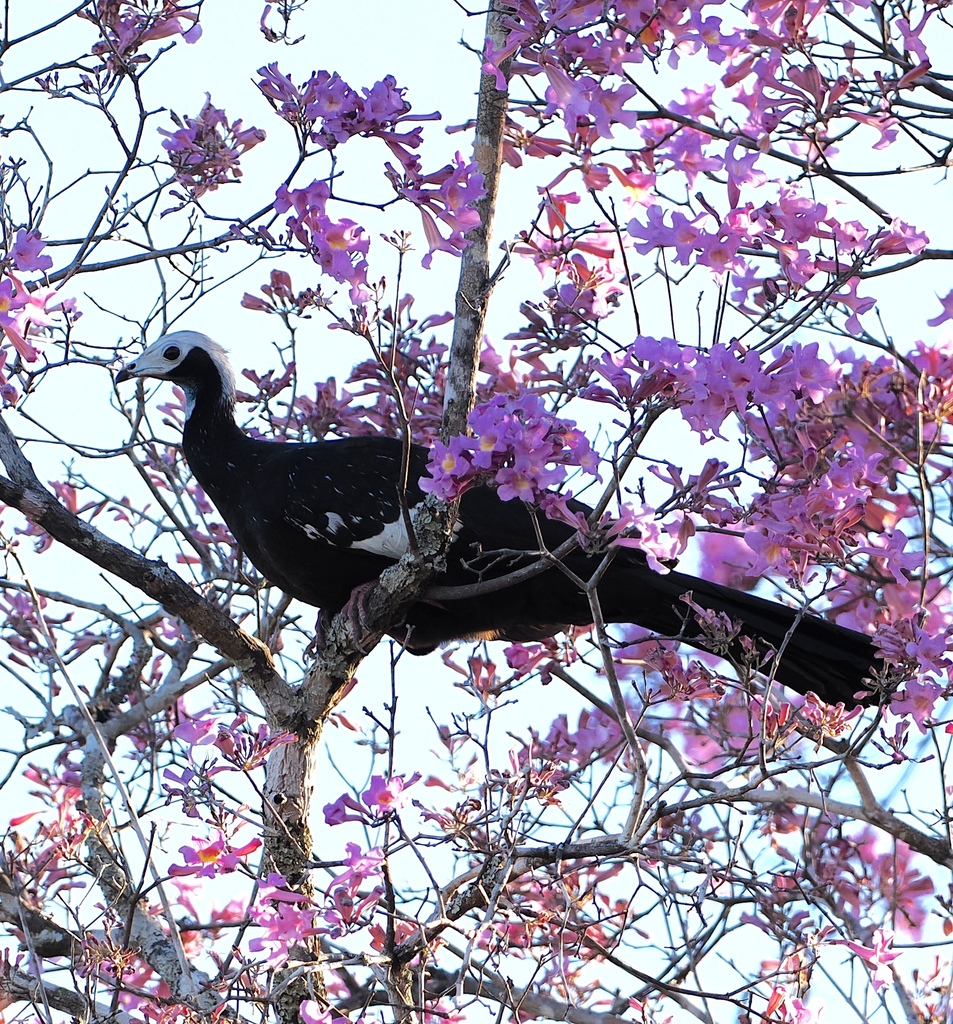
White-throated Piping Guan
Photo © desertnaturalist
Photo © desertnaturalist — CC BY 4.0 — Source: iNaturalist #314583619Identification
The white-throated piping guan is a medium-sized bird measuring 60 to 69 cm in length, with sexes alike in plumage. Most of its body is blackish with a distinctive light olive to olive green gloss that is strongest on the shoulders, wings, and tail. The forehead, crown, and nape are striking white, as are the fringes of the breast feathers, creating a distinctive head pattern. The crown feathers are notably hair-like with black or brownish black shafts that show as streaks. Look for a large white patch on the folded wing formed by the outer wing coverts, with white spots on the inner coverts. The bare skin surrounding the dark reddish brown eye is white to cobalt blue, as is the dewlap beneath. The bill varies from pale blue with a black tip to black with pinkish and blue base, while the legs are brownish red.
Range & Habitat
The white-throated piping guan is found across a broad swath of South America, ranging from extreme southeastern Peru through north-central and eastern Bolivia into southwestern Brazil and northern Paraguay. It inhabits humid tropical forests of the Amazon Basin, including terra firme, várzea, and gallery forest types, as well as cerrado woodland. This species shows a strong preference for proximity to water, almost always occurring within about 100 metres of rivers. Elevations range up to 1,500 metres in Bolivia.
Behaviour & Diet
The white-throated piping guan is thought to be mostly sedentary, though it may make local or elevational movements according to fruit availability. Its diet consists primarily of fruits and leaves from many plant families. Outside the breeding season, these birds may gather in flocks of up to about 20 individuals, particularly at salt licks, though they forage in pairs or family groups during nesting season. Foraging typically occurs in the canopy or just below it, though birds may descend to the ground beneath fruiting trees. They regularly forage alongside other cracid species.
Best Time & Places to See It
To locate white-throated piping guans, focus your efforts near rivers and watercourses in humid Amazon Basin forests and cerrado woodlands throughout their range in Peru, Bolivia, Brazil, and Paraguay. The species is vocal mostly during the breeding season, making dawn and dusk the best times to detect them through their distinctive vocalizations and displays. Salt licks outside breeding season can be productive locations, as birds gather there in small flocks.
Photography Tips
Patient observers positioned near rivers in humid forest should watch the canopy and mid-story levels where these birds typically forage. The white head markings and olive-glossed plumage provide good visual contrast for photography. During breeding season, listen for the distinctive ascending whistles or the characteristic "deck of cards" wing-whirring sound, which can guide you to displaying birds. Early morning and evening sessions near known fruiting trees or salt licks offer the best opportunities for close observation and photography of this near-threatened species.
Chapada dos Guimarães National Park
Brazil
+450 birds+1 mammals
Where weathered sandstone plateaus rise above the cerrado grasslands of central Brazil, Chapada dos Guimarães National Park protects 624 square kilometres of ecological transition zone that…
VIEW NATIONAL PARKPantanal Matogrossense National Park
Brazil
+322 birds+17 mammals
Where the flooded forests of central Brazil meet vast seasonally inundated grasslands, Pantanal Matogrossense National Park sprawls across nearly 2,900 square kilometers of one of the…
VIEW NATIONAL PARKNo community photos yet. Log in to add the first one.
No community observations of this species yet.