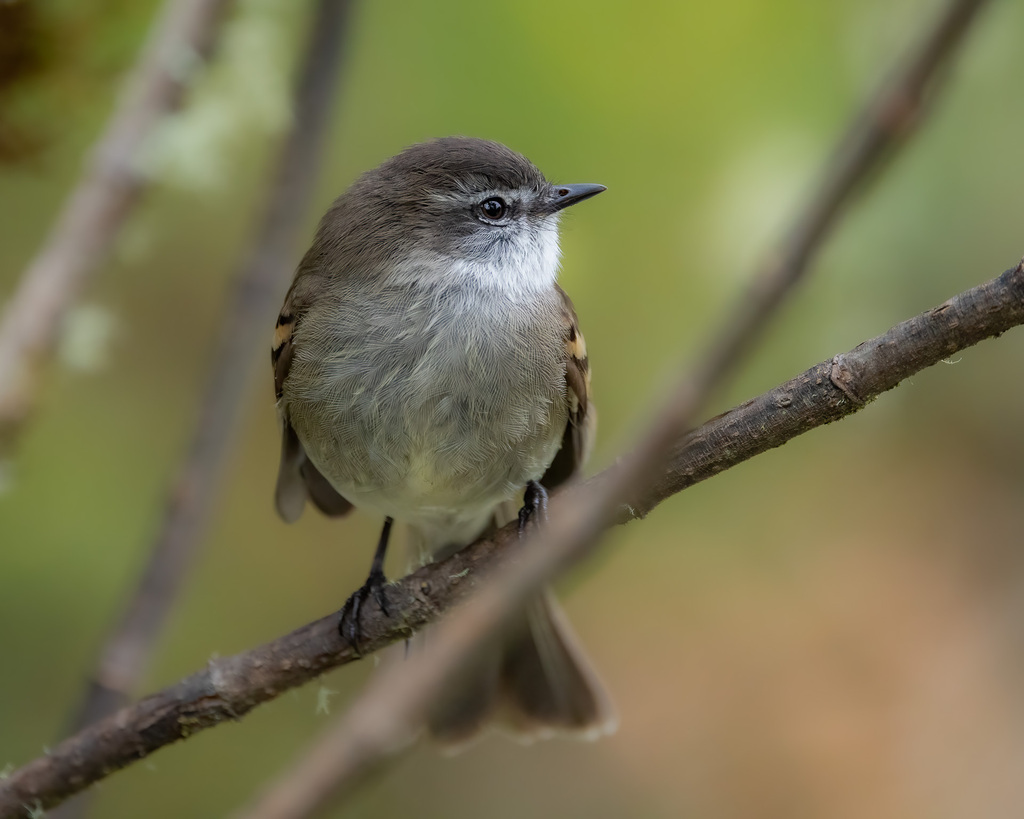
White-throated Tyrannulet
Photo © Derek Spencer
Photo © Derek Spencer — CC BY 4.0 — Source: iNaturalist photo #468820682Identification
The white-throated tyrannulet is a small tyrant flycatcher, measuring 11 to 14 cm in length. The nominate subspecies displays a distinctive combination of features: a dark olive-gray crown and nape, white lores, and a thin white supercilium contrasting with a dusky face. The throat is characteristically white and puffy, extending past the ear coverts. A vest-like gray band crosses the breast, while the rest of the underparts are medium yellow. The upperparts are medium olive-gray, with brownish-black wings edged in cinnamon-buff to yellowish buff, creating two prominent bars on the closed wing. All individuals have a dark brown iris, long black bill, and black legs and feet. The sexes are identical in plumage.
Across its 11 recognized subspecies, this bird varies considerably in coloration and size. Some populations show much browner or richer rufous tones in the wings, while others appear notably paler and more grayish. Size differences are also marked, with some subspecies considerably smaller or larger than the nominate form. These variations have led ornithologists to propose that some subspecies may represent separate species, though further research is needed to resolve these taxonomic questions.
Range & Habitat
The white-throated tyrannulet is distributed across the highlands of northern and central South America, from Venezuela and Colombia south through Ecuador and Peru to Bolivia and northern Argentina. Each of the 11 subspecies occupies a distinct geographic region, ranging from isolated Venezuelan tepuis and the cloud-wrapped peaks of the Andes to the high-altitude plateaus of Argentina's La Rioja Province. The species shows remarkable subspecific variation across this vast range, reflecting the isolation of mountain populations.
This bird inhabits temperate mountain environments between 1,300 and 4,600 meters in elevation, depending on location and subspecies. It favors humid montane forests, stunted cloudforests, and elfin forests, as well as Polylepis woodlands and shrubby clearings and pastures. The species is generally found in the interior and edges of these habitats, where it exploits the structural diversity of montane vegetation.
Behaviour & Diet
The white-throated tyrannulet is mostly resident throughout its range, though some populations make elevational movements during the austral winter or local wet season. Unlike many tyrannulets that forage from a slouched posture, this species characteristically perches upright while hunting. It feeds primarily on insects and spiders gleaned from leaves and twigs, often hanging underneath branches in typical flycatcher fashion, and occasionally making short hover-flights to snatch prey. It supplements this diet with small fruits opportunistically.
Socially, the white-throated tyrannulet typically forages singly or in pairs but regularly joins mixed-species feeding flocks, a behavior that reflects its adaptability and social flexibility. Its breeding season varies geographically, occurring from December to March in Argentina and possibly extending from January to August in Colombia. The bird constructs a neat cup nest from plant fibers, wool, moss, and spider web, materials that provide excellent insulation in its cool mountain habitat.
Best Time & Places to See It
Year-round residents in much of their range, white-throated tyrannulets are generally accessible to travelers throughout the year, though some elevational movement occurs seasonally. The species is most reliably found in extensive montane forest habitats and along forest edges, particularly in areas with mixed-species flocks. Birdwatchers visiting the Andes should focus their efforts on appropriate elevation zones—between 2,500 and 3,600 meters in Colombia, mostly 2,800 to 3,500 meters in Ecuador, and between 1,800 and 4,600 meters in Peru. In Venezuela, the species occurs between 1,300 and 3,700 meters depending on the region. Patience and careful listening are essential, as these small birds can be easily overlooked in thick montane vegetation.
Photography Tips
The white-throated tyrannulet's small size, subtle coloration, and preference for dense montane forest make it a challenging photographic subject. Position yourself along forest edges and clearings where lighting is more favorable than in the forest interior. The bird's characteristic upright posture offers a distinctive silhouette that can aid identification in photographs. Early morning often provides the best lighting and activity levels in mountain habitats.
Since this species regularly joins mixed-species flocks, patient observation of feeding flocks may provide extended viewing opportunities. The bird's habit of gleaning from leaves and hanging beneath twigs means it often pauses in exposed positions momentarily—a brief window for photography. A telephoto lens is essential given the species' small size and the typical distance at which it is first observed. Subdued lighting in cloudforest environments requires higher ISO settings and attention to autofocus challenges when photographing against dappled backgrounds.
Antisana National Park
Baritú National Park
Cajas National Park
Calilegua National Park
Cotopaxi National Park
El Rey National Park
El Tamá National Park
Huascarán National Park
Llanganates National Park
Nothing matches these filters.
No community photos yet. Log in to add the first one.
No community observations of this species yet.