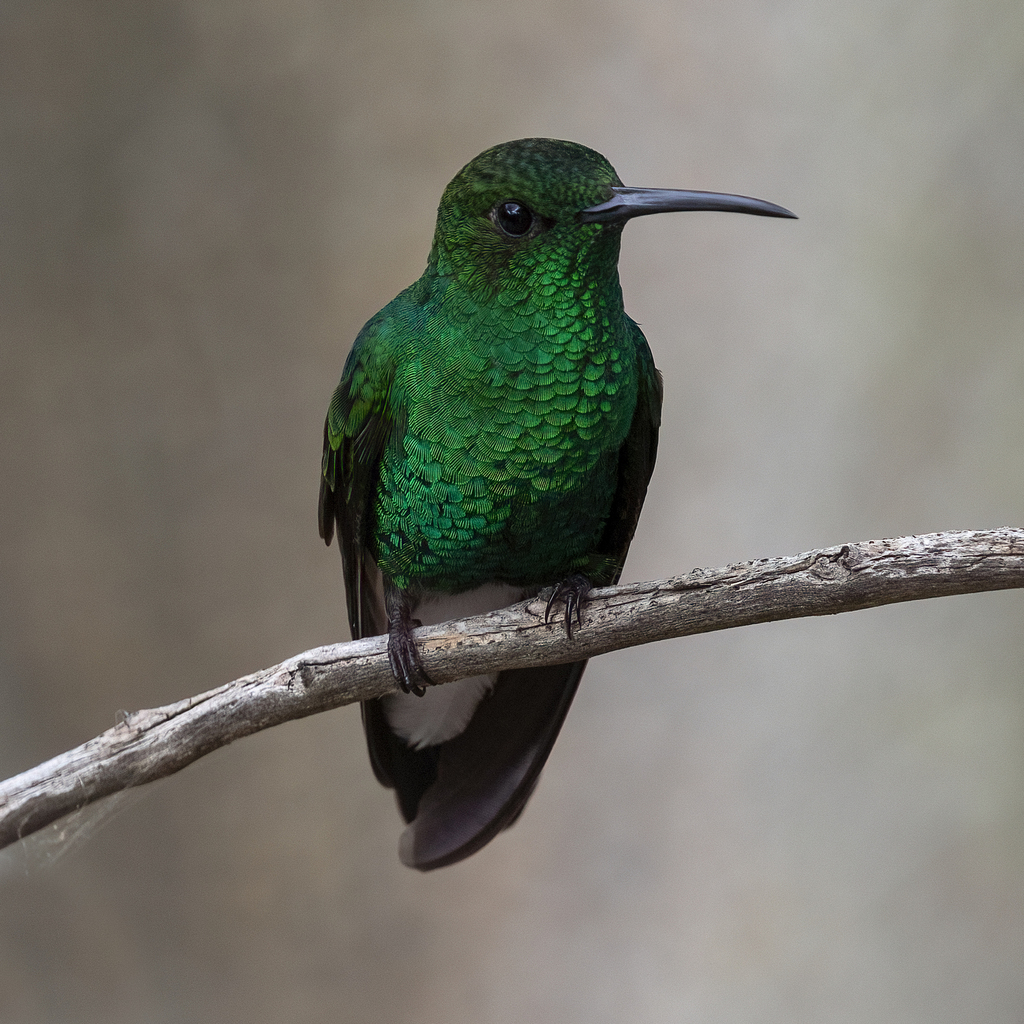
White-vented Plumeleteer
Photo © Dan Vickers
Photo © Dan Vickers — CC BY 4.0 — Source: iNaturalist #259479650Identification
The white-vented plumeleteer is a small hummingbird, measuring 10.5 to 12 cm in length with males weighing 6 to 7.3 grams and females 5.9 to 7.9 grams. The species displays striking sexual dimorphism and considerable variation across its five subspecies. Males of the nominate subspecies feature mostly dark metallic green upperparts with a bronzy crown and coppery bronze uppertail coverts, a bluish upper breast, bright metallic green lower breast, and characteristically long white undertail coverts. Females are paler metallic green above with gray underparts speckled with green on the sides. The tail is blue-black with a bronze gloss on central feathers. Most subspecies have black bills and feet, though C. b. intermedia displays a pinkish mandible base and pale pink to red feet, distinguishing it from its congeners.
Subspecific variation is notable: C. b. micans is larger with deeper blue central tail feathers in males; C. b. aeneicauda males show more golden-green underparts and bronze-copper central tail feathers; C. b. caeruleogaster is the largest subspecies with males displaying bluish-green throat and belly contrasting with blue breast; and C. b. intermedia males have greenish-blue breast and gray belly plumage.
Range & Habitat
The white-vented plumeleteer is distributed across five countries: Colombia, Ecuador, Panama, Peru, and Venezuela. Different subspecies occupy distinct regions, from central and eastern Panama and western Colombia through the Magdalena River valleys into Venezuela, with C. b. caeruleogaster restricted to Colombia's Eastern Andes and C. b. intermedia found in southwestern Ecuador and northwestern Peru. The species inhabits diverse landscapes including dry, moist, and wet forest edges and interiors, semi-open woodlands, secondary forest, and scrublands, with elevational range from sea level to 2,000 metres. Only C. b. caeruleogaster and occasionally C. b. buffonii frequent wet forest interiors, while other subspecies prefer more open habitats.
Behaviour & Diet
The white-vented plumeleteer is a non-migratory resident throughout its range. It forages for nectar across a wide variety of flowering plants from understory to near-canopy levels, primarily employing trap-lining behaviour where it visits a regular circuit of flowers, though it also aggressively defends particularly rich flower patches. Beyond nectar, the species actively hunts small arthropods by hawking from perches, hovering, and gleaning from vegetation and spider webs.
Breeding seasons vary geographically, occurring in September in Panama, February through August in the Magdalena valley, and June through November in the Eastern Andes, with possible year-round breeding in parts of Venezuela. The distinctive cup-shaped nest is constructed from plant down bound with spiderweb and adorned externally with moss and lichen, typically positioned on tree branches up to 2.5 metres high. Clutch size is two eggs, with fledging occurring within approximately 21 days. The species produces "chip" notes while foraging, though its full song remains undescribed.
Best Time & Places to See It
The white-vented plumeleteer is considered uncommon to fairly common throughout most of its range and demonstrates tolerance for some habitat disturbance. Being a year-round resident, it can be encountered in any season depending on location. Breeding seasons vary considerably across its range, providing different opportunities: seek it in Panama during September breeding activity, in Colombian Magdalena valley regions from February through August, and in the Eastern Andes from June through November. For best viewing, focus on flowering plants in forest edges, semi-open woodlands, and secondary growth where the species actively forages.
Photography Tips
Photographing the white-vented plumeleteer presents excellent opportunities for hummingbird specialists due to its small size and active foraging behaviour. The species' habit of trap-lining between established flower patches allows photographers to predict its movement patterns and set up in advance. Position yourself near flowering plants that attract the species, particularly in early morning when hummingbird activity peaks and light is optimal. The distinctive white undertail coverts of males provide a useful identification feature and photographic target.
The species' aggressive behaviour at rich flower patches means consistent return visits can be anticipated, allowing for patient positioning and technique refinement. Fast shutter speeds and appropriate flash settings are essential to capture the rapid wing beats of this small hummingbird in flight. Given the subspecific variation across the range, documenting local population characteristics adds scientific value to photography efforts.
Guided Birding Tour
Cerros de Amotape National Park
District of San Jacinto, Ecuador
+246 birds+1 mammals
Arid mountains rise abruptly from Peru's northwestern frontier, their slopes clothed in xerophytic scrubland and seasonal deciduous forest that transforms these Andean foothills into one of…
VIEW NATIONAL PARKNatural Utría National Park
Alto Baudó (Pie de Pató), Colombia
+372 birds+11 mammals
Where the Chocó's coastal mountains plunge toward the Pacific, Utría National Park preserves one of Colombia's most biodiverse and least-visited wilderness expanses. Sprawling across 1,287 square…
VIEW NATIONAL PARKNatural Serranía de los Yariguíes National Park
El Carmen de Chucurí, Colombia
+320 birds+3 mammals
Where the northern cordilleras of Colombia rise toward cloud forest, the Serranía de los Yariguíes unfolds across nearly 1,820 square kilometers of some of the most…
VIEW NATIONAL PARKNatural Farallones de Cali National Park
Buenaventura, Colombia
+733 birds+27 mammals
Where the Pacific coastal plain meets the western slopes of the Andes, Farallones de Cali National Park sprawls across nearly 3,500 square kilometers of dramatic topography…
VIEW NATIONAL PARKNatural el Cocuy National Park
Güicán, Colombia
+313 birds+3 mammals
Where the Andes rise to their highest peaks in Colombia's eastern cordillera, El Cocuy National Park sprawls across more than 6,600 square kilometers of some of…
VIEW NATIONAL PARKGuácharos Cave National Natural Park
Acevedo, Colombia
+359 birds
High in the Andean foothills of southern Huila, where mist-laden slopes rise above 1,600 metres, lies a landscape carved by underground rivers and crowned by karst…
VIEW NATIONAL PARKNatural Uramba Bahía Málaga National Park
Buenaventura, Colombia
+308 birds+15 mammals
Where the Pacific coastal rainforest descends to mangrove estuaries and rocky headlands, Uramba Bahía Málaga National Park unfolds across nearly 1,000 square kilometres of Colombia's Valle…
VIEW NATIONAL PARKNatural Sumapaz National Park
Cubarral, Colombia
+368 birds+1 mammals
Where the Andes descend toward the Amazon basin, the high páramo grasslands of Sumapaz National Park sprawl across more than five thousand square kilometers of Meta…
VIEW NATIONAL PARKEl Tamá National Park
Toledo, Colombia
+435 birds
Where the Andes descend toward the Caribbean coastal lowlands of northern Colombia, El Tamá National Park sprawls across nearly 3,800 square kilometres of montane forest, cloud…
VIEW NATIONAL PARKNatural Sierra de la Macarena National Park
Vista Hermosa, Colombia
+566 birds+15 mammals
Across nearly 20,000 square kilometres of Colombia's Meta Department, the terrain rises from lowland savanna into Andean foothills through a mosaic of gallery forests, palm-fringed wetlands,…
VIEW NATIONAL PARKGeneral de División Omar Torrijos Herrera National Park
La Pintada, Panama
+401 birds+2 mammals
Across the highlands of central Panama, where the continental divide funnels moisture-laden trade winds into steep river valleys, the terrain rises and falls in a landscape…
VIEW NATIONAL PARKSoberanía National Park
Cristóbal, Panama
+495 birds+34 mammals
Rainforest and riverine woodland blanket the rolling terrain of this 714-square-kilometre national park in Colón Province, where the Caribbean watershed feeds a maze of streams and…
VIEW NATIONAL PARKChagres National Park
Caimitillo, Panama
+486 birds+19 mammals
Where the Chagres River carves through the humid tropics of central Panama, a vast montane and lowland forest sprawls across more than 2,300 square kilometers, anchoring…
VIEW NATIONAL PARKDarién National Park
Tucutí, Panama
+534 birds+13 mammals
Where the spine of Central America crumbles into wetland and rainforest, Darién National Park sprawls across more than 20,000 square kilometres of some of the tropics'…
VIEW NATIONAL PARKPortobelo National Park
Portobelo, Panama
+366 birds+9 mammals
Where the Caribbean's turquoise waters meet the Darién's verdant shore, Portobelo National Park sprawls across 570 square kilometers of coastal forest, mangrove wetland, and coral-fringed islands…
VIEW NATIONAL PARKNo community photos yet. Log in to add the first one.
No community observations of this species yet.