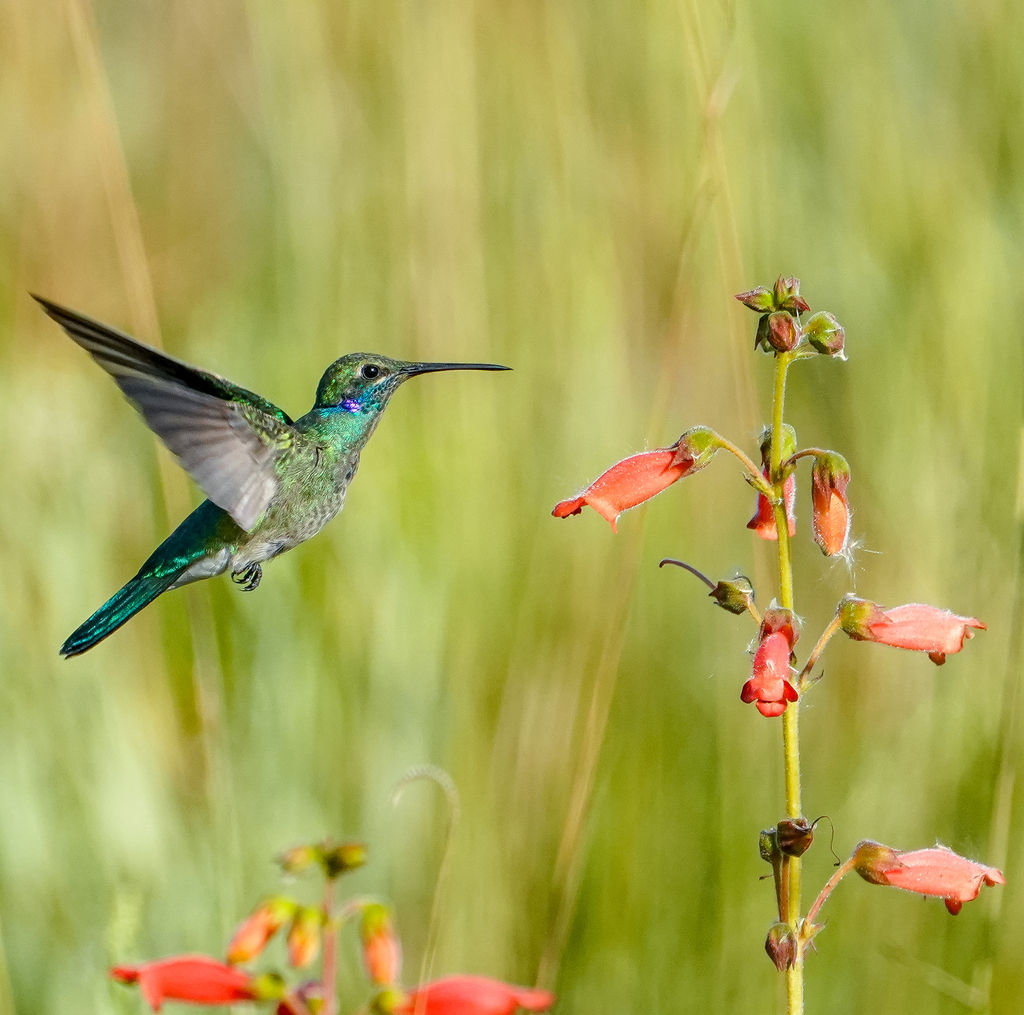
White-vented Violetear
Photo © ....Christopher Borges....
Photo © ....Christopher Borges.... — CC BY-SA 4.0 — Source: iNaturalist #296112049Identification
The white-vented violetear is a small hummingbird measuring 12 to 13 cm in length and weighing just 5.6 to 6.8 grams. Males are predominantly shiny green, noticeably lighter in shade than other violetears, with a yellow-green rump suffused with blue shimmer. The tail is glittering green featuring a distinctive wide steel-blue band near the tip, while the undertail coverts are pure white—the feature that gives this species its English name. A striking violet-blue patch covers the area behind the eye and ears. Females are similar to males but paler and more grayish overall. Both sexes may display a serrated maxilla, a characteristic reflected in the species's scientific epithet serrirostris.
Range & Habitat
This species occupies a broad swath of southern South America, with its primary range extending across much of Brazil from Mato Grosso east through Goiás, Bahia, and Espírito Santo, then southward to Santa Catarina. Its distribution continues west into Bolivia, central Paraguay, and northern Argentina as far south as Córdoba Province. The white-vented violetear favors semi-open landscapes including scrublands, savanna, grassland, and human-modified habitats such as gardens and parks. Elevations between 1,000 and 1,500 meters are preferred, though the species ranges from sea level up to 3,600 meters in the Andes.
Behaviour & Diet
The white-vented violetear is mostly sedentary, though some populations undertake short migrations. Birds inhabiting elevations above treeline in Brazil are thought to descend to lower elevations during fall. This species forages for nectar from a diverse array of flowering plants and trees and supplements its diet by catching insects in mid-air. Notably aggressive for a hummingbird, it calls from perches while chasing away competing nectar-feeders and even butterflies from productive flower patches. An early riser, it typically begins feeding before other hummingbirds.
Breeding in parts of Brazil occurs between September and March. The female alone constructs a delicate cup-shaped nest from fine fibers and spider silk, decorated externally with lichens, and typically positions it about one meter above ground on a branch or vertical fork. She incubates the usual clutch of two eggs for 15 to 16 days, with young fledging 22 to 25 days after hatching. The male's song is a constantly repeated "tsilp, tsilp, zip, tsalp, tsalp" sequence that can persist for 25 minutes, while its primary call is a hard "drüg, drüg, drüg, drüg, drüg."
Best Time & Places to See It
The white-vented violetear is common throughout most of its range and occurs in several protected areas, making it a reliable species for travelers visiting southern Brazil, Bolivia, Paraguay, and northern Argentina. The breeding season in Brazilian portions of its range (September to March) offers opportunities to observe nesting behavior and territorial displays. This species' preference for semi-open habitats and gardens makes it accessible in both protected reserves and cultivated landscapes.
Photography Tips
The white-vented violetear's early-morning feeding activity and habit of calling from exposed perches provide excellent photography opportunities. The violet-blue ear patch and pure white undertail coverts are distinctive field marks worth capturing. The bird's aggressive territorial behavior means it will often return to favored flowering plants, allowing photographers to anticipate and compose shots. The steel-blue tail band is particularly striking in good light and should be a focus for highlighting the species's identification features.
Tijuca National Park
Brazil
+317 birds+13 mammals
Where the Atlantic forest rises steeply from Rio de Janeiro's urban edge, Tijuca National Park encompasses a landscape of dramatic granite peaks, cascading waterfalls, and closed-canopy…
VIEW NATIONAL PARKEmas National Park
Brazil
+333 birds+23 mammals
Across the high plateaux of central Brazil, where the cerrado grasslands roll toward distant horizons under an immense sky, Emas National Park anchors one of South…
VIEW NATIONAL PARKSerra do Cipó National Park
Brazil
+379 birds+5 mammals
Where granite escarpments rise above the Atlantic Forest transition zone in southeastern Brazil, Serra do Cipó National Park unfolds across a landscape of dramatic ridges, cascading…
VIEW NATIONAL PARKItatiaia National Park
Brazil
+519 birds+12 mammals
Where granite peaks pierce the Atlantic rainforest canopy in southeastern Brazil, Itatiaia National Park rises as one of the country's oldest and most ecologically vital protected…
VIEW NATIONAL PARKSerra da Bocaina National Park
Brazil
+441 birds+5 mammals
Where the escarpment of the Serra da Bocaina rises sharply from the Atlantic coastal plain, tropical rainforest cloaks steep mountainsides that climb toward peaks exceeding 2,000…
VIEW NATIONAL PARKSão Joaquim National Park
Brazil
+222 birds+9 mammals
Where the southern Brazilian highlands rise above the Atlantic Forest, São Joaquim National Park protects nearly 1,000 square kilometers of montane terrain that shifts between temperate…
VIEW NATIONAL PARKSerra dos Órgãos National Park
Brazil
+446 birds+13 mammals
Granite peaks thrust skyward through the Atlantic Forest canopy in the mountains immediately north of Rio de Janeiro, their bare rock faces rising above a landscape…
VIEW NATIONAL PARKChapada dos Guimarães National Park
Brazil
+450 birds+1 mammals
Where weathered sandstone plateaus rise above the cerrado grasslands of central Brazil, Chapada dos Guimarães National Park protects 624 square kilometres of ecological transition zone that…
VIEW NATIONAL PARKChapada dos Veadeiros National Park
Brazil
+324 birds+6 mammals
Where granite plateaus rise above the cerrado savanna in central Brazil, Chapada dos Veadeiros National Park unfolds across 6,665 square kilometres of some of the world's…
VIEW NATIONAL PARKChapada Diamantina National Park
Brazil
+346 birds+5 mammals
Where granite peaks and sandstone cliffs rise abruptly from the Brazilian interior, Chapada Diamantina National Park sprawls across 4,215 square kilometers of some of Brazil's most…
VIEW NATIONAL PARKSerra do Gandarela National Park
Brazil
+333 birds+3 mammals
Where granite massifs rise through Atlantic Forest in southeastern Brazil's highlands, Serra do Gandarela National Park protects nearly 1,000 square kilometres of montane terrain that few…
VIEW NATIONAL PARKBrasília National Park
Plano Piloto, Brazil
+338 birds+15 mammals
Cerrado grassland and scattered woodland sweep across the central Brazilian plateau where this national park sprawls across more than a thousand square kilometres of the Federal…
VIEW NATIONAL PARKPacaás Novos National Park
Brazil
+279 birds+1 mammals
Across the border between Rondônia and Amazonas, vast tracts of humid tropical forest rise and fall in gentle undulations, carved by clear-flowing rivers that feed into…
VIEW NATIONAL PARKEl Rey National Park
Municipio de Las Lajitas, Argentina
+317 birds+4 mammals
Where the eastern slopes of the Andes descend into northwestern Argentina's subtropical transition zone, El Rey National Park unfolds across 841 square kilometers of dramatically varied…
VIEW NATIONAL PARKNo community photos yet. Log in to add the first one.
No community observations of this species yet.