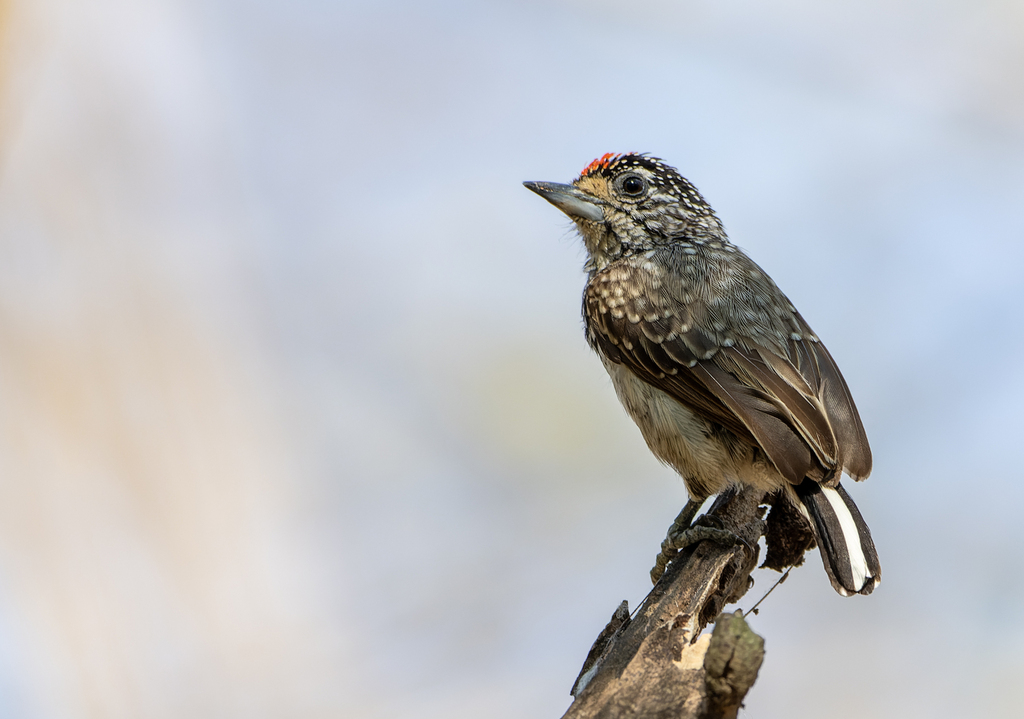
White-wedged Piculet
Photo © David F. Belmonte
Photo © David F. Belmonte — CC BY 4.0 — Source: iNaturalist photo #581024401Identification
The white-wedged piculet is a tiny woodpecker, measuring just 10–11 cm in length and weighing a mere 9–11 g. Males display a distinctive black cap with bright red tips on the forehead feathers and small white spots across the rest of the crown, while females lack this red colouring. Both sexes share a predominantly white face and hindneck with a warm brown tinge, and a characteristic white stripe behind the eye. The upperparts are warm to grayish brown, sometimes with faint pale feather tips.
The species has notably patterned underparts: pale buffish-white chin and throat feathers edged in black create a scaly appearance, while the breast has a scalloped look from similar black edging. The tail is dark brown with distinctive white inner webs on the innermost feathers and wide white patches near the end of the outer pairs. The bill is black with a paler mandible, legs are gray to green-gray, and the iris is brown. Two subspecies exist: the nominate P. a. albosquamatus and the larger, darker P. a. guttifer, which shows more contrast and warmer buff underparts.
Range & Habitat
The white-wedged piculet is found across much of central South America, occurring in Argentina, Bolivia, Brazil, and Paraguay. The nominate subspecies inhabits north-central and eastern Bolivia, southwestern Mato Grosso state in Brazil, northern Paraguay, and northwestern Argentina. The subspecies P. a. guttifer is found across eastern and central Brazil from Pará and Maranhão south to Mato Grosso and São Paulo.
These piculets favour denser areas within moderately dry cerrado habitat and also occur in gallery forests. They are remarkably adaptable to elevation, ranging from lowlands up to 2,100 m, making them accessible to birdwatchers across varied terrain. The species is a year-round resident throughout its range.
Behaviour & Diet
Little detailed information exists on the white-wedged piculet's foraging techniques, but research from the northern Pantanal in Brazil indicates that they feed exclusively on ants. Like other piculets, they are active foragers, probing bark and branches in search of their prey.
The breeding season appears concentrated in the second half of the year, though details remain scarce. They nest in cavities, including tree branches and fence posts. Clutch sizes are at least two eggs, with both parents sharing provisioning duties for nestlings. The species produces a distinctive high-pitched trill that rises initially before gradually falling in pitch, described as 'tititititititititititi'—a useful field identification sound.
Best Time & Places to See It
The white-wedged piculet can be found year-round throughout its range, as it is a permanent resident. In Brazil, it occurs in three national parks and is considered locally not uncommon in areas such as the northern Pantanal, making these locations particularly rewarding for dedicated searchers. The breeding season appears to peak in the second half of the year, which may be the optimal time to locate active pairs.
Your best chances of encountering this species involve searching suitable cerrado and gallery forest habitats, particularly in the more densely vegetated areas. Listening for its distinctive trill will greatly aid in locating this diminutive woodpecker.
Photography Tips
Photographing the white-wedged piculet presents challenges due to its tiny size and preference for dense vegetation. Use a telephoto lens (at least 500mm equivalent) to capture details while maintaining distance from the bird. The species' small size demands sharp focus and fast shutter speeds to freeze any movement as it forages on branches and tree trunks.
The male's red crown markings and distinctive white facial stripe provide excellent identification features to capture. Early morning light in cerrado and gallery forest habitats will illuminate the warm brown tones of the upperparts and showcase the scalloped pattern of the underparts. Patience and a good knowledge of the high-pitched trill will help you locate and track this elusive bird long enough to obtain quality images.
Brasília National Park
Cantão State Park
Chapada Diamantina National Park
Chapada dos Guimarães National Park
Chapada dos Veadeiros National Park
Emas National Park
Encontro das Águas State Park
Guirá State Park
Ilha Grande National Park
Nothing matches these filters.
No community photos yet. Log in to add the first one.
No community observations of this species yet.