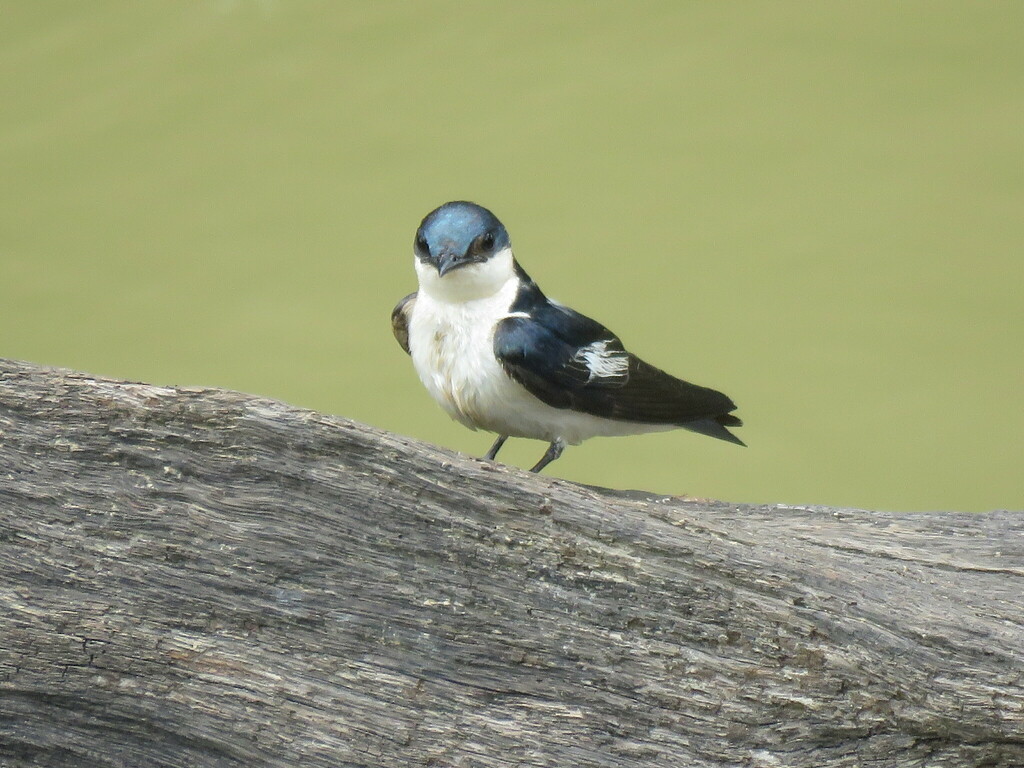
White-winged Swallow
Photo © Vincent A. Vos
Photo © Vincent A. Vos — CC BY 4.0 — Source: iNaturalist photo #211259736Identification
The white-winged swallow is a small swallow, measuring 14 cm (5.5 in) long and weighing 14–17 g. Adults display striking iridescent blue-green upperparts contrasting with clean white underparts and rump. The most distinctive feature is the white edging to the secondary flight feathers, which gives the species its name. The wings are otherwise black, as is the tail. The bird has dark brown eyes, a black bill, and black legs. Females are similar to males but show slightly less white on the wing, while juveniles are duller overall with grayer underparts and reduced white wing markings.
The white-winged swallow is easily distinguished from the similar mangrove swallow by its lack of a white line above the lores and its greater extent of white on the wings. The call is a distinctive harsh chirrup or repeated, rising buzz-like zweeed sound, with a short, harsh alarm call.
Range & Habitat
This resident breeding swallow is found throughout tropical South America, occurring in Brazil, Colombia, Venezuela, Trinidad, Bolivia, Ecuador, French Guiana, Guyana, Paraguay, Peru, Suriname, and Argentina. The species is not found west of the Andes, and occasional vagrants reach Panama. It is notably absent from Pacific coastal regions, particularly in southern South America. The species is largely non-migratory across most of its range, though populations in the southernmost parts of Brazil and Argentina migrate seasonally, typically present from mid-September to mid-April, likely wintering in the Guianas, Venezuela, and Colombia.
Behaviour & Diet
White-winged swallows are graceful fliers that catch insects in flight at low altitudes, primarily over water but also over land. Between foraging attempts, they typically perch on branches near bodies of water, using direct flight paths with characteristic flapping wing beats. The species is found in lowland areas at elevations around 500 m (1,600 ft), usually in or near bodies of water such as rivers and lakes.
For breeding, pairs build cup nests lined with other birds' feathers and seed material inside tree holes, between boulders, or in man-made structures, typically positioned a few metres above water. Pairs nest separately, and clutches consist of three to six white eggs measuring approximately 17–20 mm × 13–14.6 mm.
Best Time & Places to See It
White-winged swallows are resident year-round throughout most of tropical South America, making them reliable sightings in appropriate habitat. In Brazil and Argentina, they are present from mid-September to mid-April. The best locations to encounter this species are along lowland rivers and lakes throughout the Amazon basin, the Guianas, Venezuela, and Colombia. Look for them perched on branches overhanging water or in active flight over waterways during daylight hours.
Photography Tips
The white-winged swallow's iridescent blue-green plumage is best captured in good natural light, which reveals the metallic sheen of the upperparts. Position yourself near rivers or lakes where these birds forage, as they are active fliers but return regularly to the same perches. Early morning light is ideal for photographing their gleaming upperparts against the white underparts. Their low-altitude, direct flight over water provides excellent photo opportunities, though fast shutter speeds are necessary to freeze their rapid wing beats and aerial maneuvers.
Nothing matches these filters.
Amacayacu National Park
Amazônia National Park
Anavilhanas National Park
Bahuaja Sonene National Park
Brasília National Park
Campos Amazónicos National Park
Cantão State Park
Carlos Botelho State Park
Chapada Diamantina National Park
Nothing matches these filters.
No community photos yet. Log in to add the first one.
No community observations of this species yet.