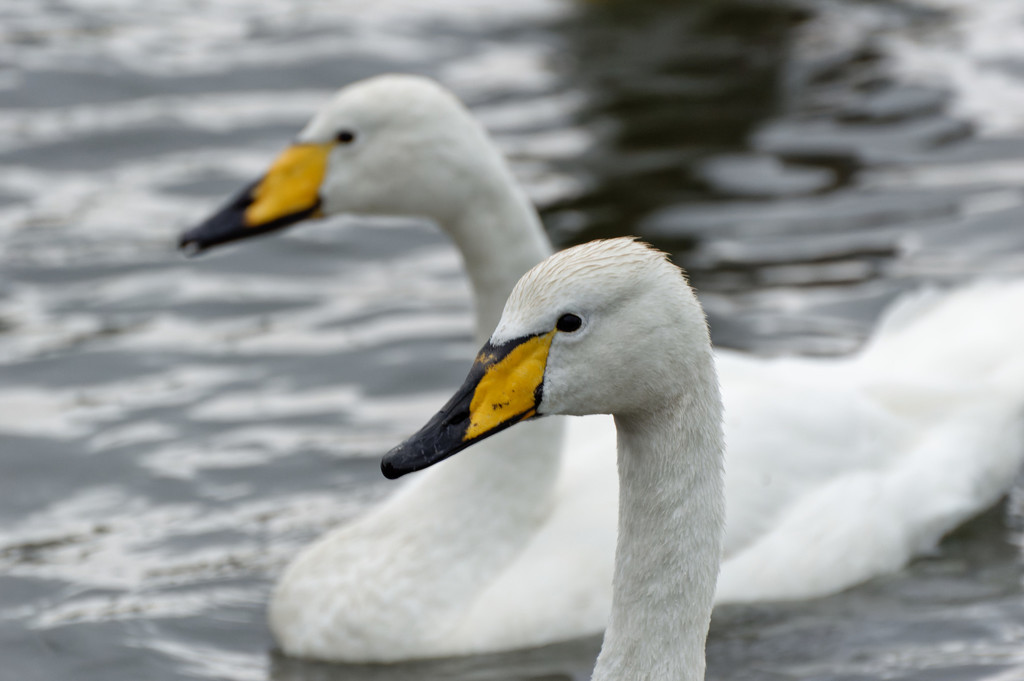
Whooper Swan
Photo © Donald Davesne
Photo © Donald Davesne — CC BY 4.0 — Source: iNaturalist photo #148717628Identification
The whooper swan is a large northern hemisphere swan and the Eurasian counterpart of the North American trumpeter swan. It measures 140–165 centimetres in length with a wingspan of 205–275 cm, making it amongst the heaviest flying birds, with males typically weighing 9.8–11.4 kg and females 8.2–9.2 kg. The whooper swan is similar in appearance to Bewick's swan but larger, with a more angular head shape and a distinctive bill pattern that always shows more yellow than black, unlike Bewick's swans which display more black than yellow. Like their close relatives, whooper swans are highly vocal birds with a deep honking call that resembles geese and is more resonant and lower-pitched than that of Bewick's swan, typically described as kloo-kloo-kloo in groups of three or four.
Range & Habitat
Whooper swans breed in the subarctic Eurosiberia, in the taiga zone further south than Bewick's swans. They are rare breeders in northern Scotland, particularly in Orkney where no more than five pairs have bred in recent years, and a handful of pairs have bred in Ireland in recent years. These powerful fliers are long-distance migrants, capable of travelling hundreds or even thousands of miles to their wintering sites in southern Europe and eastern Asia. Icelandic breeders overwinter in the United Kingdom and Ireland, especially in wildfowl nature reserves. The species is an occasional vagrant to the Indian subcontinent and western North America.
Behaviour & Diet
Whooper swans require large areas of water to live in, spending much of their time swimming, straining the water for food, or eating plants that grow on the bottom. During migration, they fly at altitudes of 50–200 m at speeds of up to 100 km/h, often stopping at sites along the way. These swans pair for life and breed in nests built in or near water in dense cover, with females typically laying 2–7 eggs. Incubation averages 35 days, and cygnets fledge at 78–105 days depending on geographic location. Whooper swans use sophisticated communication methods to coordinate group flight, employing head bobs, head shakes, and wing flaps to signal with each other, with swans that signal actively being significantly more successful at convincing their flock to follow them.
Best Time & Places to See It
Winter is the prime time to observe whooper swans in their southern wintering grounds, particularly in the United Kingdom and Ireland where Icelandic populations congregate in wildfowl nature reserves managed by the Royal Society for the Protection of Birds and the Wildfowl and Wetlands Trust. During spring and autumn migration, these birds may be spotted at various stop-over sites across their range. Early morning visits to wetlands and large water bodies offer the best opportunities for observation, as swans are active in feeding and communication during these times.
Photography Tips
Whooper swans offer excellent photographic opportunities due to their large size and striking appearance. Photograph them in groups during migration or wintering to capture their dynamic communication behaviours, including the distinctive head bobs and wing flaps used for flock coordination. The contrast between their white plumage and darker water creates strong compositional elements. Capture their powerful flight by photographing them in formation during migration, shooting from a low angle to emphasize their impressive wingspan of up to 275 cm. Early morning or late afternoon light will enhance the purity of their white feathers and create atmospheric images of these magnificent birds.
Alaska Maritime National Wildlife Refuge
Altai Tavan Bogd National Park
Åsnens National Park
Avesnois Regional Nature Park
Baikal National Park
Bannau Brycheiniog National Park
Białowieża National Park
Biebrza National Park
Bory Tucholskie National Park
Nothing matches these filters.
No community photos yet. Log in to add the first one.
No community observations of this species yet.