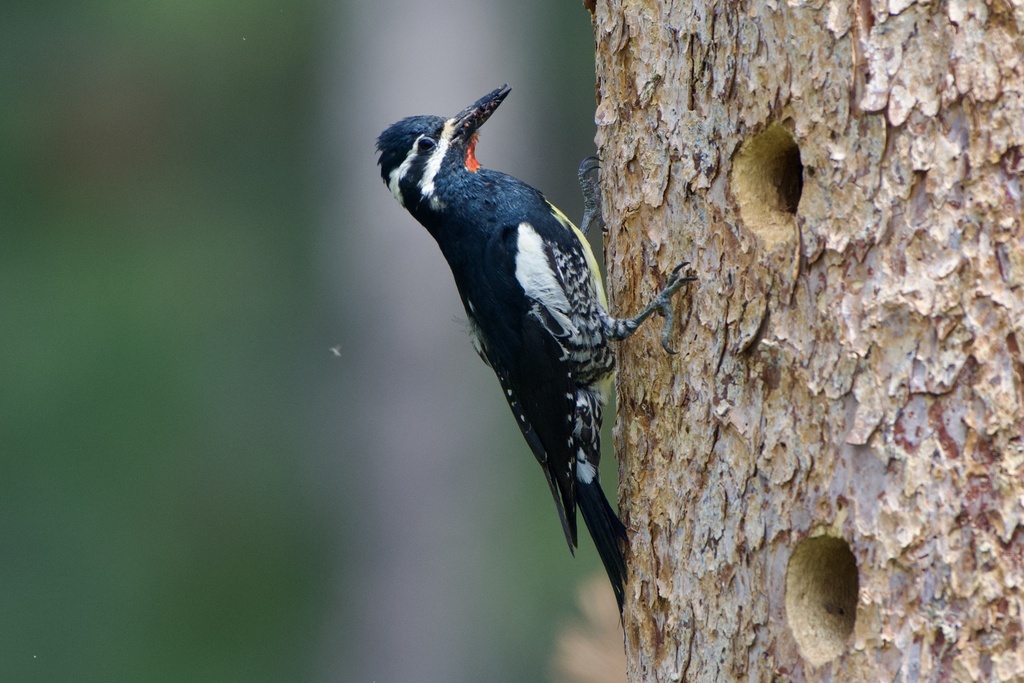
Williamson’s Sapsucker
Photo © Dario Taraborelli
Photo © Dario Taraborelli — CC0 1.0 — Source: iNaturalist photo #207903479Identification
Williamson's sapsucker is a medium-sized woodpecker measuring 8.3–9.8 inches in length with a wingspan of 17 inches and weighing 1.6–1.9 ounces. The species exhibits striking sexual dimorphism. Adult males are iridescent black on the head, back, sides, and tail, featuring a white stripe behind the eye and a lower white stripe across each side of the head. They display a distinctive red chin and bright yellow belly, with black wings marked by large white patches. Females are dramatically different: mainly black with a pale yellow breast, brownish head with black streaking, and fine barring on the back, breast, and sides—so distinct that females were originally classified as a separate species, the black-breasted woodpecker.
Range & Habitat
Breeding habitat consists of open forested areas dominated by conifers, particularly ponderosa pine, Douglas-fir, and grand fir, with subalpine fir and western larch also playing important roles. These partially migratory birds breed across western North America from northern Mexico to British Columbia. While some populations are permanent residents, migrating birds form small flocks and may travel as far south as central Mexico. The species is of conservation concern, particularly in Canada, where fewer than 500 individuals breed, mainly in mature larch forests of south-central British Columbia. Habitat loss through forest harvesting has led to rapid decline, and the species was designated endangered in Canada in 2005.
Behaviour & Diet
Williamson's sapsuckers excavate a new nesting cavity each year, sometimes reusing the same tree. These birds are vocal territory holders, drumming to establish and maintain their domains. While they feed primarily on tree sap from conifers, insects become their main food source during the breeding season. Outside breeding periods, berries supplement their diet, providing nutritional variety throughout the year.
Best Time & Places to See It
The best opportunities to observe Williamson's sapsucker occur during the breeding season in their core range of coniferous forests from British Columbia south through the western United States to Mexico. In Canada, south-central British Columbia offers the most reliable viewing, though numbers remain limited. Migrating birds can be encountered in central Mexico during winter months when flocks form and move through their range.
Photography Tips
Photographing male Williamson's sapsuckers rewards patience, as their striking plumage—iridescent black contrasting with white stripes, red chin, and brilliant yellow belly—offers excellent photographic subjects. Females present a different challenge due to their cryptic coloring and fine markings. Look for birds working on conifer trunks during breeding season, when they are most active and visible. The contrast between male and female plumage makes capturing both sexes particularly valuable for wildlife documentation.
Big Bend National Park
Black Canyon of the Gunnison National Park
Bosque del Apache National Wildlife Refuge
Bryce Canyon National Park
Canyonlands National Park
Capitol Reef National Park
Carlsbad Caverns National Park
Cave Creek Canyon
Chiricahua Mountains
Nothing matches these filters.
No community photos yet. Log in to add the first one.
No community observations of this species yet.