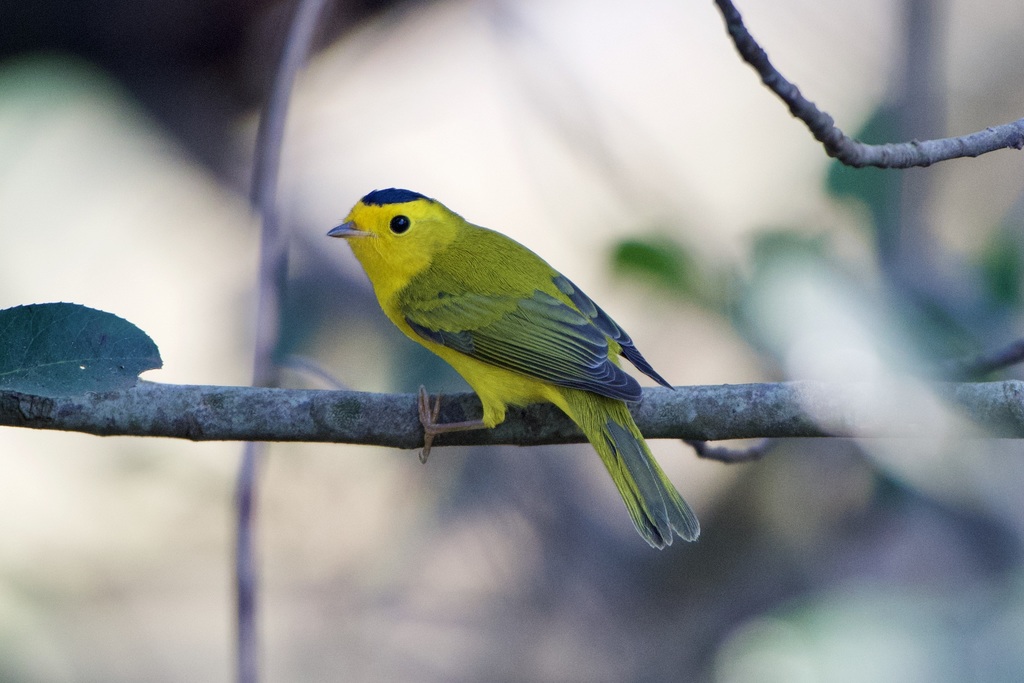
Wilson’s Warbler
Photo © Dario Taraborelli
Photo © Dario Taraborelli — CC0 1.0 — Source: iNaturalist photo #94047485Identification
Wilson's warbler is a diminutive songbird, measuring just 10–12 cm in length with a wingspan of 14–17 cm. It is greenish-brown above with bright yellow underparts, and both sexes share this basic plumage pattern. The most distinctive feature is the small black cap on the male's crown; this marking is reduced or absent in females, depending on the subspecies. The western subspecies C. p. chryseola is noticeably greener and brighter overall, with males displaying a distinctive orange-tinged yellow forehead. Its song is a chattering series of loud descending notes, with a sharp "chuff" call. Wilson's warbler may be confused with the yellow warbler, but differs in its shape, lack of yellow wing markings, and absence of yellow tail spots.
Range & Habitat
Wilson's warbler breeds across Canada and south through the western United States, with populations varying in size across its range. It winters from Mexico through much of Central America, with some populations showing strong migratory preferences—notably the chryseola subspecies, which migrates preferentially to the southern end of the Baja Peninsula. During breeding season, it favors fairly open woodland with undergrowth, shrubs, and thickets in moist areas near streams, ponds, bogs, and wet clearings. In winter, it frequents overgrown clearings, coffee plantations, forest edges, deciduous and tropical evergreen forests, pine-oak forests, mangroves, thorn-scrub, and riparian gallery forests. Year-round, it shows a preference for secondary growth, riparian habitats, and montane or boreal forests with overgrown clearcuts. The species is a very rare vagrant to western Europe.
Behaviour & Diet
Wilson's warbler is an active insectivore, gleaning insects from leaves and twigs or catching them in mid-air. Its diet includes beetles, bees, caterpillars, and occasionally berries. The species is notably restless while feeding, moving rapidly through shrubs, along the ground, and into taller trees during winter, often twitching its tail or flicking its wings nervously. Breeding begins in early March on the west coast and extends into August in northern populations. Females build cup nests from vegetation, typically lined with grasses and hair and often sunk into moss or sedges at the base of shrubs. Clutches range from 2 to 7 creamy or off-white eggs with fine reddish spots; eggs hatch in 11–15 days and young fledge in 8–13 days. Montane populations generally achieve higher clutch sizes and nest success rates than coastal populations, and some are polygamous. The species frequently hosts brown-headed cowbirds.
Best Time & Places to See It
Spring and early summer offer the best viewing opportunities in breeding areas across Canada and western North America, with nesting activity beginning in early March on the west coast. Winter birders should focus on Mexico and Central America, where the species is more abundant in suitable secondary forest, riparian habitats, and forest edges. Look for this active warbler in areas with dense undergrowth and shrubby vegetation; patient observation of movement through low and mid-story vegetation will reward careful birders. Montane forest regions tend to support larger and more successful breeding populations than coastal areas.
Photography Tips
Wilson's warbler's small size and rapid, nervous movements present a challenge for photographers. Use a fast shutter speed (1/1000th of a second or faster) to freeze its constant tail twitches and wing flicks. Position yourself near shrubby areas and wait for the bird to forage at a predictable height; the species' preference for secondary growth means you may find cooperative subjects among dense tangles. Early morning light will help reveal the subtle green and yellow plumage tones and the diagnostic black cap on males. During breeding season, patience near nesting shrubs may yield intimate behavioral shots, though always maintain a respectful distance to avoid disturbing nesting activity.
Tombstone Territorial Park
Acadia National Park
Alaska Maritime National Wildlife Refuge
Algonquin Provincial Park
Alligator River National Wildlife Refuge
Arches National Park
Arctic National Wildlife Refuge
Arenal Volcano National Park
Badlands National Park
Nothing matches these filters.
No community photos yet. Log in to add the first one.
No community observations of this species yet.