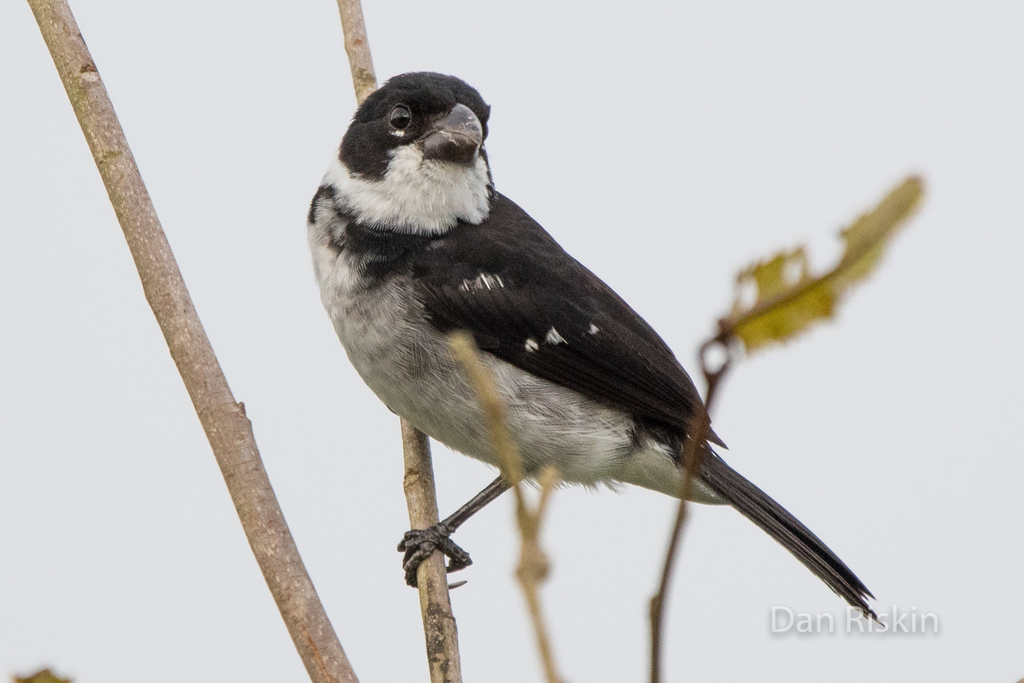
Wing-barred Seedeater
Photo © Dan Riskin
Photo © Dan Riskin — CC BY 4.0 — Source: iNaturalist photo #62659993The wing-barred seedeater (Sporophila americana) is a passerine bird from coastal regions of north-eastern South America in north-eastern Venezuela, Tobago, the Guianas, Amapá and north-eastern Pará (with a single record from Maranhão), Brazil, and along the Amazon River upstream to around Manaus. Formerly, it included the mainly Central American Sporophila corvina and the west Amazonian S. murallae as subspecies, in which case the combined species had the common name Variable Seedeater. Following the split, this common name is now restricted to S. corvina. == Description == It has a total length of approximately 11 cm (4+1⁄4 in). Adult males have a relatively heavy black bill. The upperparts are black, except for a greyish rump (actually white finely streaked black, but only visible up-close) and two distinct white wing-bars (the lower often reduced). The underparts are white, except for a broad black pectoral collar (sometimes reduced and incomplete) and blackish mottling to the upper flanks. The far duller female has a brownish bill, dull buffy-olive upperparts and pale olive-ochre underparts. Juveniles resemble adult females. == Ecology == It is found in open or semi-open grassy areas and shrub, usually in pairs or small flocks. As with other Sporophila seedeaters, it mainly…
Yasuní National Park
Aguarico, Ecuador
+601 birds+43 mammals
Where the western Amazon basin converges with Ecuador's Orellana Province, lowland rainforest reaches toward the horizon in an unbroken canopy of staggering botanical density. Yasuní National…
VIEW NATIONAL PARKSumaco Napo-Galeras National Park
Loreto, Ecuador
+563 birds+4 mammals
Where Ecuador's Amazon transitions into cloud forest, a massive shield volcano rises from the emerald lowlands of Orellana Province, anchoring one of the continent's most biodiverse…
VIEW NATIONAL PARKAmacayacu National Park
Leticia, Colombia
+567 birds+25 mammals
Where the Rio Amazonas curves through the tri-border region where Colombia, Peru, and Brazil converge, Amacayacu National Park sprawls across more than 5,250 square kilometres of…
VIEW NATIONAL PARKAmazônia National Park
Brazil
+439 birds+6 mammals
Where the Rio Amazonas and its tributaries weave through the heart of Pará state, a vast tapestry of rainforest stretches across 23,611 square kilometers of unbroken…
VIEW NATIONAL PARKAnavilhanas National Park
Brazil
+468 birds+8 mammals
Across the Rio Negro in central Amazonas, an archipelago of over a thousand islands rises from the world's largest rainforest river system, creating a labyrinth of…
VIEW NATIONAL PARKCampos Amazónicos National Park
Amazonas, Brazil
+434 birds+7 mammals
Sprawling across the southwestern Amazon basin in Amazonas state, this 27,263-square-kilometre national park encompasses some of the region's most pristine lowland rainforest, where terra firme forest…
VIEW NATIONAL PARKTingo Maria National Park
Mariano Dámaso Beraún, Peru
+423 birds
Where the eastern slopes of the Peruvian Andes descend toward the Amazon basin, the landscape fractures into a maze of limestone ridges, humid gorges, and cloud-wrapped…
VIEW NATIONAL PARKNo community photos yet. Log in to add the first one.
No community observations of this species yet.