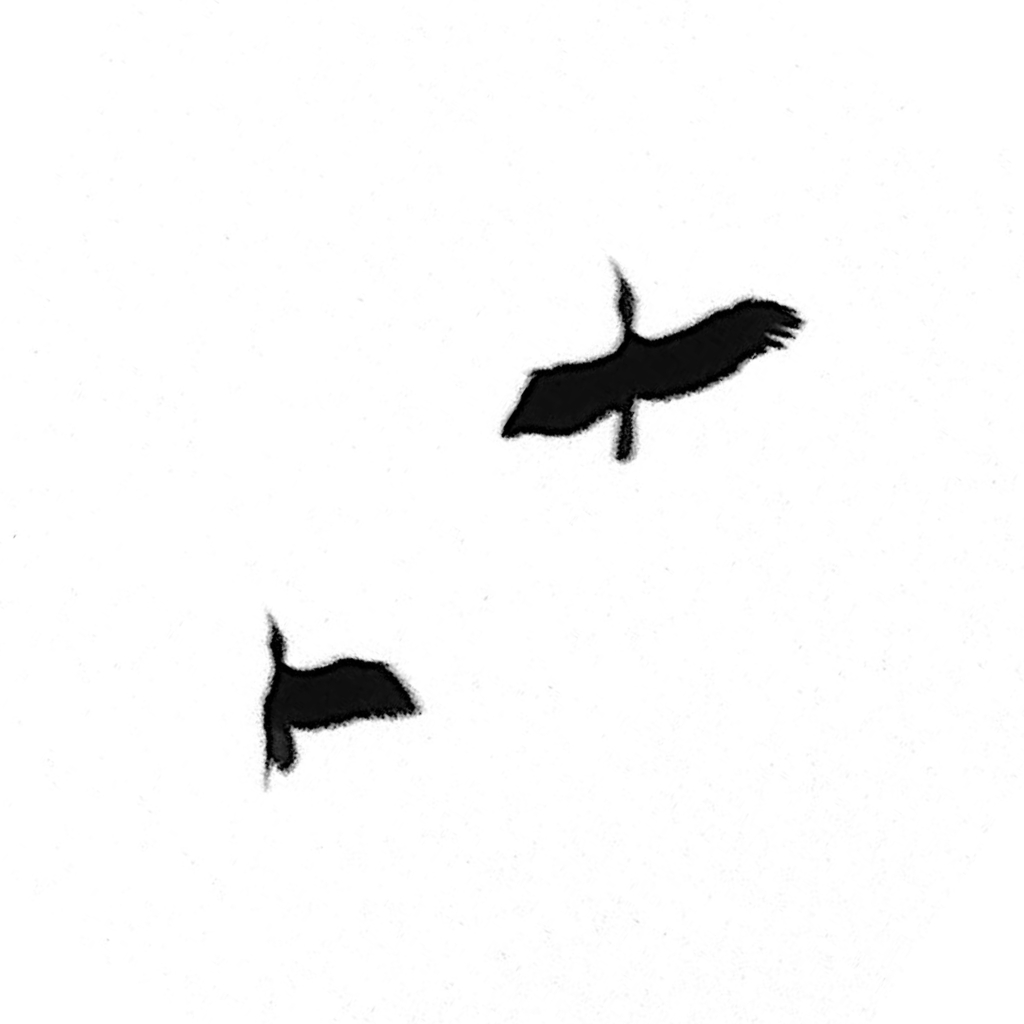
Wreathed Hornbill
Photo © James K. Douch
Photo © James K. Douch — CC BY-SA 4.0 — Source: iNaturalist #98273789Identification
The wreathed hornbill is a striking medium-sized bird, measuring 75 to 90 cm in length, with males weighing 1.68 to 3.65 kg and females slightly smaller at 1.36 to 2.69 kg. Both sexes are predominantly black with pale yellow bills and reddish skin around the eyes, but sexual dimorphism is pronounced in their throat patches: males display a bright yellow gular skin with a white neck, while females have a distinctive blue throat. Males also feature a rufous crown and white upper breast, contrasting with the females' uniformly black plumage.
The species is named for its characteristic long, curved bill with distinctive serrated ridges, or "wreaths," on the casque of the upper mandible—a feature that becomes increasingly pronounced with age. A black band encircles the gular skin, and both sexes display a white tail. The bill's casque contains foamy air-filled cavities layered with keratin tiles, a structure that has evolved to serve multiple functions including vocalization enhancement, physical display, and age-status signalling.
Range & Habitat
The wreathed hornbill inhabits tropical evergreen forests across a vast range extending from southern Bhutan and Northeast India through Bangladesh, mainland Southeast Asia, and into the Greater Sunda Islands, where it is restricted to Sumatra, Java, and Borneo. It has been recorded at elevations up to 2,560 m. Within Northeast India, the species occupies unlogged primary forests and selectively logged forests in the Eastern Himalayan foothills, with notable populations documented at reserves including Nameri and Namdapha National Parks in Assam and Arunachal Pradesh respectively.
The species exhibits seasonal elevation shifts, inhabiting lowland areas during breeding season before migrating to higher elevations during the non-breeding season. Historical sightings include records from Sarpang district in Bhutan and the Mali River valley in Myanmar, where flocks have been observed at elevations of 800–2,500 m.
Behaviour & Diet
The wreathed hornbill is a highly social frugivore that feeds primarily on large fruits consumed whole, leaving seeds intact—a feeding behaviour critical for long-distance seed dispersal in forest ecosystems. Most active during early mornings when foraging, the species is most energetic at dawn and dusk, resting during midday heat. Unlike other hornbill species, wreathed hornbills live in notably larger flocks, remaining in groups during both breeding and non-breeding seasons. Flock sizes vary with location and season, ranging from means of 4.7 to 6.6 individuals in some areas to densities of 68 birds per square kilometre in December in certain reserves.
This species is a prolific traveller, covering mean minimum daily distances of up to 24.8 km during breeding season and dispersing seeds up to 10.8 km from nesting sites. The wreathed hornbill's main vocalisation is a loud double yelp described as "coo-cuk" or "wuff-wurff," typically repeated in sequences of three or more from perches or during flight. When calling, birds dramatically display their colourful throat sacs by sharply thrusting their heads backwards and upwards.
Best Time & Places to See It
For reliable sightings, visit Northeast India's protected areas, particularly Namdapha National Park in Arunachal Pradesh and Nameri National Park in Assam, where the species inhabits primary and selectively logged evergreen forests. The non-breeding season (particularly December) offers the best viewing opportunities, when birds congregate in larger, more visible flocks. Early morning hours are essential, as the wreathed hornbill is most active during dawn foraging periods.
Pakke Tiger Reserve in Arunachal Pradesh is another productive location. In Southeast Asia, the Mali River valley in Myanmar and lowland forests of Sumatra, Java, and Borneo offer possibilities, though habitat fragmentation and hunting pressure have reduced populations in many areas. The species' long-distance movements mean patience and good forest access are necessary for consistent encounters.
Photography Tips
Early morning light is essential for capturing the wreathed hornbill's striking plumage and contrasting throat markings. Position yourself in evergreen forest clearings or along fruiting trees where birds forage, and listen for their distinctive loud double yelp calls to locate flocks. The bird's dramatic head-thrusting display during vocalization—when it showcases its colourful yellow or blue throat sac—provides a memorable photographic moment, though it occurs unpredictably.
The striking sexual dimorphism between males and females offers excellent opportunities for comparative photography. The bird's pale yellow bill and reddish eye-patches stand out against the predominantly black plumage, particularly in soft morning light. Given the species' large home range and long daily movements of up to 24.8 km, patience at known feeding sites during peak foraging periods increases encounter probability. Working with local guides familiar with flock movements and fruiting phenology will significantly improve your chances of sustained views.
Orang National Park
Rangagarapathar, India
+298 birds+1 mammals
Where the Brahmaputra's floodplains meet the foothills of Assam, Orang National Park unfolds across a mosaic of riverine grasslands, forests and wetlands that pulse with the…
VIEW NATIONAL PARKKhao Yai National Park
Prachantakham District, Thailand
+377 birds+46 mammals
Evergreen dipterocarp forest blankets the rolling terrain of this national park in eastern Thailand, where limestone hills rise abruptly from the forest floor and seasonal streams…
VIEW NATIONAL PARKKaziranga National Park
Kohora, India
+422 birds+26 mammals
Dawn breaks over the floodplains of the Brahmaputra, where tall grasslands stretch endlessly beneath monsoon-heavy skies. This sprawling wilderness of northeastern Assam is a mosaic of…
VIEW NATIONAL PARKTaman Negara National Park
Kampong Samas, Malaysia
+393 birds+48 mammals
Where ancient rainforest meets limestone peaks, one of Southeast Asia's oldest protected wilderness preserves sprawls across 4,343 square kilometers of primordial landscape. Dipterocarp giants tower overhead,…
VIEW NATIONAL PARKGunung Mulu National Park
Long Seridan, Malaysia
+280 birds+39 mammals
Where granite monoliths pierce the rainforest canopy of Sarawak, an ancient limestone karst landscape reveals one of Southeast Asia's most biodiverse strongholds. Soaring peaks cloaked in…
VIEW NATIONAL PARKTaman Nasional Baluran
Situbondo, Indonesia
+189 birds+9 mammals
Across the northeastern tip of East Java, where monsoon winds sweep down from the Bali Strait, a landscape of contrasts unfolds within 374 square kilometres of…
VIEW NATIONAL PARKTaman Nasional Meru Betiri
Jember, Indonesia
+93 birds+1 mammals
Across East Java's southeastern coast, where the Indian Ocean meets a landscape of volcanic soils and monsoon-fed forests, sprawls a national park that epitomizes the ecological…
VIEW NATIONAL PARKWest Bali National Park
Gerokgak, Indonesia
+240 birds+8 mammals
Across West Bali's northwestern reaches, where the Indian Ocean meets volcanic slopes and limestone cliffs plunge toward turquoise shallows, sprawls a protected realm of roughly 325…
VIEW NATIONAL PARKGunung Ciremai National Park
Majalengka, Indonesia
+116 birds+1 mammals
Volcanic slopes rise sharply from West Java's interior, where Gunung Ciremai's 3,078-metre summit dominates a landscape carved by geological upheaval and shaped by equatorial monsoon rainfall.…
VIEW NATIONAL PARKKerinci Seblat National Park
Kerinci, Indonesia
+228 birds+16 mammals
Across nearly 67,000 square kilometres of Sumatra's spine, a mountainous realm of equatorial rainforest rises from steaming lowlands to volcanic peaks shrouded in cloud. Kerinci Seblat…
VIEW NATIONAL PARKWay Kambas National Park
Lampung Timur, Indonesia
+237 birds+20 mammals
Across the low swamplands of eastern Lampung, where freshwater wetlands merge into tidal mangrove forests along the Sunda Strait, sprawls one of Sumatra's most vital sanctuaries.…
VIEW NATIONAL PARKNo community photos yet. Log in to add the first one.
No community observations of this species yet.