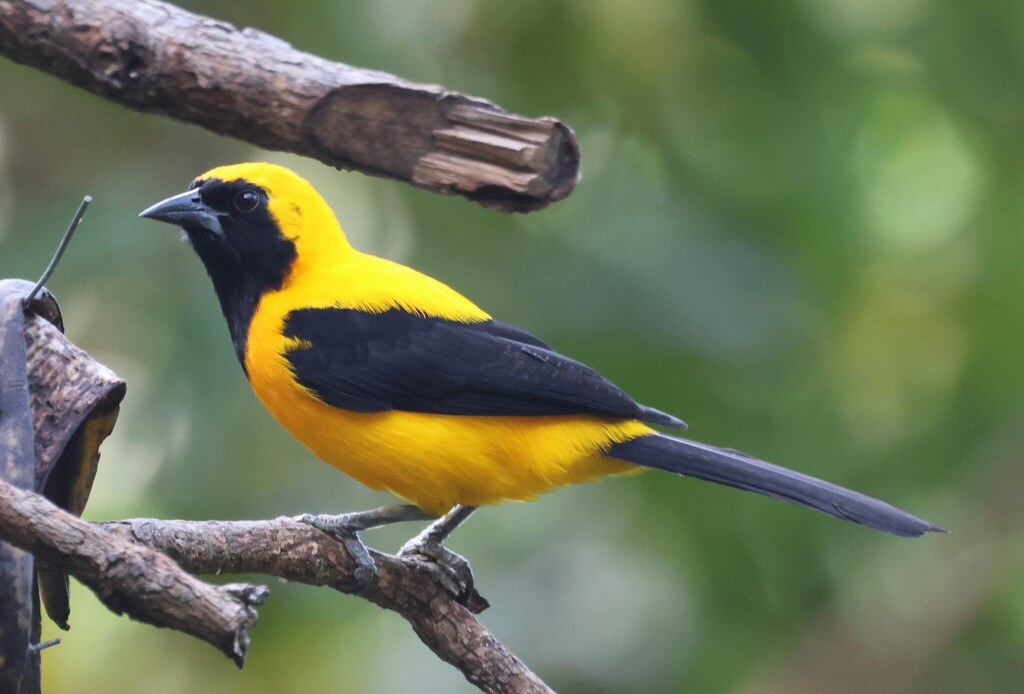
Yellow-backed Oriole
Photo © scaup
Photo © scaup — CC BY 4.0 — Source: iNaturalist photo #612058082Identification
The Yellow-backed Oriole is a striking, sexually monomorphic species averaging 21.5 cm in length, making it a relatively medium-sized oriole. Adults display strongly contrasting yellow and black plumage: the wings, tail, shoulders, throat, and face are all black, while the back and underparts are an extremely bright yellow. The bill is black with a bluish-grey base to the mandible, and exposed skin and claws are bluish-black. Adult females closely resemble males but with yellow parts appearing slightly greenish, making field identification by sex extremely difficult. Immature birds resemble adult females but appear greener overall, with dark brown (rather than black) flight feathers and a distinctive olive eye-line that distinguishes them from adults.
Range & Habitat
Yellow-backed Orioles are found throughout Central America and northern South America, divided into three allopatric populations across Mexico, Central America, and South America. The species occurs in Belize, Colombia, El Salvador, Guatemala, Honduras, Mexico, Nicaragua, Panama, and Venezuela. They prefer open, mixed pine-oak woodlands and dry scrub forest but tolerate a wide variety of habitats, including banana plantations and occasionally lowland deciduous forest. Altitude tolerance is considerable: while typically found below 900 meters, Central and South American populations frequently occur above 1,000 meters, with observations recorded up to approximately 3,000 meters.
Behaviour & Diet
Yellow-backed Orioles are monogamous, breeding once annually with a single mate. They are often observed in small family flocks of up to eight individuals and occasionally join mixed-species flocks with band-backed wrens, jays, and other medium-sized orioles. This species has a clear, whistling voice similar to Spot-breasted Orioles, with songs consisting of a series of clear notes that acquire a muddy, warbled quality in southern Central American populations. Both sexes sing from high tree perches, and common calls include a nasal "chert," whistling chatter, and nasal alarm calls.
Primarily insectivorous, Yellow-backed Orioles feed on caterpillars, wasps, ants, weevils, and other arthropods, augmenting their diet with bananas, nectar from balsa and Heliconia flowers, and occasionally nectar robbed from unopened flowers. They forage in pairs or family units, hunting insects by probing tree bark and epiphytes.
Best Time & Places to See It
Yellow-backed Orioles are year-round residents throughout their range in Mexico, Central America, and northern South America. Look for them in open pine-oak woodlands and dry scrub forests at various elevations. Their preference for high perches and clear vocalizations make them relatively detectable, especially when they sing from elevated tree branches. Visit banana plantations and mature deciduous forests where they occasionally occur, particularly in areas above 1,000 meters in Central and South America.
Photography Tips
The high contrast between bright yellow underparts and black upperparts makes Yellow-backed Orioles visually striking subjects, though the extreme brightness of yellow plumage may challenge exposure metering. Position yourself to capture their characteristic posture high in tree canopies, where they deliver their whistling song. Look for nesting birds near palm fronds where they hang their distinctive shallow, woven basket nests in mature trees at least 7 meters tall. Early morning hours are ideal for capturing singing birds when they are most vocal and active, and backlighting can accentuate the luminous quality of their yellow plumage.
Guided Birding Tour
Natural Serranía de los Yariguíes National Park
El Carmen de Chucurí, Colombia
+320 birds+3 mammals
Where the northern cordilleras of Colombia rise toward cloud forest, the Serranía de los Yariguíes unfolds across nearly 1,820 square kilometers of some of the most…
VIEW NATIONAL PARKNatural Farallones de Cali National Park
Buenaventura, Colombia
+733 birds+27 mammals
Where the Pacific coastal plain meets the western slopes of the Andes, Farallones de Cali National Park sprawls across nearly 3,500 square kilometers of dramatic topography…
VIEW NATIONAL PARKNatural Chingaza National Park
Junín, Colombia
+285 birds+6 mammals
Where the Andes rise above three thousand metres in the Cundinamarca region, high-altitude grasslands and cloud forests converge in a landscape shaped by both geology and…
VIEW NATIONAL PARKNatural el Cocuy National Park
Güicán, Colombia
+313 birds+3 mammals
Where the Andes rise to their highest peaks in Colombia's eastern cordillera, El Cocuy National Park sprawls across more than 6,600 square kilometers of some of…
VIEW NATIONAL PARKPuracé National Natural Park
Puracé, Colombia
+327 birds+2 mammals
Where the Andes thrust upward across southwestern Colombia, Puracé National Natural Park spans nearly 2,631 square kilometers of some of South America's most dramatic montane terrain.…
VIEW NATIONAL PARKGuácharos Cave National Natural Park
Acevedo, Colombia
+359 birds
High in the Andean foothills of southern Huila, where mist-laden slopes rise above 1,600 metres, lies a landscape carved by underground rivers and crowned by karst…
VIEW NATIONAL PARKNatural Uramba Bahía Málaga National Park
Buenaventura, Colombia
+308 birds+15 mammals
Where the Pacific coastal rainforest descends to mangrove estuaries and rocky headlands, Uramba Bahía Málaga National Park unfolds across nearly 1,000 square kilometres of Colombia's Valle…
VIEW NATIONAL PARKNatural Sumapaz National Park
Cubarral, Colombia
+368 birds+1 mammals
Where the Andes descend toward the Amazon basin, the high páramo grasslands of Sumapaz National Park sprawl across more than five thousand square kilometers of Meta…
VIEW NATIONAL PARKEl Tamá National Park
Toledo, Colombia
+435 birds
Where the Andes descend toward the Caribbean coastal lowlands of northern Colombia, El Tamá National Park sprawls across nearly 3,800 square kilometres of montane forest, cloud…
VIEW NATIONAL PARKNatural Nevado del Huila National Park
Planadas, Colombia
+117 birds
Where the Colombian Andes rise above 5,000 metres, tropical cloud forest yields to páramo and glaciated peaks, and the Planadas region of Tolima contains one of…
VIEW NATIONAL PARKSarigua National Park
Parita, Panama
+56 birds+1 mammals
Across the Parita lowlands of Herrera Province, mangrove forests and tidal mudflats define a landscape shaped entirely by water—where brackish estuaries meet the Pacific and the…
VIEW NATIONAL PARKGeneral de División Omar Torrijos Herrera National Park
La Pintada, Panama
+401 birds+2 mammals
Across the highlands of central Panama, where the continental divide funnels moisture-laden trade winds into steep river valleys, the terrain rises and falls in a landscape…
VIEW NATIONAL PARKSoberanía National Park
Cristóbal, Panama
+495 birds+34 mammals
Rainforest and riverine woodland blanket the rolling terrain of this 714-square-kilometre national park in Colón Province, where the Caribbean watershed feeds a maze of streams and…
VIEW NATIONAL PARKChagres National Park
Caimitillo, Panama
+486 birds+19 mammals
Where the Chagres River carves through the humid tropics of central Panama, a vast montane and lowland forest sprawls across more than 2,300 square kilometers, anchoring…
VIEW NATIONAL PARKDarién National Park
Tucutí, Panama
+534 birds+13 mammals
Where the spine of Central America crumbles into wetland and rainforest, Darién National Park sprawls across more than 20,000 square kilometres of some of the tropics'…
VIEW NATIONAL PARKPortobelo National Park
Portobelo, Panama
+366 birds+9 mammals
Where the Caribbean's turquoise waters meet the Darién's verdant shore, Portobelo National Park sprawls across 570 square kilometers of coastal forest, mangrove wetland, and coral-fringed islands…
VIEW NATIONAL PARKDzibilchantún National Park
Barcelona, Mexico
+144 birds+2 mammals
Across the limestone plains of Yucatán, where cenotes pierce the bedrock and tropical forest clings to shallow soils, lies Dzibilchantún—a modest yet ecologically vital national park…
VIEW NATIONAL PARKLagunas de Montebello National Park
Laguna de Montebello, Mexico
+360 birds+2 mammals
Where turquoise lagoons pierce the limestone plateau of southeastern Chiapas, the Lagunas de Montebello National Park unfolds across roughly 174 square kilometers of spectral water and…
VIEW NATIONAL PARKSian Ka’an
Chunyaxché, Mexico
+350 birds+16 mammals
Where the Yucatán Peninsula dissolves into wetland and mangrove, a vast mosaic of forest, lagoon, and coastal margin creates one of Mexico's most biodiverse strongholds. Across…
VIEW BIOSPHERE RESERVENo community photos yet. Log in to add the first one.
No community observations of this species yet.