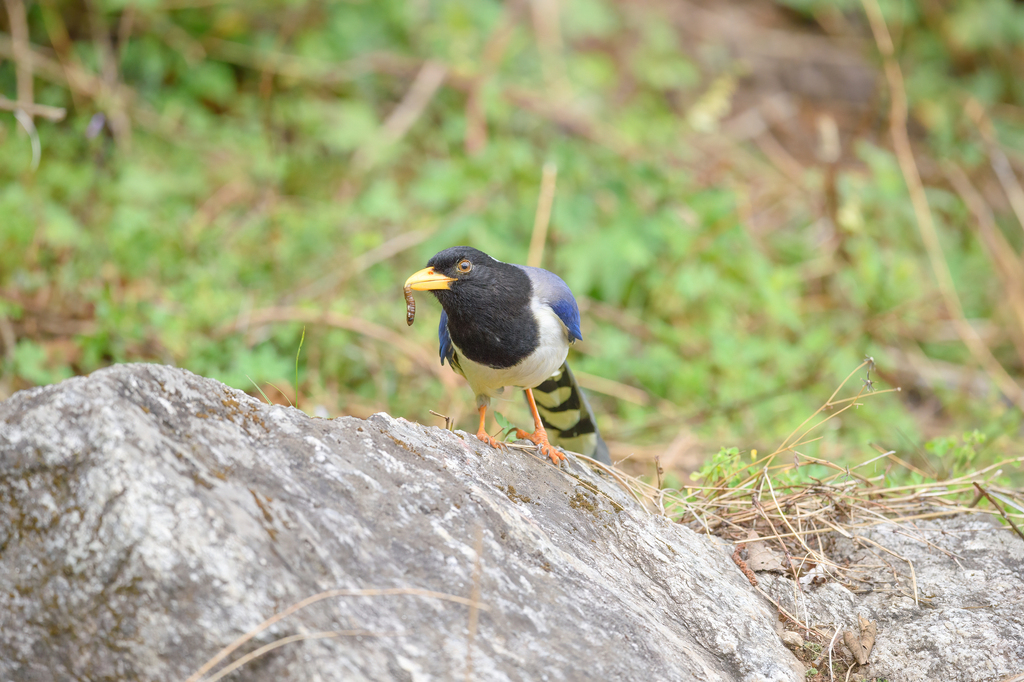
Yellow-billed Blue Magpie
Photo © Morten Ross
Photo © Morten Ross — CC BY 4.0 — Source: iNaturalist photo #221311063Identification
The Yellow-billed Blue Magpie is a striking and unmistakable bird, measuring 66 cm in length with a notably long tail accounting for about 46 cm of its total size. Both sexes share identical plumage, making identification straightforward once you've spotted one of these beauties. The head, neck, and breast are glossy black, contrasted by a distinctive white patch on the nape. The remainder of the underparts are white with a faint lilac tinge, while the entire upper plumage displays a vibrant purplish-blue coloration that brightens considerably on the wings and tail.
The species' namesake yellow bill is a prominent identifying feature, along with white-tipped flight feathers and white outermost wing feathers. The long, graduated tail is particularly diagnostic, with blue feathers tipped in white, except for the very long central tail feathers which display a striking band of black before the white tip. This elegant combination of colours and patterns makes the Yellow-billed Blue Magpie one of the most visually arresting birds of the Himalayan region.
Range & Habitat
This species is found throughout the Himalayas from Hazara to the Brahmaputra, with a disjunct population in Vietnam. Two subspecies are recognized: U. f. cucullata is the more common western form, distributed from the western boundary of the range through Western Nepal and is particularly abundant in hill stations of the Western Himalayas. The eastern form occurs from Eastern Nepal eastwards and is slightly darker on the underparts with a more pronounced lilac tinge.
Yellow-billed Blue Magpies are primarily birds of montane forests, breeding in zones ranging from 1,500 to 3,000 metres elevation, though the eastern subspecies seldom descends below 1,830 metres. While most common in areas of dense jungle, they also inhabit agricultural areas and bare mountain sides at higher elevations. The species is resident throughout its range, though birds typically descend to lower elevations during winter months, making seasonal movements an important consideration for birdwatchers.
Behaviour & Diet
These are highly social, primarily arboreal birds that live in parties of seven or eight individuals and are distinctly territorial. When on the ground—where they feed frequently—they adopt a characteristic hopping gait with their tails held high to prevent the long feathers from dragging. Their flight is slow and undulating once they venture into open spaces, a useful identification feature when observing them in flight.
The Yellow-billed Blue Magpie is an omnivorous forager with a varied diet consisting of small mammals, the eggs and young of other birds, insects, wild fruits, and berries. They are remarkably vocal birds, producing a wide variety of calls and vocalizations that echo through their forest habitats. This vocal activity often helps birdwatchers locate them before they're seen.
Best Time & Places to See It
To find Yellow-billed Blue Magpies, focus your efforts on the Himalayan hill stations and forests within their range. In the Western Himalayas, well-known hill stations offer particularly good opportunities for encounters. Winter months may require searching at lower elevations as birds descend from higher breeding zones, while breeding season sees them in montane forests between 1,500 and 3,000 metres.
Areas of dense jungle with heavy foliage are ideal, though they're adaptable enough to be found in agricultural areas and even on bare mountain sides. Since they live in parties and are territorial, finding one individual often means others are nearby. Early morning is typically the best time for birdwatching, when these vocal birds are most active and vocal.
Photography Tips
The Yellow-billed Blue Magpie's vibrant blue plumage and striking contrasting black-and-white markings make it a rewarding subject for wildlife photographers. The bird's long, elegant tail presents compositional opportunities but also challenges—compose your shots to include this diagnostic feature while keeping the entire bird in frame. The white tail tips and flight feather patterns are particularly striking in flight, so be prepared with a fast shutter speed and tracking autofocus.
The bird's hopping gait on the ground and deliberate movements in trees provide good opportunities for sharp images. Early morning light will make the purplish-blue upper plumage and white patches truly shine. Since these birds are social and territorial, once you locate a party, patience often rewards you with multiple viewing angles and behaviours. Their arboreal habits mean they're frequently backlit by canopy gaps—use exposure compensation carefully to retain detail in both the black head and white underparts.
Langtang National Park
Helambu, Nepal
+364 birds+14 mammals
Where the southern slopes of the Himalayan highlands descend toward the subtropical valleys of central Nepal, Langtang National Park sprawls across one of the subcontinent's most…
VIEW NATIONAL PARKSagarmatha National Park
Khumjung, Nepal
+219 birds+7 mammals
Soaring peaks and deep glacial valleys define this alpine wilderness in northeastern Nepal, where the terrain rises from forested foothills into a realm of high-altitude tundra…
VIEW NATIONAL PARKKhangchendzonga National Park
Sakkyong, India
+290 birds+1 mammals
Where the eastern Himalayas surge toward their crowning peaks, Khangchendzonga National Park embraces a landscape of almost overwhelming vertical drama. Rising from subtropical river valleys into…
VIEW NATIONAL PARKNanda Devi National Park
Garpak, India
+218 birds+5 mammals
Where the Himalayas surge into their most dramatic alpine amphitheater, a wilderness of raw geological power unfolds across 624 square kilometers of pristine terrain. Nanda Devi,…
VIEW NATIONAL PARKValley of Flowers National Park
Ghangaria, India
+117 birds+1 mammals
Where alpine meadows explode with color each monsoon season, the Himalayan slopes of Uttarakhand rise to create one of Earth's most extraordinary floral displays. Perched between…
VIEW NATIONAL PARKGaoligong Mountain National Nature Reserve
Nujiang Lisu Autonomous Prefecture, China
+443 birds+13 mammals
VIEW NATURE RESERVEBaima Snow Mountain National Nature Reserve
Diqing Tibetan Autonomous Prefecture, China
+204 birds+3 mammals
High-altitude ridges and steep-sided valleys define this reserve in northwestern Yunnan, where elevations surge from around 3,000 metres to peaks above 4,100 metres. The terrain supports…
VIEW NATURE RESERVENo community photos yet. Log in to add the first one.
No community observations of this species yet.