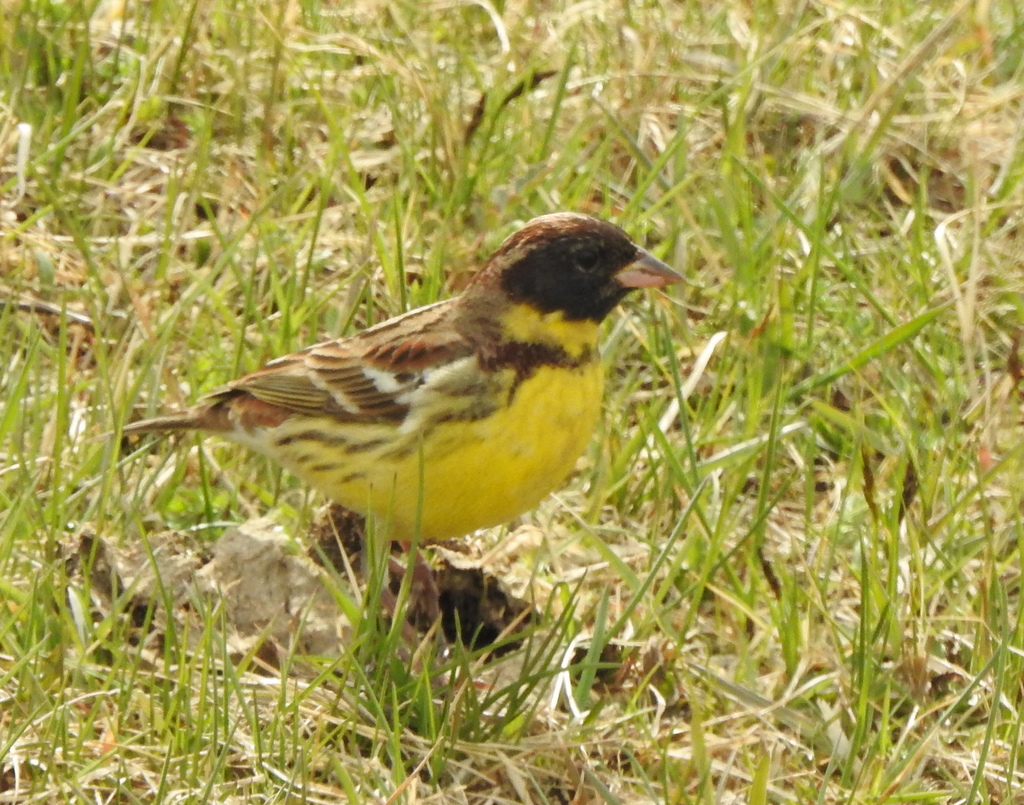
Yellow-breasted Bunting
Photo © Анна Васильченко
Photo © Анна Васильченко — CC BY 4.0 — Source: iNaturalist #83367637Identification
The yellow-breasted bunting is a small, stocky passerine measuring 14–16 cm in length and weighing 17–26 g. The breeding male is unmistakable: bright white underparts with black flank streaks, brown upperparts, black face and throat bar, and a distinctive pink lower mandible. Females are more subdued, with heavily streaked grey-brown backs, less intensely yellow underparts, and a whitish face marked by dark crown, eye and cheek stripes. Juveniles resemble females but with buff-toned underparts and face. The bird's distinctive call is a sharp 'zick', while its song is a clear, repeated 'tru-tru, tri-tri'.
Range & Habitat
This species breeds across the boreal and East Palearctic regions, with two subspecies: E. a. aureola ranges from Finland to the Bering Sea, while E. a. ornata extends from the Amur River through Manchuria, North Korea, Kamchatka and the Kuril Islands. Birds migrate to winter in southeast Asia, India, and North Korea, with some reaching rare but regular locations in western Europe and occasional vagrants appearing in Alaska and Canada. During winter, large flocks concentrate in cultivated areas, rice fields and grasslands, preferring to roost in reedbeds and rice-fields.
Behaviour & Diet
Yellow-breasted buntings breed in open, scrubby areas with dry water rice fields for foraging and reedbeds for roosting, typically near water and throughout Siberia. They lay four to six eggs in ground nests. Diet varies seasonally: they feed primarily on insects when rearing young, and on seeds during other periods. During winter, they form large flocks, sometimes exceeding 6,000 individuals in favoured roosts.
Best Time & Places to See It
Winter is the prime season for observing this species, particularly in southeast Asia where birds concentrate in rice-growing regions and reedbeds. Myanmar's Irrawaddy Delta, particularly the Kyon Ka Pyin-Tap Seik Conservation Area, has hosted some of the largest known roosts. The breeding season requires travel to remote boreal and subarctic regions from Finland eastward. Passage migrants occasionally appear in western Europe during spring and autumn migration.
Photography Tips
The striking plumage of breeding males—bold black and white markings contrasted with chestnut tones—makes them attractive subjects, though their small size demands a telephoto lens. Winter flocks in reedbeds offer opportunities for large-scale compositions, though roosting birds can be distant and require patience. Early morning light at wintering sites will highlight the males' white underparts and black markings, while the females' subtle streaking requires careful exposure metering. Exercise ethical restraint: given the species' critically endangered status and vulnerability to trapping, minimize disturbance to roosting flocks.
Langtang National Park
Helambu, Nepal
+364 birds+14 mammals
Where the southern slopes of the Himalayan highlands descend toward the subtropical valleys of central Nepal, Langtang National Park sprawls across one of the subcontinent's most…
VIEW NATIONAL PARKKhao Yai National Park
Prachantakham District, Thailand
+377 birds+46 mammals
Evergreen dipterocarp forest blankets the rolling terrain of this national park in eastern Thailand, where limestone hills rise abruptly from the forest floor and seasonal streams…
VIEW NATIONAL PARKBaikal National Park
Ольхонский район, Russia
+184 birds+11 mammals
Where the world's deepest freshwater lake meets ancient Siberian taiga, Baikal National Park sprawls across 66,203 square kilometers of one of Earth's most singular ecosystems. The…
VIEW NATIONAL PARKTransbaikal National Park
Barguzinsky Rayon, Russia
+83 birds+7 mammals
Where the eastern shore of Lake Baikal meets the Barguzinsky Range, a vast wilderness of boreal forest, alpine tundra, and rocky shoreline unfolds across more than…
VIEW NATIONAL PARKNalychevo National Park
Nalychevo, Russia
+30 birds+5 mammals
Where volcanic peaks pierce the mist of Russia's far northeast, a primordial landscape of steaming geothermal springs and pristine river valleys unfolds across the Kamchatka Peninsula.…
VIEW NATIONAL PARKHustai National Park
Altanbulag, Mongolia
+198 birds+16 mammals
Where the steppe rolls endlessly beneath vast Mongolian skies, Hustai National Park preserves one of Central Asia's most dynamic grassland ecosystems. Rolling hills and open prairie…
VIEW NATIONAL PARKGobi Gurvan Saikhan National Park
Tsagaan Subarga Hural, Mongolia
+183 birds+23 mammals
Where rust-coloured badlands rise from the southern Gobi steppe, the terrain transforms into a landscape of geological drama that few visitors expect to find in Mongolia's…
VIEW NATIONAL PARKLand of the Leopard National Park
Khasansky District, Russia
+83 birds+11 mammals
Where coniferous and mixed forests sweep across the rolling terrain of Russia's Far East, Land of the Leopard National Park embraces a landscape shaped by the…
VIEW NATIONAL PARKNo community photos yet. Log in to add the first one.
No community observations of this species yet.