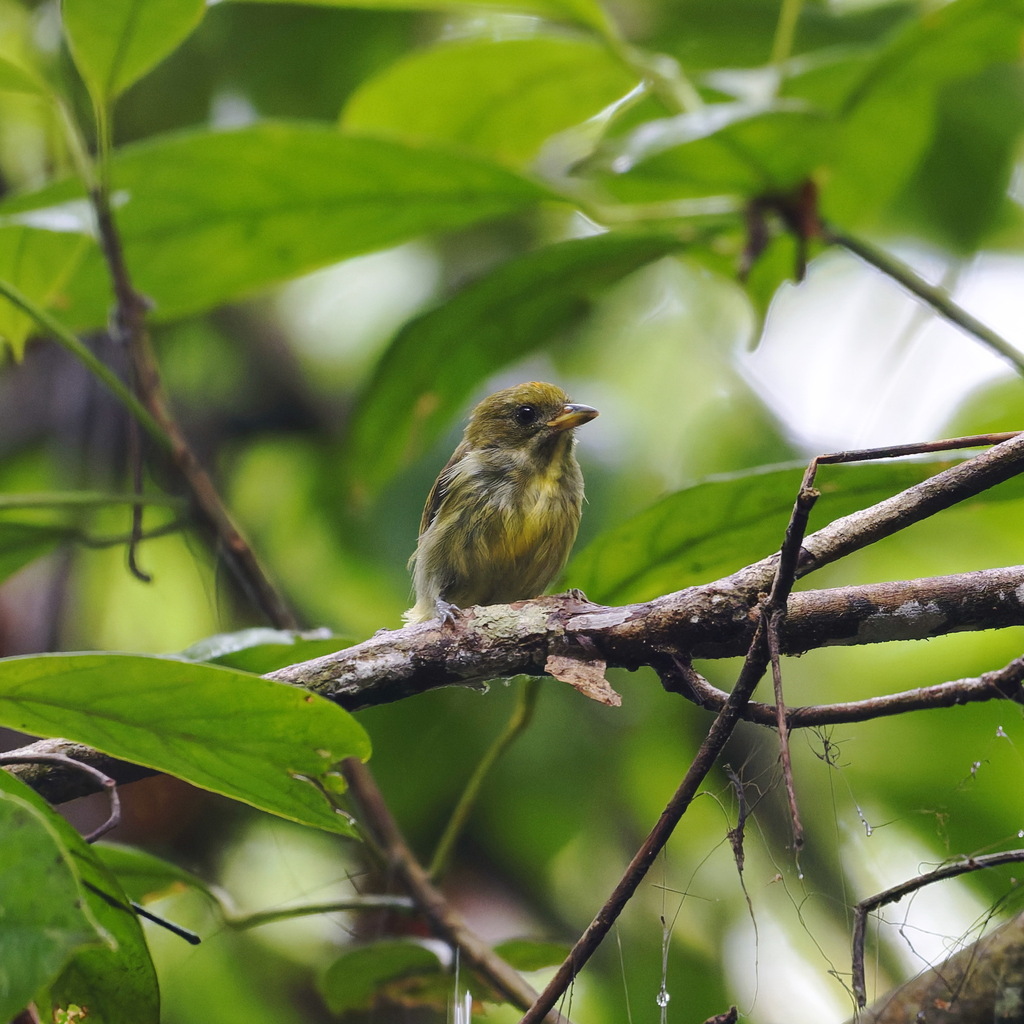
Yellow-breasted Flowerpecker
Photo © Лариса Артемьева
Photo © Лариса Артемьева — CC0 1.0 — Source: iNaturalist #329717536Identification
The yellow-breasted flowerpecker is a small, vividly coloured bird that rewards close observation with striking plumage details. Both males and females display an olive green back contrasted by a bright neon orange patch on the crown and a yellow underbelly marked with black streaks on the sides. The species has a distinctive red iris, white throat brushes, and grey legs. Males range from 7.5 to 11.8 inches in length, while females are slightly smaller at 7.8 to 7.9 inches. Their high-pitched chirps are distinctive, making them identifiable by sound as well as sight.
Range & habitat
The yellow-breasted flowerpecker is found across a broad range spanning southern Asia, including Brunei, Indonesia, Malaysia, Myanmar, and Thailand. Four recognized subspecies occupy different regions: P. m. septentrionalis in the north and central Malay Peninsula; P. m. oblitus in the south Malay Peninsula; P. m. maculatus across Sumatra, Nias, Belitung, and Borneo; and P. m. natunensis in the Natuna Islands. The species is now considered extinct in Singapore.
These birds are non-migratory residents of subtropical and tropical moist lowland forests as well as montane forests. They typically forage in the middle and upper levels of lowland and foothill forests and forest edges, remaining year-round in their preferred terrestrial habitats.
Behaviour & diet
The yellow-breasted flowerpecker is primarily frugivorous and nectarivorous, feeding on fruit, nectar, and pollen from a variety of forest plants including Benjamin fig, Ficus villosa, Melastoma malabathricum, Straits rhododendron, and hairy Clidemia. Their specialized diet makes them dependent on flowering and fruiting cycles throughout their range.
Breeding typically occurs during summer months, varying by region. The species constructs distinctive nests from fern rhizomes and tree cotton, reinforced with spider webbing. These nests feature a characteristic triangular entrance hole pointing upwards and are concealed by overhanging leaves. Clutches contain two white eggs decorated with brown spots and blotches concentrated toward the end. Both parents nurture the chicks until fledging.
Best time & places to see it
Observers seeking yellow-breasted flowerpeckers should focus on lowland and foothill forests across their Southeast Asian range, particularly in the Malay Peninsula, Sumatra, and Borneo where populations remain stable. Summer months offer the best viewing opportunities, especially during the breeding season when birds are more active and vocal. Forest edges and the middle to upper canopy levels are productive areas for sighting these small, active birds as they move through flowering and fruiting trees.
Photography tips
The yellow-breasted flowerpecker's small size and preference for the upper canopy present challenges for photographers. The bird's neon orange crown and yellow underparts are striking subjects, but patience and a telephoto lens are essential for capturing quality images. Early morning light will best render the bright colours of the plumage. Listen for high-pitched calls to locate birds, then position yourself quietly near fruiting or flowering trees where flowerpeckers forage. Their non-migratory habits mean that productive feeding sites can be revisited reliably throughout the year.
Hat Noppharat Thara-Mu Ko Phi Phi National Park
Ao Nang, Thailand
+253 birds+9 mammals
Where limestone karsts rise dramatically from turquoise waters, Hat Noppharat Thara-Mu Ko Phi Phi National Park unfolds across a mosaic of beach, mangrove forest, and island…
VIEW NATIONAL PARKBako National Park
Kuching, Malaysia
+210 birds+17 mammals
Weathered sandstone cliffs rise dramatically from the South China Sea, their ochre faces sculpted by millennia of wind and tide into a landscape of extraordinary geological…
VIEW NATIONAL PARKKuching Wetlands National Park
Kuching, Malaysia
+103 birds+4 mammals
Where brackish waters meet mangrove stilts and freshwater swamps blend into coastal mudflats, one of Southeast Asia's most dynamic wetland ecosystems unfolds across Sarawak's northwestern coast.…
VIEW NATIONAL PARKTaman Negara National Park
Kampong Samas, Malaysia
+393 birds+48 mammals
Where ancient rainforest meets limestone peaks, one of Southeast Asia's oldest protected wilderness preserves sprawls across 4,343 square kilometers of primordial landscape. Dipterocarp giants tower overhead,…
VIEW NATIONAL PARKTaman Negara Bukit Lambir National Park
Miri, Malaysia
+153 birds+7 mammals
Rainforest cascades down sandstone ridges where crystal streams carve through ancient geology, creating a landscape of profound biological richness in Sarawak's interior. This 68-square-kilometre sanctuary protects…
VIEW NATIONAL PARKGunung Mulu National Park
Long Seridan, Malaysia
+280 birds+39 mammals
Where granite monoliths pierce the rainforest canopy of Sarawak, an ancient limestone karst landscape reveals one of Southeast Asia's most biodiverse strongholds. Soaring peaks cloaked in…
VIEW NATIONAL PARKKerinci Seblat National Park
Kerinci, Indonesia
+228 birds+16 mammals
Across nearly 67,000 square kilometres of Sumatra's spine, a mountainous realm of equatorial rainforest rises from steaming lowlands to volcanic peaks shrouded in cloud. Kerinci Seblat…
VIEW NATIONAL PARKGunung Palung National Park
Kayong Utara, Indonesia
+38 birds+1 mammals
Rainforest swells across the steep terrain of West Kalimantan, where ancient volcanic ridges rise abruptly from lowland swamps and weathered plateaus. Gunung Palung National Park encompasses…
VIEW NATIONAL PARKWay Kambas National Park
Lampung Timur, Indonesia
+237 birds+20 mammals
Across the low swamplands of eastern Lampung, where freshwater wetlands merge into tidal mangrove forests along the Sunda Strait, sprawls one of Sumatra's most vital sanctuaries.…
VIEW NATIONAL PARKNo community photos yet. Log in to add the first one.
No community observations of this species yet.