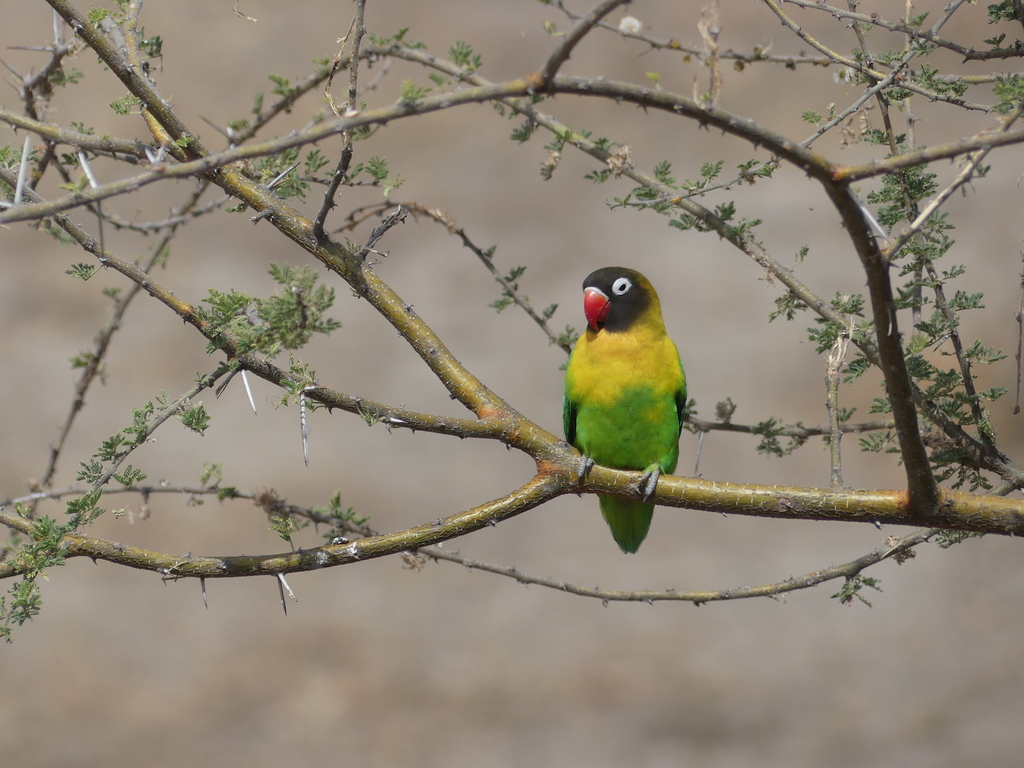
Yellow-collared Lovebird
Photo © Valentin Moser
Photo © Valentin Moser — CC BY 4.0 — Source: iNaturalist photo #454486584Identification
The yellow-collared lovebird is a small parrot, measuring approximately 14.5 cm (5.5 inches) in length. Its most distinctive feature is a striking black head contrasted with a bright red beak, white eye-rings, and a continuous band of yellow across the breast that extends into a bright yellow collar and nape. The bird's upperparts are dark green, while its underparts are a lighter shade of green. Males and females are identical in appearance, making field identification straightforward but sexing individuals challenging without close examination.
Range & Habitat
The yellow-collared lovebird is native to the Arusha Region of Tanzania, where it represents a monotypic species found nowhere else in the wild. The species has been introduced to Burundi and Kenya, where established populations now occur. Escaped cage birds have been observed in Puerto Rico and Arizona, though no breeding populations have become established in these locations. A notable feral population exists in France, originating from aviary escapes and hybridized with other lovebird species.
Behaviour & Diet
Yellow-collared lovebirds are colonial breeders that build nests from strips of twigs and bark, typically within tree cavities. During courtship, males perform distinctive displays, moving their heads up and down and sliding excitedly toward females. Females lay clutches of four to five white eggs and incubate them for approximately 23 days; chicks fledge around 42 days after hatching. These birds are known to be less aggressive than some larger lovebird species and can be housed with other birds, though hybridization risks exist when kept with closely related species.
Best Time & Places to See It
To observe yellow-collared lovebirds in their native habitat, visit the Arusha Region of Tanzania. The species has also been introduced successfully to parts of Burundi and Kenya, where sightings may be possible. For travellers unable to visit East Africa, established feral populations exist near Napier, New Zealand, and in France, though these birds may be hybrids or color mutations not representative of wild birds.
Photography Tips
The yellow-collared lovebird's striking contrast of black head, red beak, white eye-rings, and yellow markings makes it photogenic in good light. The bird's small size—just 5.5 inches—requires patience and telephoto lenses to capture detail. Look for individuals in tree cavities during breeding season or in colonial roosting sites. The bright yellow, green, red, and white coloration photographs well in natural morning light, which brings out the subtle differences between the darker upperparts and lighter underparts. Early mornings are typically best for activity and photography opportunities.
Serengeti National Park
Tanzania
+558 birds+57 mammals
Across Tanzania's northern plateau, where volcanic soils meet acacia woodland and open grassland, unfolds one of Earth's most dynamic ecosystems. The Serengeti National Park sprawls across…
VIEW NATIONAL PARKArusha National Park
Tanzania
+555 birds+16 mammals
Where the slopes of Mount Mawenzi rise above the Arusha region, a compact yet ecologically rich national park unfolds across montane forest, moorland, and alpine zones.…
VIEW NATIONAL PARKTarangire National Park
Tanzania
+527 birds+50 mammals
Acacia woodland and grassland sweep across the Manyara Region where the Tarangire River carves through low hills and volcanic soils, creating one of East Africa's most…
VIEW NATIONAL PARKNgorongoro Conservation Area
Tanzania
+626 birds+55 mammals
Volcanic calderas and open grassland dominate this high plateau in northern Tanzania, where the landscape rises above 2,000 metres and ancient geological forces have shaped both…
VIEW WILDLIFE MANAGEMENT AREAParque Nacional Cerro de la Estrella
Mexico
+126 birds+4 mammals
Where volcanic peaks rise sharply above Mexico City's sprawling metropolis, Parque Nacional Cerro de la Estrella offers a rare glimpse of high-altitude terrain within one of…
VIEW NATIONAL PARKLake Nakuru National Park
Nakuru West, Kenya
+494 birds+32 mammals
Alkaline waters ringed by acacia woodland and grassland create one of East Africa's most distinctive wetland ecosystems, where the interplay of geology and climate sustains a…
VIEW NATIONAL PARKNo community photos yet. Log in to add the first one.
No community observations of this species yet.