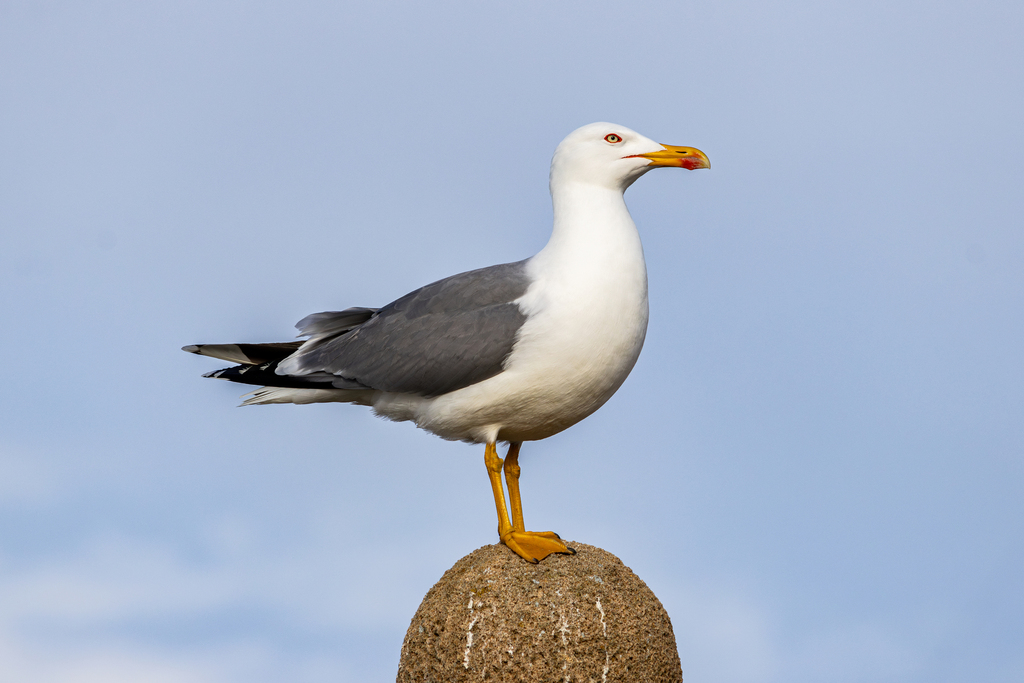
Yellow-legged Gull
Photo © Diego González Dopico
Photo © Diego González Dopico — CC BY 4.0 — Source: iNaturalist photo #470971328Identification
The yellow-legged gull is a large gull ranging from 52 to 68 cm in length with a wingspan of 120 to 155 cm. Adults are externally similar to herring gulls but are distinguished by their bright yellow legs, a key field mark. They have a grey back that is slightly darker than herring gulls but lighter than lesser black-backed gulls, and are much whiter-headed in autumn. Adults display more extensively black wing tips with few white spots, a red spot on the bill, and a characteristic red eye-ring (unlike the herring gull's dark yellow ring). Their call is a loud, deep, and nasal laugh.
First-year birds present a different appearance, with a paler head, rump, and underparts than young herring gulls, more closely resembling first-year great black-backed gulls. They have dark bills and eyes with pinkish-grey legs and a well-defined black tail band. By their second winter, birds appear almost adult-like except for patterned feathers on the wing coverts, black bill tips, dark eyes, and light yellow flesh-coloured legs.
Range & Habitat
The yellow-legged gull is found across Europe, the Middle East, and North Africa, with its breeding range centred on the Mediterranean Sea. It is common throughout North Africa in Morocco, Algeria, and Tunisia, with recent breeding occurring in Libya and Egypt. In the Middle East, it breeds in Israel, Palestine, Syria, Cyprus, and Turkey, while European populations are established along all Mediterranean coasts and Atlantic islands north to Brittany and west to the Azores, as well as on the western Black Sea coast.
In recent decades, the species has expanded northward into central and western Europe, with occasional breeding attempts in southern England since 1995. Many birds remain year-round in their breeding areas, while others migrate to mild western European regions or travel as far south as Senegal, Gambia, and the Red Sea. Late summer sees extensive northward post-breeding dispersal, with particularly high numbers in southern England from July to October.
Behaviour & Diet
Yellow-legged gulls are opportunistic omnivores, scavenging at rubbish tips and elsewhere while also hunting suitable prey in fields and coastal areas. They readily rob smaller gulls and seabirds of their catches. Urban populations are particularly adaptable; during Italy's 2020 lockdown, reduced food waste prompted Roman yellow-legged gulls to hunt larger prey including rats and rock doves. Atlantic populations in Gibraltar have been observed picking and eating fruit from olive trees in flight, while populations in the Bay of Biscay obtain most fish by foraging in harbours and feeding themselves rather than relying on fishing vessel discards.
Best Time & Places to See It
Yellow-legged gulls are best encountered throughout the Mediterranean basin and along Atlantic coasts from the Azores to Brittany. The breeding season, from March to May, offers opportunities to observe them at nesting colonies on sea cliffs, buildings, and increasingly in urban settings. For northern Europe visitors, late summer through October provides excellent viewing opportunities, particularly in southern England where post-breeding dispersal brings high numbers from July onwards.
Photography Tips
The bright yellow legs provide an excellent field mark for identification photography. Capture the red eye-ring and red bill spot in close-ups of adults, and note the contrast between the grey back and white head, especially in autumn plumage. First-year and second-year birds offer different photographic subjects, so document the progression of plumage changes. At breeding colonies on cliffs and buildings, photograph nesting behaviour and egg defence, while harbour and urban settings provide opportunities to capture opportunistic feeding behaviour. Their vocal nature means sound recording can complement visual documentation of their distinctive nasal calls.
Parque del Centenario
Abruzzo, Lazio and Molise National Park
Al Hoceima National Park
Alpilles Regional Nature Park
Alta Murgia National Park
Appennino Lucano Val d’Agri Lagonegrese National Park
Appennino Tosco-Emiliano National Park
Asinara National Park
Avesnois Regional Nature Park
Nothing matches these filters.
No community photos yet. Log in to add the first one.