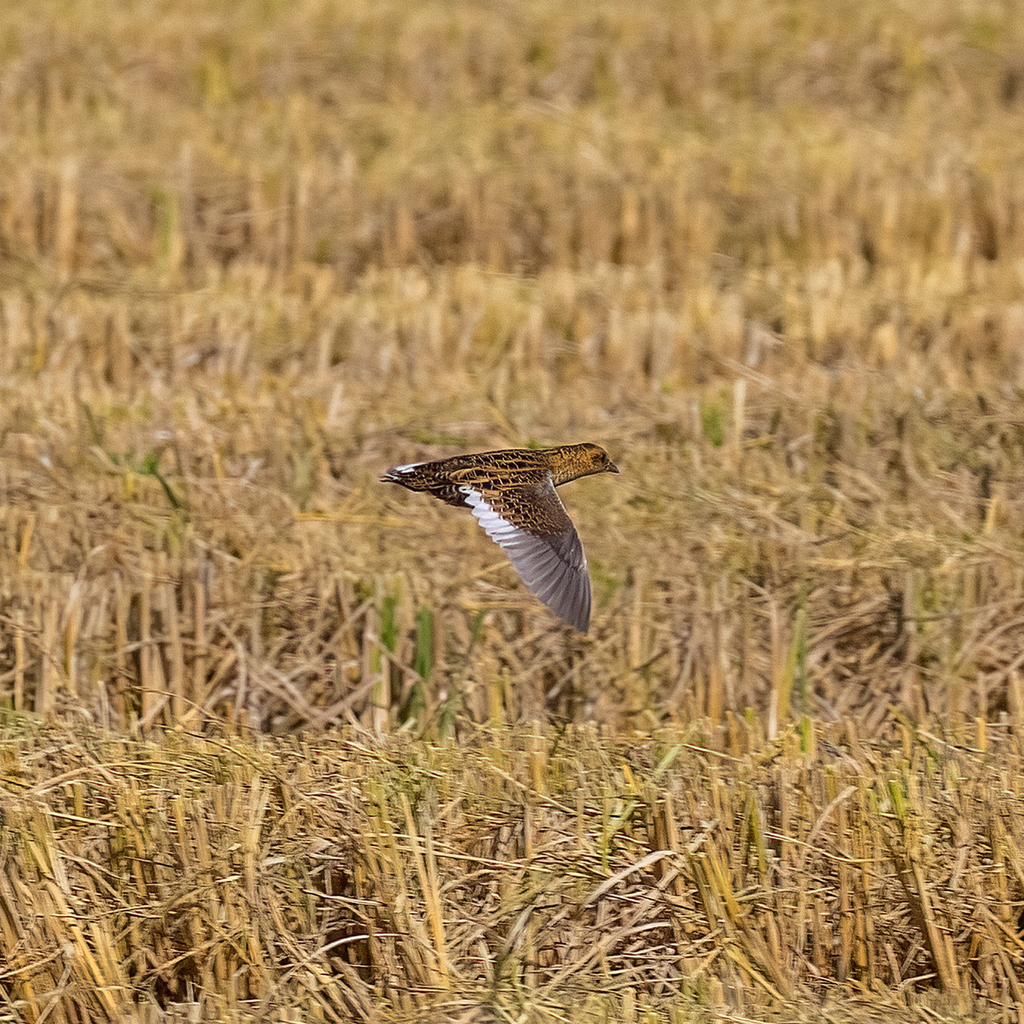
Yellow Rail
Photo © Dan Vickers
Photo © Dan Vickers — CC BY 4.0 — Source: iNaturalist #256401662The yellow rail (Coturnicops noveboracensis) is a small secretive marsh bird of the family Rallidae that is found in North America. == Taxonomy == The yellow rail was formally described in 1789 by the German naturalist Johann Friedrich Gmelin in his revised and expanded edition of Carl Linnaeus's Systema Naturae. He placed it with all the coots in the genus Fulica and coined the binomial name Fulica noveboracensis. Gmelin based his description on the "yellow breasted gallinule" that had been briefly described in 1785 by the Welsh naturalist Thomas Pennant in his book Arctic Zoology. The yellow rail is now placed in the genus Coturnicops that was erected in 1855 by the English zoologist George Robert Gray. The genus name combines coturnix, the Latin word for a "quail", with ōps, an Ancient Greek word meaning "appearance". The specific epithet noveboracensis is Latin for New York (novus means "new" and Eboracum is York, England). Two subspecies are recognised: C. n. noveboracensis (Gmelin, JF, 1789) – Canada and north USA † C. n. goldmani (Nelson, 1904) – central Mexico (extinct) == Description == Adults have brown upperparts streaked with black, a yellowish-brown breast, a light belly and barred flanks. The short thick…
Indiana Dunes National Park
Porter, United States
+304 birds+15 mammals
Along the southern shore of Lake Michigan, where glacial geology meets temperate woodland and open water, sprawls a landscape of extraordinary ecological complexity. The dunes themselves—massive…
VIEW NATIONAL PARKWapusk National Park
Unorganized Division No. 23, Canada
+140 birds+6 mammals
Across the subarctic lowlands of northern Manitoba, where permafrost underlies a mosaic of stunted boreal forest, open muskeg, and coastal tundra, Wapusk National Park sprawls across…
VIEW NATIONAL PARKWood Buffalo National Park
Improvement District No. 24, Canada
+187 birds+10 mammals
Across nearly 75,000 square kilometres of boreal forest, wetland and grassland in northern Alberta, the landscape unfolds in a mosaic of spruce and pine woodland interspersed…
VIEW NATIONAL PARKPoint Pelee National Park
Leamington, Canada
+296 birds+14 mammals
Where Lake Erie's shallow waters meet the Ontario shoreline, a slender sandy peninsula juts into the Great Lakes like a natural funnel for migrating wildlife. This…
VIEW NATIONAL PARKChincoteague National Wildlife Refuge
Chincoteague, United States
+362 birds+16 mammals
Across the barrier islands and salt marshes of Virginia's Eastern Shore, where Atlantic tides sculpt an intricate mosaic of sandy spits and tidal flats, lies one…
VIEW WILDLIFE SANCTUARYKlamath Marsh National Wildlife Refuge
Klamath County, United States
+219 birds+7 mammals
Where the volcanic plateau of south-central Oregon slopes into a broad, shallow basin lies one of the Pacific Northwest's most underappreciated wetland sanctuaries. Klamath Marsh National…
VIEW WILDLIFE SANCTUARYSt. Marks National Wildlife Refuge
Saint Marks, United States
+324 birds+16 mammals
Where the Apalachee Bay begins to define the Florida coastline, salt marshes and freshwater impoundments merge into one of the southeastern United States' most productive wildlife…
VIEW WILDLIFE SANCTUARYNo community photos yet. Log in to add the first one.
No community observations of this species yet.