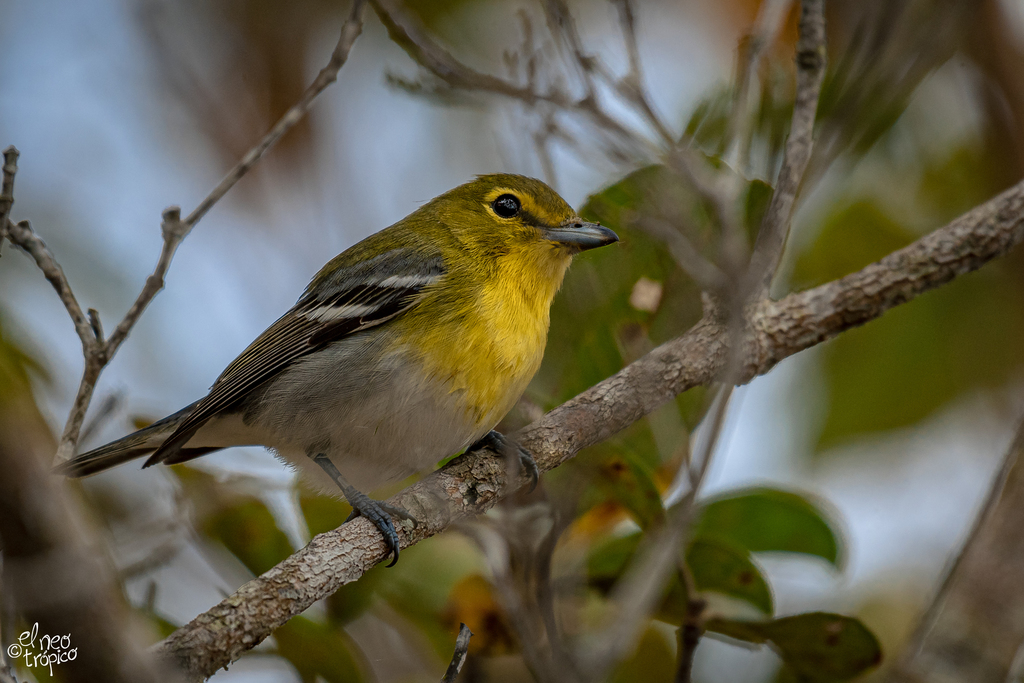
Yellow-throated Vireo
Photo © Daniel Pineda Vera
Photo © Daniel Pineda Vera — CC BY 4.0 — Source: iNaturalist photo #110195027Identification
The Yellow-throated Vireo is a small songbird measuring 5.1–5.9 inches (13–15 cm) in length with a wingspan of 9.1 inches (23 cm). Adults are distinctive and relatively easy to identify in the field. The head and upperparts are olive-green, contrasting with a bright yellow throat and white belly. The most striking feature is the yellow "spectacles"—bold eye-rings that frame dark eyes and give the bird a characteristic alert expression. The tail and wings are dark with white wing bars, and the bird has thick blue-grey legs and a notably stout, heavy bill typical of vireos. Both sexes appear similar.
Range & Habitat
Yellow-throated Vireos breed in open deciduous woodlands across southern Canada and the eastern United States. They are migratory birds that abandon their breeding grounds in fall, traveling to winter in the deep southern United States, Mexico, the Caribbean, and Central America. The species is an extremely rare vagrant to western Europe, with only a handful of documented sightings in places such as Cornwall, Great Britain, and Heligoland, Germany.
Behaviour & Diet
These vireos forage actively for insects high in the canopy of tall trees, gleaning food from foliage and branches as they move through the treetops. Their diet is supplemented with berries, particularly important before migration and during winter months when insects are scarce. They have been observed feeding on gumbo-limbo fruit (Bursera simaruba). Yellow-throated Vireos construct distinctive thick, cup-shaped nests that they attach securely to a fork in a tree branch, providing a sturdy foundation for their eggs and young.
Best Time & Places to See It
During breeding season, search for Yellow-throated Vireos in open deciduous forests of eastern North America from southern Canada southward. Look in the upper canopy where they forage for insects. Migration periods offer opportunities to see them in a wider range of habitats as they move between breeding and wintering grounds. Winter observers should focus on the deep southern United States, Mexico, the Caribbean, and Central America where these birds spend the non-breeding season.
Photography Tips
The bright yellow throat and spectacles make this vireo visually striking, but patience is essential as they spend most of their time high in trees foraging actively. Use a telephoto lens to capture details from a distance without disturbing the bird. Early morning light accentuates the yellow markings and contrasts beautifully with the olive and white plumage. Photograph against clear sky backgrounds to highlight the distinctive yellow eye-rings. The bird's relatively deliberate, methodical foraging movements may provide brief windows for sharp images when it pauses to investigate prey.
Acadia National Park
Algonquin Provincial Park
Alligator River National Wildlife Refuge
Arenal Volcano National Park
Arrecifes de Cozumel National Park
Barbilla National Park
Barra del Colorado National Wildlife Refuge
Baru Volcano National Park
Big Bend National Park
Nothing matches these filters.
No community photos yet. Log in to add the first one.
No community observations of this species yet.