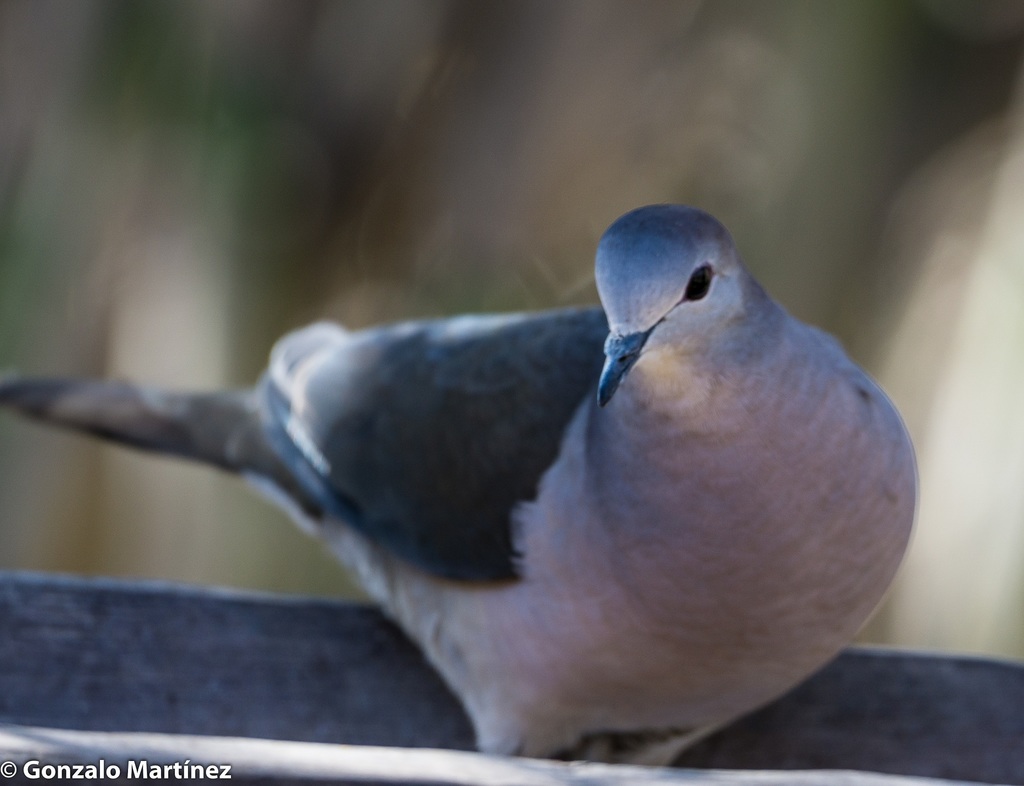
Yungas Dove
Photo © Gonzalo Martinez
Photo © Gonzalo Martinez — CC BY 4.0 — Source: iNaturalist photo #146677970The Yungas dove (Leptotila megalura), also known as the white-faced dove or large-tailed dove, is a species of bird in the family Columbidae. It is found in Argentina and Bolivia. == Taxonomy and systematics == The Yungas dove is monotypic. However, the southern population has sometimes been suggested as a distinct subspecies. The Yungas dove and the grey-fronted dove (L. rufaxilla) are sister species. == Description == The Yungas dove is 29 to 32 cm (11 to 13 in) long. The adult's forehead is grayish and its crown bluish gray. The eye is very dark and is surrounded by white feathers; the rest of the face is buff or pinkish buff. Its upperparts and tail are a dark ruddy brown with a purple gloss on the hindneck and upper mantle. Its breast and the sides of the neck are grayish pink lightening to white on the belly. The adult sexes are similar; the juvenile is duller and its wing coverts appear scaly. == Distribution and habitat == The Yungas dove is found in the Bolivian and Southern Andean Yungas on the east slope of the Andes of Bolivia and northwestern Argentina. It inhabits humid subtropical and tropical woodlands including secondary…
El Rey National Park
Municipio de Las Lajitas, Argentina
+317 birds+4 mammals
Where the eastern slopes of the Andes descend into northwestern Argentina's subtropical transition zone, El Rey National Park unfolds across 841 square kilometers of dramatically varied…
VIEW NATIONAL PARKCalilegua National Park
Municipio de Calilegua, Argentina
+288 birds+8 mammals
Where the eastern Andean slopes plunge into northwestern Argentina's humid subtropics, nearly 2,645 square kilometers of steep terrain and luxuriant forest compose one of South America's…
VIEW NATIONAL PARKBaritú National Park
Argentina
+81 birds+2 mammals
Where the eastern slopes of the Serranías del Hornocal descend into cloud forest and subtropical ravines, Baritú National Park protects one of northwestern Argentina's most biodiverse…
VIEW NATIONAL PARKNo community photos yet. Log in to add the first one.
No community observations of this species yet.