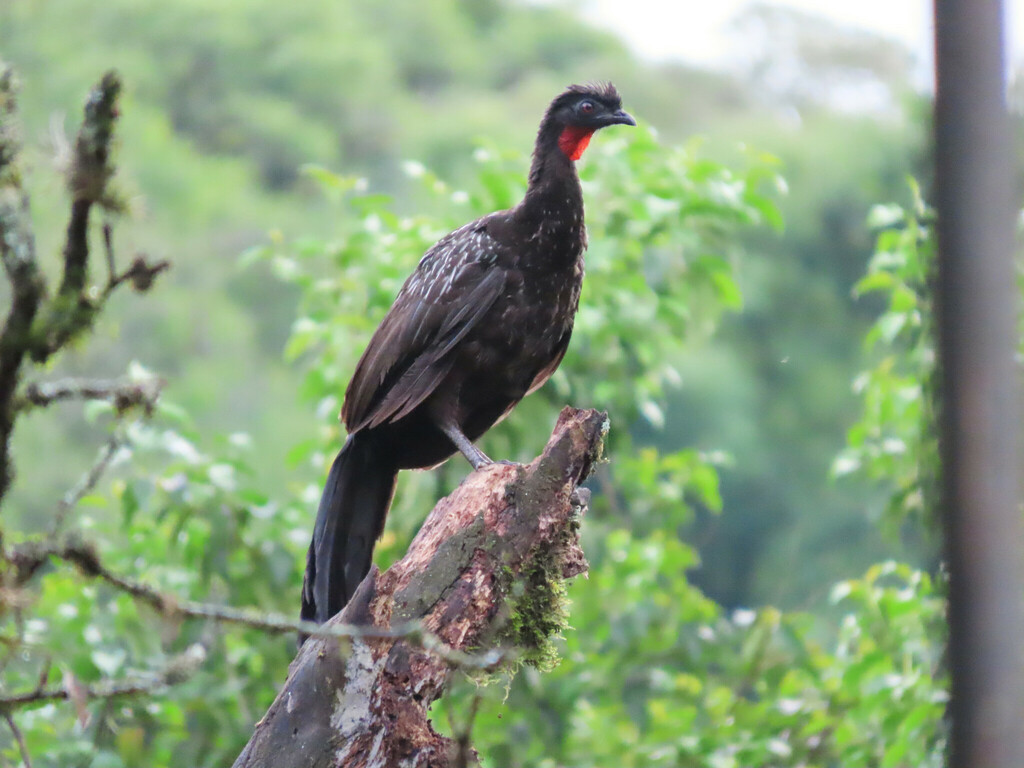
Yungas Guan
Photo © Nicolas Olejnik
Photo © Nicolas Olejnik — CC BY 4.0 — Source: iNaturalist photo #456149304Identification
The Yungas guan is a large, distinctive member of the guan family, noticeably bigger than its close relative, the dusky-legged guan. Both males and females are identical in plumage. The species displays a striking contrast between its chestnut upper parts and dull reddish-brown underside, with the belly marked by distinctive brown to orange horizontal barring. The tail is dark brown, while the head and back of the neck are jet black. A key identifying feature is the prominent white edging on the feathers of the neck, back, and chest—significantly more conspicuous than in the dusky-legged guan. The bird's bare facial skin is slate gray, and its wattle is bright red, adding a splash of colour to its otherwise earth-toned appearance.
Yungas guans are substantial birds, with recorded lengths ranging from 77 to 89 centimetres (30 to 35 inches). Their size alone distinguishes them readily from the smaller dusky-legged guan, making them unmistakable in their montane range.
Range & Habitat
The Yungas guan inhabits the eastern slopes of the Andes, restricted to the Southern Andean Yungas region of southwestern Bolivia and northwestern Argentina. This species occupies a specialised ecological niche within subtropical evergreen forest, found from elevations below 1,000 metres up to approximately 1,900 metres, where they navigate the dense canopy and understory of this biodiverse ecosystem.
Behaviour & Diet
Yungas guans are primarily frugivorous and folivorous, feeding on fruit and leaves in proportions that vary throughout their range depending on seasonal availability. While generally sedentary birds, they are thought to exhibit elevational movements across different seasons, likely following food resources as fruiting patterns change throughout the year. The species' breeding season occurs mainly between October and December, corresponding to the spring and early summer months in the Southern Hemisphere.
Best Time & Places to See It
The Yungas guan occurs only in a limited geographic range within the Andean foothills of southwestern Bolivia and northwestern Argentina. The subtropical evergreen forests between 1,000 and 1,900 metres elevation in these regions represent the best locations to encounter this species. October to December offers the advantage of observing breeding activity, though the bird's year-round presence and sedentary nature means it can be found throughout the year in suitable habitat.
Photography Tips
Photographing Yungas guans in their montane forest habitat presents the typical challenges of dense, dim understory lighting. The species' dark plumage—particularly its black head and neck—requires careful exposure metering to retain detail. Position yourself where morning or late afternoon light can filter through the canopy to highlight the distinctive white feather edgings and red facial wattle. The bird's substantial size and bold field marks make it a rewarding subject once located, and its relatively sedentary nature affords decent opportunities for patient photographers willing to spend time in appropriate forest habitat.
El Rey National Park
Municipio de Las Lajitas, Argentina
+317 birds+4 mammals
Where the eastern slopes of the Andes descend into northwestern Argentina's subtropical transition zone, El Rey National Park unfolds across 841 square kilometers of dramatically varied…
VIEW NATIONAL PARKCalilegua National Park
Municipio de Calilegua, Argentina
+288 birds+8 mammals
Where the eastern Andean slopes plunge into northwestern Argentina's humid subtropics, nearly 2,645 square kilometers of steep terrain and luxuriant forest compose one of South America's…
VIEW NATIONAL PARKBaritú National Park
Argentina
+81 birds+2 mammals
Where the eastern slopes of the Serranías del Hornocal descend into cloud forest and subtropical ravines, Baritú National Park protects one of northwestern Argentina's most biodiverse…
VIEW NATIONAL PARKNo community photos yet. Log in to add the first one.
No community observations of this species yet.