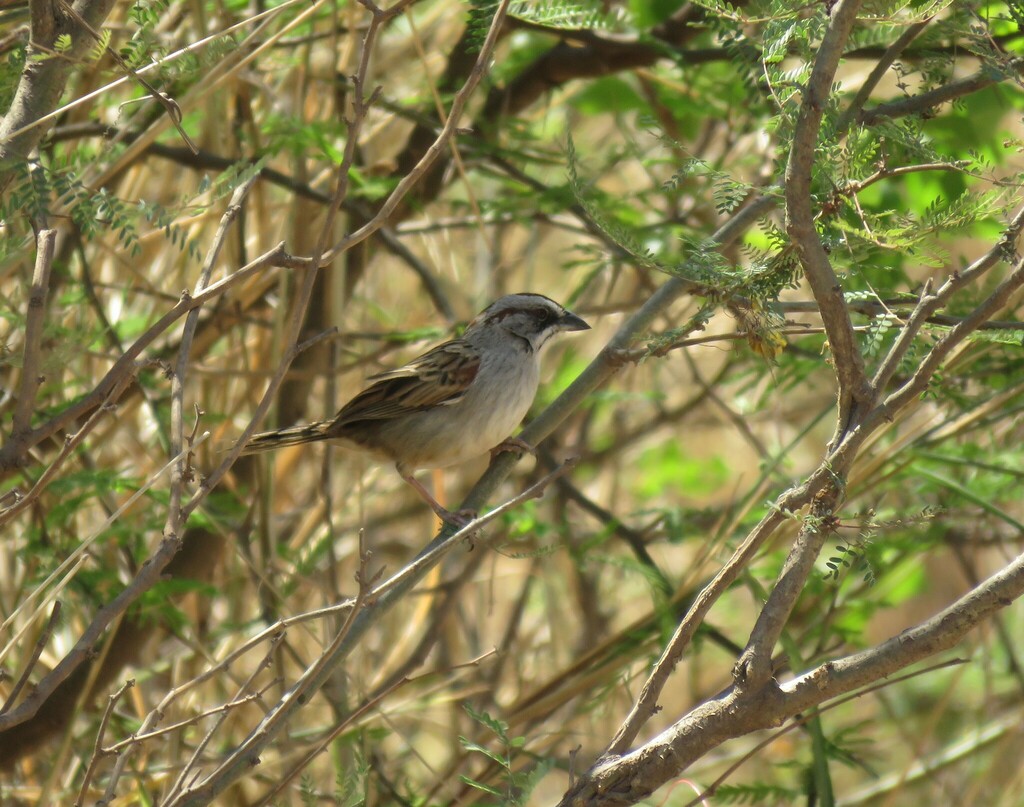
Yungas Sparrow
Photo © Nicolas Olejnik
Photo © Nicolas Olejnik — CC BY 4.0 — Source: iNaturalist #142160724The Yungas sparrow (Rhynchospiza dabbenei) is a species of bird in the family Passerellidae endemic to the Southern Andean Yungas of southeastern Bolivia and northwestern Argentina. It was formerly considered a subspecies of what was then called the stripe-capped sparrow (R. strigiceps). == Taxonomy and systematics == The Yungas sparrow was previously classified as a subspecies of Rhynchospiza strigiceps, which was at that time called the stripe-capped sparrow. Before that, Rhynchospiza had been subsumed into genus Aimophila. A 2009 publication restored the genus Rhynchospiza and a 2019 publication split R. dabbenei from R. strigiceps. Based on the 2019 publication, in June 2020 the South American Classification Committee (SACC) of the American Ornithological Society (AOS) accepted R. dabbenei as the Yungas sparrow and renamed R. strigiceps Chaco sparrow. The International Ornithological Congress (IOC) followed suit in January 2021. == Description == The Yungas sparrow is larger than its former "parent" R. strigiceps. Its upper parts are brown with darker streaks and varying amounts of rust and gray. It is pale gray below blending to buff on the flanks and in the vent area. The head is gray with chestnut crown and postocular stripes, black lores, and a white moustachial stripe. ==…
El Rey National Park
Municipio de Las Lajitas, Argentina
+317 birds+4 mammals
Where the eastern slopes of the Andes descend into northwestern Argentina's subtropical transition zone, El Rey National Park unfolds across 841 square kilometers of dramatically varied…
VIEW NATIONAL PARKCalilegua National Park
Municipio de Calilegua, Argentina
+288 birds+8 mammals
Where the eastern Andean slopes plunge into northwestern Argentina's humid subtropics, nearly 2,645 square kilometers of steep terrain and luxuriant forest compose one of South America's…
VIEW NATIONAL PARKNo community photos yet. Log in to add the first one.
No community observations of this species yet.