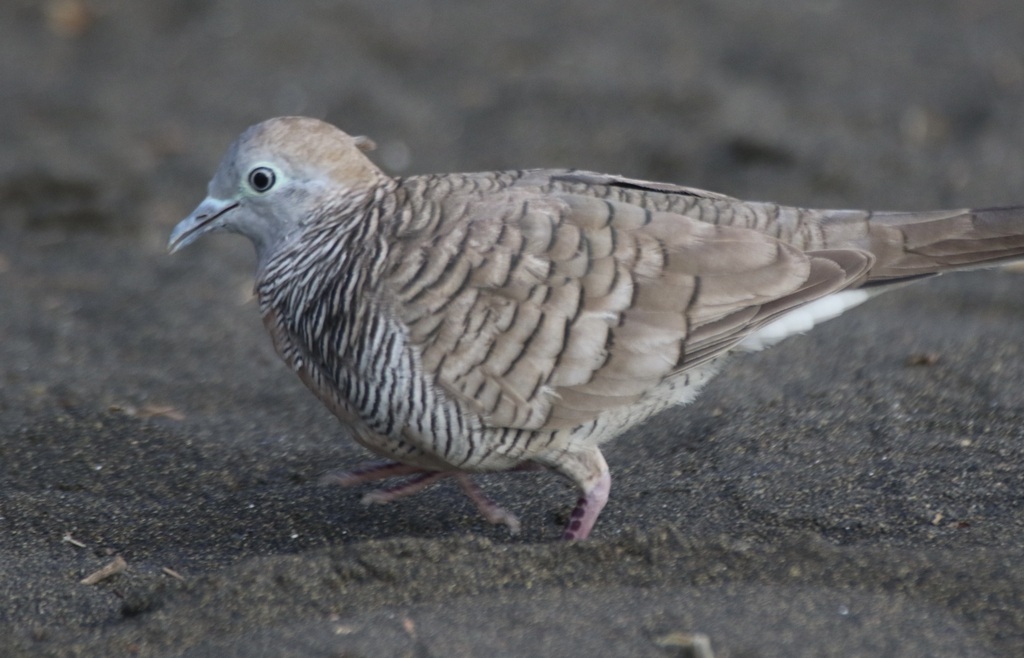
Zebra Dove
Photo © Cricket Raspet
Photo © Cricket Raspet — CC BY 4.0 — Source: iNaturalist photo #682969681Identification
The zebra dove is a small, slender dove measuring 20–23 centimetres in length with a wingspan of 24–26 cm. Its most distinctive feature is the striking black-and-white barring on its predominantly brownish-grey upperparts, which gives the species its common name. The underparts are pinkish with black bars adorning the sides of the neck, breast, and belly. The face is blue-grey with bare blue skin around the eyes, and white tips on the tail feathers provide a useful identifying mark in flight. Juveniles are duller and paler than adults and may show brown feathers, making them slightly trickier to identify in the field.
Range & Habitat
Native to Southeast Asia, the zebra dove's natural range extends from southern Thailand, Tenasserim, Peninsular Malaysia, and Singapore through the Indonesian islands of Sumatra and Java, with potential populations in Borneo, Bali, Lombok, Sumbawa, and the Philippines. However, due to escapes and deliberate releases from the cagebird trade, feral populations now occur across a much wider area including Laos, Sulawesi, Hawaii, French Polynesia, the Seychelles, Mauritius, and several other island locations.
The species favours scrub, farmland, and open lowland country, and has readily adapted to human-modified landscapes, becoming common in parks and gardens throughout its range. In some locations such as Hawaii and the Seychelles, zebra doves rank among the most abundant birds present, though trapping for the cage-bird industry has made them rare in parts of Indonesia.
Behaviour & Diet
Zebra doves are renowned for their soft, pleasant, staccato cooing calls—so prized in their native range that cooing competitions are held to find the bird with the finest voice. Unlike most other doves, they are solitary or paired foragers rather than gregarious, moving about with a distinctive rodent-like scurrying motion as they search for food on bare ground, short grass, and roads. Their subtle plumage provides excellent camouflage in these open habitats.
The diet consists primarily of small grass and weed seeds, supplemented with insects and other small invertebrates. During the native breeding season from September to June, males perform courtship displays featuring bowing, cooing, and tail-raising and spreading. Pairs build simple platform nests of leaves and grass blades in bushes, trees, or occasionally on the ground or window ledges. One or two white eggs are incubated by both parents for 13–18 days, and young fledge within two weeks, achieving strong flight within three weeks.
Best Time & Places to See It
In its native Southeast Asian range, the zebra dove is most active during the breeding season from September to June. The species is commonly encountered in open country, farmland, parks, and gardens throughout lowland areas. For the best viewing experience, focus on parks and gardens in Thailand, Malaysia, Indonesia, and the Philippines, where the birds are abundant and relatively approachable. In introduced populations such as those in Hawaii and the Seychelles, zebra doves are among the most abundant birds and can be found year-round in suitable open habitat.
Photography Tips
The zebra dove's small size and ground-feeding habits offer unique photographic opportunities. Position yourself near open, bare ground or short grass where birds forage in early morning or late afternoon light. Their cryptic brown and grey plumage blends remarkably well with dusty or stony ground, so scan carefully and watch for movement rather than relying on colour to spot them. The black-and-white barring on the upperparts and the contrasting blue-grey face make excellent compositional elements when captured in side profile.
Since zebra doves often forage alone or in pairs rather than flocks, you may have better success approaching individual birds slowly and patiently. Their characteristic poses—bowing displays during breeding season and their distinctive scurrying gait—provide dynamic shooting opportunities. The white tail tips are particularly striking in flight, so consider attempting shots as birds take off or land in trees and bushes.
4-Day Short Vacation to Uganda – Gorilla Trekking Bwindi
Hat Noppharat Thara-Mu Ko Phi Phi National Park
Ao Nang, Thailand
+253 birds+9 mammals
Where limestone karsts rise dramatically from turquoise waters, Hat Noppharat Thara-Mu Ko Phi Phi National Park unfolds across a mosaic of beach, mangrove forest, and island…
VIEW NATIONAL PARKKhao Yai National Park
Prachantakham District, Thailand
+377 birds+46 mammals
Evergreen dipterocarp forest blankets the rolling terrain of this national park in eastern Thailand, where limestone hills rise abruptly from the forest floor and seasonal streams…
VIEW NATIONAL PARKKhao Laem Ya-Mu Ko Samet National Park
Mueang Rayong District, Thailand
+159 birds+3 mammals
Where limestone hills meet the Gulf of Thailand, Khao Laem Ya–Mu Ko Samet National Park stitches together a mosaic of terrestrial and marine worlds that few…
VIEW NATIONAL PARKKhao Laem National Park
Sangkhla Buri District, Thailand
+197 birds
Where the Vajiralongkorn Reservoir sprawls across the forested valleys of Kanchanaburi's northern borderlands, Khao Laem National Park protects a landscape where limestone ridges rise dramatically from…
VIEW NATIONAL PARKHawaiʻi Volcanoes National Park
Hawaiʻi County, United States
+84 birds+2 mammals
Where volcanic slopes descend toward the Pacific across more than five thousand square kilometers, Hawaiʻi Volcanoes National Park presents one of Earth's most dynamic laboratories of…
VIEW NATIONAL PARKBako National Park
Kuching, Malaysia
+210 birds+17 mammals
Weathered sandstone cliffs rise dramatically from the South China Sea, their ochre faces sculpted by millennia of wind and tide into a landscape of extraordinary geological…
VIEW NATIONAL PARKKuching Wetlands National Park
Kuching, Malaysia
+103 birds+4 mammals
Where brackish waters meet mangrove stilts and freshwater swamps blend into coastal mudflats, one of Southeast Asia's most dynamic wetland ecosystems unfolds across Sarawak's northwestern coast.…
VIEW NATIONAL PARKTaman Negara National Park
Kampong Samas, Malaysia
+393 birds+48 mammals
Where ancient rainforest meets limestone peaks, one of Southeast Asia's oldest protected wilderness preserves sprawls across 4,343 square kilometers of primordial landscape. Dipterocarp giants tower overhead,…
VIEW NATIONAL PARKPenang National Park
Balik Pulau, Malaysia
+107 birds+2 mammals
Granite peaks rise abruptly from the Andaman Sea where tropical rainforest clings to steep slopes in one of Malaysia's oldest protected landscapes. Mangrove forests fringe the…
VIEW NATIONAL PARKTaman Negara Bukit Lambir National Park
Miri, Malaysia
+153 birds+7 mammals
Rainforest cascades down sandstone ridges where crystal streams carve through ancient geology, creating a landscape of profound biological richness in Sarawak's interior. This 68-square-kilometre sanctuary protects…
VIEW NATIONAL PARKGunung Mulu National Park
Long Seridan, Malaysia
+280 birds+39 mammals
Where granite monoliths pierce the rainforest canopy of Sarawak, an ancient limestone karst landscape reveals one of Southeast Asia's most biodiverse strongholds. Soaring peaks cloaked in…
VIEW NATIONAL PARKTaman Nasional Baluran
Situbondo, Indonesia
+189 birds+9 mammals
Across the northeastern tip of East Java, where monsoon winds sweep down from the Bali Strait, a landscape of contrasts unfolds within 374 square kilometres of…
VIEW NATIONAL PARKTaman Nasional Meru Betiri
Jember, Indonesia
+93 birds+1 mammals
Across East Java's southeastern coast, where the Indian Ocean meets a landscape of volcanic soils and monsoon-fed forests, sprawls a national park that epitomizes the ecological…
VIEW NATIONAL PARKWest Bali National Park
Gerokgak, Indonesia
+240 birds+8 mammals
Across West Bali's northwestern reaches, where the Indian Ocean meets volcanic slopes and limestone cliffs plunge toward turquoise shallows, sprawls a protected realm of roughly 325…
VIEW NATIONAL PARKBogani Nani Wartabone National Park
Bolaang Mongondow, Indonesia
+154 birds+4 mammals
Across North Sulawesi's rugged interior, where tectonic uplift has carved steep ridges and deep valleys through ancient volcanic terrain, Bogani Nani Wartabone National Park sprawls across…
VIEW NATIONAL PARKGunung Ciremai National Park
Majalengka, Indonesia
+116 birds+1 mammals
Volcanic slopes rise sharply from West Java's interior, where Gunung Ciremai's 3,078-metre summit dominates a landscape carved by geological upheaval and shaped by equatorial monsoon rainfall.…
VIEW NATIONAL PARKGunung Merbabu National Park
Magelang, Indonesia
+61 birds+2 mammals
Where volcanic slopes rise sharply from the plateau of Central Java, Gunung Merbabu National Park encompasses nearly 200 square kilometers of montane forest that transitions through…
VIEW NATIONAL PARKMount Merapi National Park
Hargobinangun, Indonesia
+150 birds+3 mammals
Where the volcanic slopes of central Java rise into mist and montane forest, Mount Merapi National Park guards one of Indonesia's most dynamic landscapes. Spanning roughly…
VIEW NATIONAL PARKLore Lindu National Park
Indonesia
+177 birds+4 mammals
Across the mountainous spine of Central Sulawesi spreads a wilderness of montane forest, rolling ridges, and deep valleys that rises from the island's volcanic bedrock to…
VIEW NATIONAL PARKWay Kambas National Park
Lampung Timur, Indonesia
+237 birds+20 mammals
Across the low swamplands of eastern Lampung, where freshwater wetlands merge into tidal mangrove forests along the Sunda Strait, sprawls one of Sumatra's most vital sanctuaries.…
VIEW NATIONAL PARKHaleakalā National Park
Maui County, United States
+66 birds+4 mammals
Ascending from sea level to over 10,000 feet across a mere thirty miles, Haleakalā National Park commands one of the Pacific's most dramatic elevation gradients, where…
VIEW NATIONAL PARKKīlauea Point National Wildlife Refuge
Kilauea, United States
+79 birds+1 mammals
At the northernmost tip of Kauai, where the Pacific trades collide with volcanic rock, Kīlauea Point National Wildlife Sanctuary crowns a dramatic headland overlooking one of…
VIEW WILDLIFE SANCTUARYNo community photos yet. Log in to add the first one.
No community observations of this species yet.