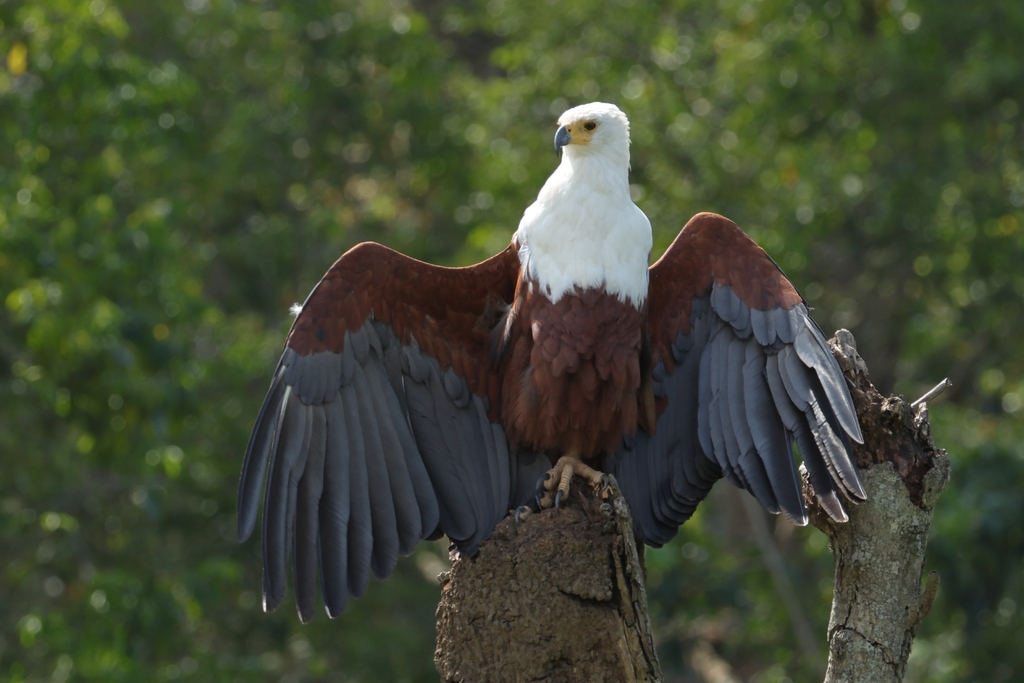
Pigargo Vocinglero
Photo © Barry Stewart
Photo © Barry Stewart — CC BY 4.0 — Source: iNaturalist photo #660124280Identification
The African fish eagle is a large and unmistakable bird of prey. Adults are highly distinctive, with snowy white heads, breasts, and tails contrasting sharply against dark brown bodies and powerful black wings. The face is bare and yellow, as is the hook-shaped beak, which is tipped in black—perfectly adapted for its carnivorous lifestyle. Dark brown eyes and rough-soled feet equipped with powerful talons complete the formidable predator's appearance. Females are noticeably larger than males, weighing 3.2–3.6 kg compared to males at 2.0–2.5 kg, with females achieving wingspans of up to 2.4 m. Juveniles appear entirely brown with paler eyes and gradually acquire the distinctive white head and tail plumage of adults. The species is superficially similar to the bald eagle but the two are not closely related and occur on different continents.
The African fish eagle's most iconic feature is its distinctive cry—a weee-ah, hyo-hyo or heee-ah, heeah-heeah call that many consider evocative of the spirit of Africa itself. Males produce shriller vocalizations than females.
Range & Habitat
This species is found throughout sub-Saharan Africa wherever large bodies of open water with abundant food supply occur. It is the national bird of Malawi, Namibia, Zambia, and Zimbabwe. African fish eagles remain quite common near freshwater lakes, reservoirs, and rivers, though they can occasionally be found near coastal areas at river mouths and lagoons. Key locations include the Orange River in South Africa and Namibia, the Okavango Delta in Botswana, Lake Malawi, Lake Victoria, and the Rift Valley lakes of Central Africa.
This is a generalist species requiring only open water with sufficient prey and good perching trees. It thrives in diverse habitats including grasslands, swamps, marshes, tropical rainforests, fynbos, and even desert-bordering coastlines such as those of Namibia. The species is notably absent from arid areas with little surface water.
Behaviour & Diet
The African fish eagle feeds primarily on fish, which it captures in a characteristic hunting technique: swooping down from a riverside or lakeside perch to snatch prey from the water with its large, clawed talons, then flying back to eat its catch. Like other sea eagles, it possesses specialized structures on its toes called spiricules that enable it to grip slippery fish. The eagle typically catches fish weighing 200 to 1,000 grams, though it can take fish up to 4,200 grams; if a catch proves too heavy to sustain flight, the bird will drop into the water and paddle to shore using its wings. Common prey includes mullets and catfish, though cichlids, tilapias, lungfish, characins, and eels are also taken. Remarkably, the eagle even preys upon African tigerfish, especially when hunting barn swallows in flight.
Beyond fish, the African fish eagle is opportunistic and regularly hunts waterbirds including ducks, coots, cormorants, grebes, darters, and young herons and egrets. Pairs are believed to mate for life and maintain two or more nests built from sticks in large trees, with some nests reaching 2.0 m across after years of reuse and renovation. Breeding occurs during the dry season when water levels are low. Females lay one to three white eggs with reddish speckles, with incubation lasting 42 to 45 days. Chicks fledge at 70 to 75 days old and remain dependent for up to three months before becoming nomadic. Survivors of the first year can live 12 to 24 years.
Best Time & Places to See It
The African fish eagle is still quite common throughout its range, making it a reliable species for dedicated birdwatchers and wildlife travelers. The best locations are near large bodies of open freshwater: Lake Malawi, the Okavango Delta, Lake Victoria, the Rift Valley lakes, and river systems such as the Orange River offer excellent viewing opportunities. The species occurs in substantial numbers around these major water bodies across Malawi, Tanzania, Mozambique, Botswana, South Africa, and Namibia.
Since African fish eagles breed during the dry season and require good perches overlooking water, they are most easily spotted from accessible vantage points along lakes and rivers during this period. Early morning hours are typically best for observing hunting activity, as eagles often perch conspicuously in large riverside or lakeside trees.
Photography Tips
The African fish eagle's striking white head and dark plumage provide excellent contrast for photography, particularly when perched against green vegetation or blue water. Early morning and late afternoon light will enhance the brilliant white of the head and tail. Position yourself with the sun behind you to avoid backlighting the white plumage, which can fool camera meters into underexposure.
For action shots, position yourself near a productive fishing location and wait for hunting activity. The eagle's characteristic hunting stoop and water-skimming approach offer dynamic photographic opportunities. The massive wingspan of females (up to 2.4 m) is best captured with the bird in flight against a clear sky or across water. Patience and a good telephoto lens of at least 400–600 mm will reward you with memorable images of this iconic African predator.
Serengeti National Park
Tanzania
+131 aves+30 mamíferos
Dawn breaks over an endless golden savanna where acacia-studded plains stretch to distant volcanic highlands, their slopes cloaked in montane […]
VER PARQUE NACIONALArusha National Park
Tanzania
+132 aves+30 mamíferos
Where the volcanic slopes of Mount Meru rise dramatically from Tanzania’s northern highlands, a landscape of extraordinary ecological diversity unfolds […]
VER PARQUE NACIONALRubondo Island National Park
Tanzania
+84 aves+14 mamíferos
Dawn breaks over Lake Victoria’s southwestern waters, revealing a primordial landscape where dense tropical forest cascades toward pristine shorelines. This […]
VER PARQUE NACIONALMapungubwe National Park
Musina Local Municipality, Botsuana
+132 aves+30 mamíferos
Where the Limpopo River carves a boundary between nations, ancient sandstone cliffs rise in sculptured isolation above riverine woodland and […]
VER PARQUE NACIONALChobe National Park
Botsuana
+122 aves+30 mamíferos
Where the Zambezi River cuts through northern Botswana, one of Africa’s greatest concentrations of large mammals gathers across flood plains, […]
VER PARQUE NACIONALKhaudum National Park
Botsuana
+57 aves+18 mamíferos
Where the Kalahari’s red dunes roll into dense mopane woodland and riverine thickets, a raw and unforgiving landscape rewards those […]
VER PARQUE NACIONALVirunga National Park
Uganda
+132 aves+30 mamíferos
Where the Rwenzori Mountains pierce the equatorial sky and volcanic slopes descend toward the Congo Basin, one of Africa’s most […]
VER PARQUE NACIONALMurchison Falls National Park
Uganda
+129 aves+30 mamíferos
Where the Victoria Nile surges through a narrow rocky chasm and plummets 43 metres in a thunderous cascade, Uganda’s oldest […]
VER PARQUE NACIONALLake Mburo National Park
Uganda
+124 aves+30 mamíferos
Dawn breaks across a mosaic of acacia woodland, papyrus swamps, and open grassland where Uganda’s southwestern savanna meets the edge […]
VER PARQUE NACIONALTsavo East National Park
Athi ward, Kenya
+132 aves+30 mamíferos
Dawn breaks over one of Africa’s most expansive wilderness areas, where volcanic outcrops pierce the savanna and the Galana River […]
VER PARQUE NACIONALTsavo West National Park
Mwatate, Kenya
+132 aves+30 mamíferos
Where volcanic rock formations pierce the savanna and sulfurous springs bubble beneath rust-coloured earth, Kenya’s southwestern wilderness reveals itself in […]
VER PARQUE NACIONALAmboseli National Park
Etonet/Lenkism ward, Kenya
+124 aves+30 mamíferos
Dawn breaks over a vast volcanic plain where Mount Kilimanjaro dominates the horizon, its snow-capped peak floating above the Tanzanian […]
VER PARQUE NACIONALKilimanjaro National Park
Kenya
+132 aves+30 mamíferos
Where Africa’s tallest mountain rises in solitary majesty, moorland grasslands give way to dense montane forests draped in moss and […]
VER PARQUE NACIONALMount-Kenya National Park
Abothuguchi west ward, Kenya
+132 aves+30 mamíferos
Where volcanic peaks pierce the equatorial sky and glaciers crown Africa’s second-highest mountain, an extraordinary ecosystem unfolds across five distinct […]
VER PARQUE NACIONALTarangire National Park
Tanzania
+124 aves+30 mamíferos
Where acacia woodlands meet vast plains and the Tarangire River cuts a lifeline through Tanzania’s heartland, one of Africa’s most […]
VER PARQUE NACIONALKitulo National Park
Tanzania
+94 aves+15 mamíferos
Where the Southern Highlands of Tanzania rise above the clouds, rolling montane grasslands sweep across a landscape sculpted by water […]
VER PARQUE NACIONALToro-Semliki Proposed National Park
Uganda
+40 aves+9 mamíferos
Where the Albertine Rift’s escarpment rises dramatically above the equatorial lowlands, a spectacular mosaic of ecosystems unfolds across nearly 1,800 […]
VER PARQUE NACIONALQueen Elizabeth National Park
Uganda
+129 aves+30 mamíferos
Where the Albertine Rift’s dramatic escarpments plunge toward sprawling savanna, one of Africa’s most ecologically diverse landscapes unfolds across southwestern […]
VER PARQUE NACIONALMabamba Swamp
Memere, Uganda
150+ aves
Where papyrus stands shoulder-high and water mirrors an infinite sky, one of Africa’s most biodiverse wetland systems unfolds across 283 […]
VER RESERVA NATURALGarden Route National Park
George, Sudáfrica
+126 aves+30 mamíferos
Where fynbos-clad mountains plunge into temperate forests and pristine coastline, one of Africa’s most ecologically diverse reserves sprawls across nearly […]
VER PARQUE NACIONALPilanesberg National Park
Moses Kotane Local Municipality, Sudáfrica
+130 aves+30 mamíferos
Where ancient volcanic calderas rise above the surrounding lowveld, a 734-square-kilometre sanctuary unfolds across the North West Province of South […]
VER PARQUE NACIONALMokala National Park
Siyancuma Local Municipality, Sudáfrica
+123 aves+30 mamíferos
Where semi-arid savanna meets ancient granite outcrops, a 715-square-kilometre wilderness unfolds across the Northern Cape’s undulating terrain. Mokala’s landscape is […]
VER PARQUE NACIONALKruger National Park
Ba-Phalaborwa Local Municipality, Sudáfrica
+132 aves+30 mamíferos
Where the Limpopo River forms a natural frontier, vast savannas sweep across nearly 20,000 square kilometers of pristine African wilderness. […]
VER PARQUE NACIONALAgulhas National Park
Cape Agulhas Local Municipality, Sudáfrica
+106 aves+30 mamíferos
Where the Indian and Atlantic Oceans collide along Africa’s southernmost tip, a rugged coastline of limestone cliffs and windswept grasslands […]
VER PARQUE NACIONALMountain Zebra National Park
Inxuba Yethemba Local Municipality, Sudáfrica
+123 aves+30 mamíferos
Jagged sandstone peaks rise abruptly from the high interior plateau of the Eastern Cape, their weathered faces sculpted by millennia […]
VER PARQUE NACIONALBontebok National Park
Swellendam Local Municipality, Sudáfrica
+101 aves+30 mamíferos
Dawn breaks over rippling grasslands where the Breede River carves a verdant ribbon through the Western Cape lowlands. This intimate […]
VER PARQUE NACIONALMarakele National Park
Modimolle Local Municipality, Sudáfrica
+122 aves+30 mamíferos
Where granite gorges slice through the bushveld and ancient mountains rise in weathered majesty, southern Africa’s most underrated wilderness unfolds […]
VER PARQUE NACIONALCamdeboo National Park
Camdeboo Local Municipality, Sudáfrica
+124 aves+30 mamíferos
Where granite gorges slice through semi-arid plateaus, ancient dolerite formations rise like sentinels above the Sundays River valley. Sprawling across […]
VER PARQUE NACIONALZiwa Rhino and Wildlife Ranch
Nakasongola, Uganda
+131 aves+17 mamíferos
Where papyrus wetlands merge into sprawling savanna, Uganda’s central landscape opens into one of East Africa’s most vital rhino recovery […]
VER SANTUARIO DE VIDA SILVESTREKhaudum National Park
Namibia
+46 aves+16 mamíferos
Where mopane woodland gives way to sudden waterhole clearings and ancient elephant paths cross calcrete plains, one of southern Africa’s […]
VER PARQUE NACIONALSperrgebiet National Park
Barcelona, Namibia
+119 aves+30 mamíferos
Where the Namib Desert’s red dunes collide with the Atlantic’s cold embrace, over 56,000 square kilometers of raw wilderness unfolds […]
VER PARQUE NACIONALNkasa Rupara National Park
Namibia
+106 aves+28 mamíferos
Where the Okavango Delta’s papyrus-choked waterways spill into northern Namibia’s borderlands, a landscape of startling contrasts emerges. Sprawling across 518 […]
VER PARQUE NACIONALBwabwata National Park
Namibia
150+ aves+23 mamíferos
Where the Kavango and Zambezi rivers converge across northeastern Namibia, a vast wilderness of 14,249 square kilometres unfolds in layers […]
VER PARQUE NACIONALAbijata-Shalla Lakes National Park
Etiopía
+135 aves+22 mamíferos
Where two soda lakes mirror the Ethiopian highlands, a landscape of stark volcanic beauty unfolds across the Rift Valley floor. […]
VER PARQUE NACIONALAwash National Park
Didiga, Etiopía
+134 aves+29 mamíferos
Where the Ethiopian Rift Valley carves through volcanic plateaus, a ribbon of riverine forest winds through acacia scrubland and grassland, […]
VER PARQUE NATURALNech Sar National Park
Arba Minch, Etiopía
+109 aves+17 mamíferos
Where the East African Rift Valley plateaus drop dramatically toward the shore of Lake Abaya, a mosaic of habitats unfolds […]
VER PARQUE NACIONALTable Mountains National Park
Karłów, Polonia
150+ aves+30 mamíferos
Where sandstone plateaus rise like ancient fortresses above forested valleys, Poland’s 108-square-kilometre wilderness unfolds across the Table Mountains. Vertical rock […]
VER PARQUE NACIONALMakgadikgadi Pans National Park
Gucta, Botsuana
+107 aves+22 mamíferos
Where salt-crusted flatlands stretch endlessly toward a shimmering horizon, one of Africa’s most extraordinary ecosystems awakens with the rains. The […]
VER PARQUE NACIONALAún no hay fotos de la comunidad. Inicia sesión para añadir la primera.
Aún no hay observaciones de la comunidad de esta especie.