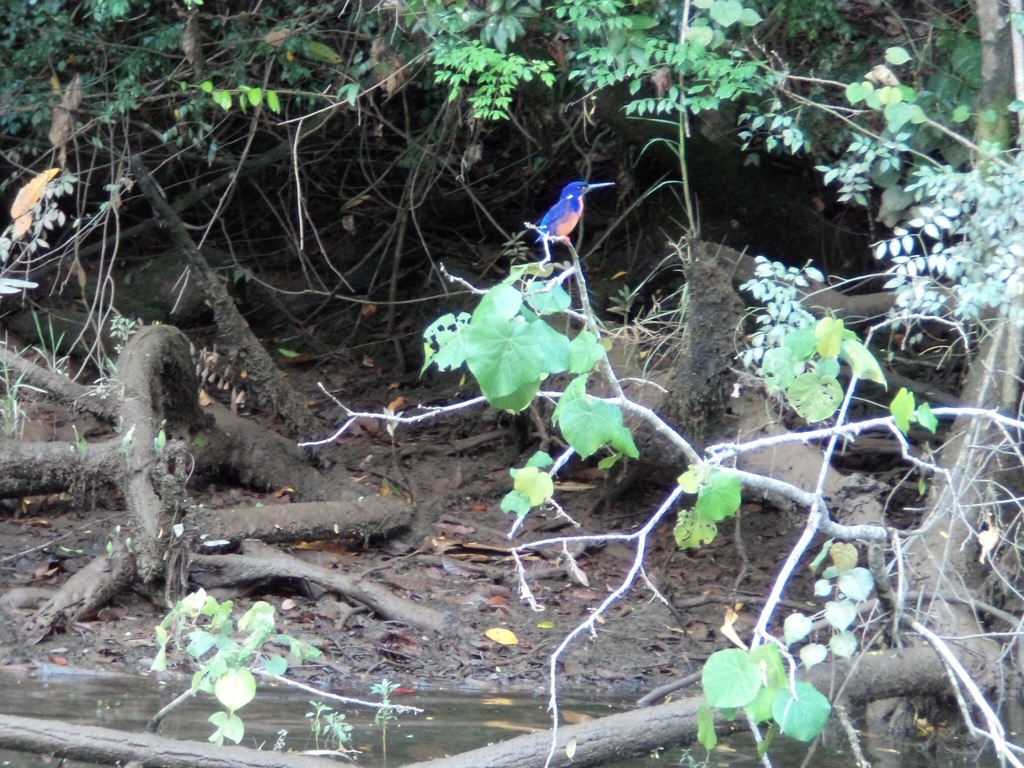
Martín pescador azur
Photo © redrovertracy
Photo © redrovertracy — CC BY 4.0 — Source: iNaturalist #28775648Identification
The azure kingfisher is a tiny jewel of a bird, measuring just 17–19 cm in length, making it one of the smallest kingfishers you'll encounter. Males weigh 29–32 g while females are marginally heavier at 31–35 g. This species is unmistakably colourful: it sports a deep blue to azure back that gives it its name, paired with a distinctive large white to buff spot on the side of the neck and throat. The breast and flanks display a striking rufous-buff colouration adorned with blue-violet streaks. An unusual feature is its bright red feet with only two forward-facing toes. Look closely at the face, and you'll notice white lores (the region between eye and bill) that appear as two prominent white eye-like spots when viewed head-on—a feature that may serve to deter potential predators.
Range & Habitat
The azure kingfisher inhabits northern and eastern Australia and Tasmania, as well as the lowlands of New Guinea, neighbouring islands, and stretches as far as North Maluku and Romang. The species is common throughout the northern portions of its range, becoming increasingly uncommon towards the south. Though generally sedentary, some individuals undertake seasonal migrations. These birds favour vegetated creek banks, lakes, swamps, tidal estuaries, and mangrove habitats—anywhere shallow water meets dense vegetation.
Behaviour & Diet
Azure kingfishers are elusive hunters, remaining inconspicuous until they suddenly dart from a perch above the water in pursuit of prey. Their diet consists of small fish, crustaceans (including shrimps, amphipods, and freshwater yabbies), water beetles, spiders, locusts, and occasionally small frogs or tadpoles. Breeding occurs from September to April in northern Australia and August to February in the south, with pairs sometimes raising two broods per season. Nests are excavated as chambers at the end of 1-metre burrows in earthen creek banks. Females lay clutches of 4–6 white, glossy, rounded eggs measuring 22 × 19 mm. Both parents incubate for 20–22 days and then feed the chicks for 3–5 weeks. Floods and brown snakes pose occasional threats to nests. Usually silent, azure kingfishers produce a distinctive high-pitched, shrill "pseet-pseet" call during breeding, often delivered in flight.
Best Time & Places to See It
The breeding season, from September to April in the north and August to February in the south, is your best opportunity to locate this species, as birds are more vocal and active during this period. The azure kingfisher is common throughout northern Australia and New Guinea's lowlands, making these regions your most reliable destinations. Search vegetated creeks, mangrove edges, and swamp margins in early morning or late afternoon when the birds are most active.
Photography Tips
Patience is essential when photographing azure kingfishers. Position yourself quietly near suitable habitat and wait for birds to emerge from cover. The low, rapid flight makes fast shutter speeds necessary—at least 1/1000th of a second. The bird's vivid azure and rufous plumage demands careful exposure metering to preserve colour saturation without blown highlights on the white throat patch. Early morning light will showcase the metallic blue back beautifully, while the distinctive white eye-spots on the face make head-on portraits particularly striking.
Carnarvon National Park
Philadelphia, Australia
+93 aves+21 mamíferos
Where granite gorges slice through Queensland’s semi-arid interior, ancient sandstone walls tower above crystalline waterhole oases in an landscape that […]
VER PARQUE NACIONALWickham National Park
Brisbane, Australia
+123 aves+30 mamíferos
Rugged sandstone plateaus rise dramatically across this compact yet ecologically rich corner of Western Australia’s Kimberley region, where ancient weathered […]
VER PARQUE NACIONALKakadu National Park
Kakadu, Australia
+130 aves+20 mamíferos
Kakadu National Park is Australia’s largest national park and one of the world’s most remarkable protected areas, covering nearly 20,000 […]
VER PARQUE NACIONALDaintree National Park
Dedin, Australia
+125 aves+30 mamíferos
Daintree National Park is one of the world’s oldest and most biologically diverse tropical rainforests, protecting an extraordinary landscape where […]
VER PARQUE NACIONALLower Glenelg National Park
Australia
+64 aves+11 mamíferos
Where limestone cliffs plunge toward tannin-stained waters, South Australia’s southwestern frontier reveals one of the continent’s most sculptured wilderness areas. […]
VER PARQUE NACIONALSpringbrook National Park
Australia
+131 aves+30 mamíferos
Where subtropical rainforest cascades down steep volcanic escarpments and mist clings to ancient tree ferns, one of Australia’s most biodiverse […]
VER PARQUE NACIONALLamington National Park
Australia
+122 aves+30 mamíferos
Where subtropical rainforest cloaks volcanic plateaus in Queensland’s Gold Coast hinterland, one of Australia’s oldest national parks unfolds across 541 […]
VER PARQUE NACIONALRoyal National Park
Sydney, Australia
+133 aves+24 mamíferos
Sandstone cliffs plunge toward the Tasman Sea along New South Wales’ southern coast, where Royal National Park unfolds across 343 […]
VER PARQUE NACIONALSundown National Park
Australia
+88 aves+11 mamíferos
Where the Queensland borderlands rise into sandstone plateaux and eucalyptus woodland, rugged gorges slice through 305 square kilometres of some […]
VER PARQUE NACIONALRinyirru National Park
Lakefield, Australia
+141 aves+6 mamíferos
Where granite outcrops pierce windswept savanna and seasonal floodplains stretch toward the horizon, Australia’s northeastern extremity harbors one of the […]
VER PARQUE NACIONALBald Rock National Park
Australia
+123 aves+26 mamíferos
Where granite peaks thrust skyward across the New England Tablelands, weathered stone and eucalypt woodland meet in a landscape of […]
VER PARQUE NACIONALGirraween National Park
Australia
+121 aves+22 mamíferos
Where granite boulders the size of cathedrals rise from eucalypt woodland, Queensland’s Southern Downs reveal one of Australia’s most geologically […]
VER PARQUE NACIONALMorton National Park
Australia
+125 aves+27 mamíferos
Where sandstone cliffs plunge into temperate rainforest and eucalypt woodlands blanket the New South Wales highlands, Morton National Park sprawls […]
VER PARQUE NACIONALHeathcote National Park
Sydney, Australia
+131 aves+26 mamíferos
Where sandstone ridges rise above eucalyptus woodlands and crystalline creeks carve through ancient valleys, one of Victoria’s most underrated wilderness […]
VER PARQUE NACIONALGlass House Mountains National Park
Australia
+129 aves+30 mamíferos
Volcanic peaks thrust skyward across the Queensland hinterland, their steep-sided summits sculpted from ancient lava flows and weathered by millions […]
VER PARQUE NACIONALAún no hay fotos de la comunidad. Inicia sesión para añadir la primera.
Aún no hay observaciones de la comunidad de esta especie.