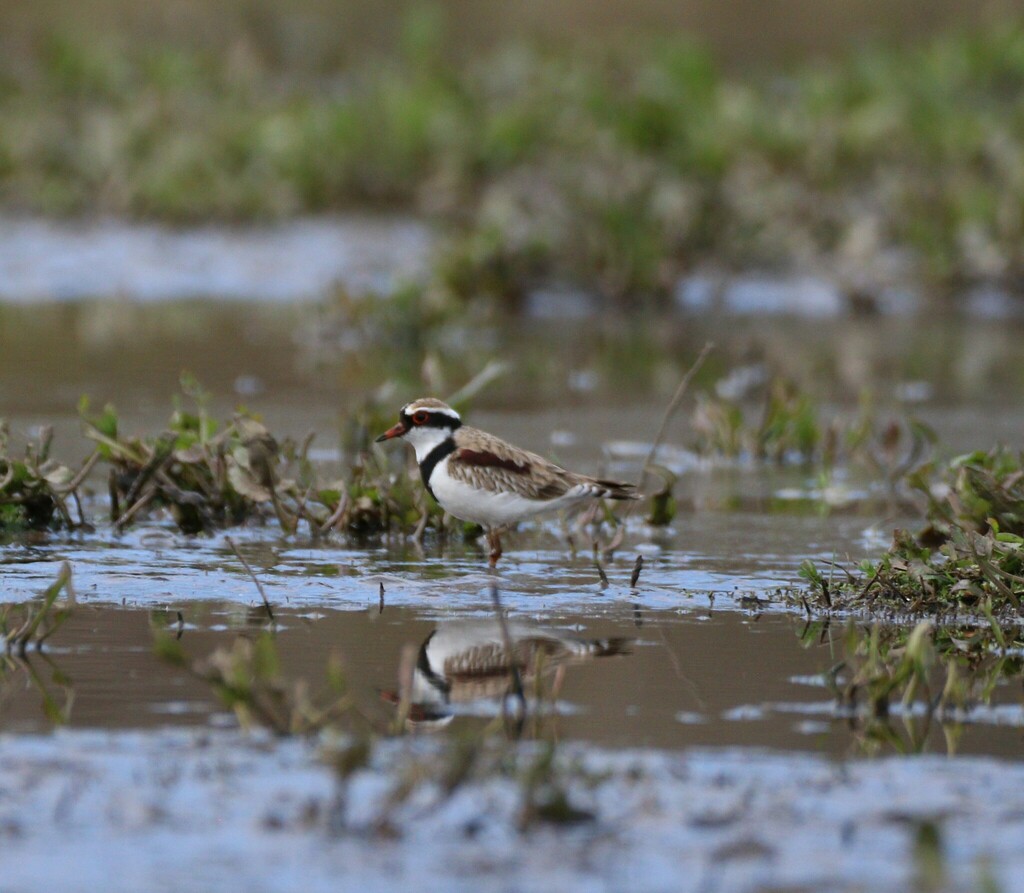
Chorlitejo Frentinegro
Photo © Julia Palmer
Photo © Julia Palmer — CC BY 4.0 — Source: iNaturalist #240258315Identification
The black-fronted dotterel is a small plover, measuring just 16–18 cm in length with a wingspan of 33–35 cm and weighing only 30–35 g. Despite its diminutive size, it is unmistakable in the field thanks to its striking plumage. Adults display a distinctive black face mask covering the forehead, combined with a bold v-shaped black band across the chest. The dorsal plumage is mottled brown, with the wings and crown matching this earthy tone—colouration that provides excellent camouflage against aerial predators. The orbital eye rings are bright red, as is the base of the bill, which darkens to black at the tip. Pale orange legs complete the profile. Males and females are similar in appearance, and unlike many wading birds, black-fronted dotterels retain the same plumage throughout the year. Juveniles are noticeably duller, with a greyish beak and lacking both the black forehead and breast band.
Range & Habitat
The black-fronted dotterel is native to mainland Australia and Tasmania, inhabiting most of the continent except parts of the Great Victoria Desert. The species is uncommonly seen along coastlines but frequents nearby wetlands and basins. In the 1950s, the species naturally colonised New Zealand, first recorded in Hawke's Bay in 1954, subsequently spreading to regions such as Manawatu, North Canterbury, and eventually the South Island by the 1970s. Today it occupies most of New Zealand, with key breeding populations along the Wairau and Awatere rivers.
These birds are strongly tied to freshwater habitats, favouring the edges of lakes, dams, billabongs, and shallow temporary claypan pools. They occasionally inhabit mudflats and estuaries. Black-fronted dotterels are typically sedentary, maintaining territories on a semi-regular basis, though they may travel considerable distances to reach food-rich areas or shift location in response to rainfall patterns, departing when water levels rise and returning as areas dry.
Behaviour & Diet
Black-fronted dotterels forage using a distinctive technique: short running motions with the body held horizontal, punctuated by stops to peck at prey with rapid bobbing movements. Their diet comprises crustaceans, insects, and seeds. The species breeds between August and February, though northern populations may breed opportunistically following suitable rainfall. Courtship involves calling and aerial displays by both partners.
Nests are simple depressions decorated with twigs, shells, and pebbles. Clutches of 2–3 eggs are greyish-yellow with brown and lavender markings. Both parents share incubation over 4–5 weeks, and when not incubating, remain nearby to feed and rest. Adults employ sophisticated temperature regulation, shading eggs from sun or moistening their breast feathers to cool them. Chicks leave the nest within 24 hours of hatching to hide in sheltered areas while both parents provide care and vigilantly distract predators through loud calling and injury-feigning displays.
Best Time & Places to See It
Black-fronted dotterels are commonly spotted in south-western Queensland and northern New South Wales in Australia, and in Hawke's Bay in New Zealand. The breeding season from August to February offers the best opportunities for observation, particularly in northern Australia where breeding may occur following suitable rainfall. The species' preference for the edges of freshwater bodies means that wetlands, lakes, dams, and temporary pools are your best bets for locating them.
Photography Tips
The bird's small size and horizontal foraging posture reward patient observation with a telephoto lens. The striking black facial markings and chest band provide excellent contrast for photography. Early morning light enhances the red eye-rings and bill colouration. During breeding season, watch for adults performing distraction displays or shading eggs—dramatic behavioural moments. The mottled brown dorsal plumage blends seamlessly with shoreline substrates, so scan the margins of water bodies carefully and look for movement rather than relying on static appearance. The bird's calm, sedentary nature makes it relatively approachable compared to many plovers.
Kakadu National Park
Kakadu, Australia
+130 aves+20 mamíferos
Kakadu National Park is Australia’s largest national park and one of the world’s most remarkable protected areas, covering nearly 20,000 […]
VER PARQUE NACIONALGreater Bendigo National Park
Bendigo, Australia
+135 aves+16 mamíferos
Where granite tors pierce the undulating woodlands of central Victoria, a landscape of surprising ecological complexity unfolds across nearly 1,100 […]
VER PARQUE NACIONALChiltern-Mt Pilot National Park
Australia
+135 aves+17 mamíferos
Where granite peaks rise sharply above undulating eucalypt woodlands, the landscape reveals a mosaic of ecological treasures spanning nearly 870 […]
VER PARQUE NACIONALIkara-Flinders Ranges National Park
Australia
+83 aves+9 mamíferos
Where ancient ridges rise in rust-red waves across South Australia’s heartland, one of the continent’s most dramatic mountain ranges unfolds […]
VER PARQUE NACIONALLittle Desert National Park
Australia
+107 aves+7 mamíferos
Where red sand dunes roll beneath a vast Australian sky, mallee scrubland stretches across 2,609 square kilometres of northwestern Victoria. […]
VER PARQUE NACIONALBelair National Park
Adelaide, Australia
+132 aves+19 mamíferos
Where the Adelaide Hills rise dramatically from the surrounding plains, eucalyptus woodlands of remarkable diversity cloak a landscape sculpted by […]
VER PARQUE NACIONALNaracoorte Caves National Park
Australia
+119 aves+14 mamíferos
Limestone pavements and sinkhole forests define this 53-square-kilometre sanctuary in South Australia’s southeast, where ancient cave systems plunge deep into […]
VER PARQUE NACIONALLockyer National Park
Australia
+127 aves+30 mamíferos
Where volcanic ridges meet subtropical woodland, a mosaic of eucalypt forest and grassy woodland unfolds across southeastern Queensland’s hidden gem. […]
VER PARQUE NACIONALRinyirru National Park
Lakefield, Australia
+141 aves+6 mamíferos
Where granite outcrops pierce windswept savanna and seasonal floodplains stretch toward the horizon, Australia’s northeastern extremity harbors one of the […]
VER PARQUE NACIONALHeathcote National Park
Sydney, Australia
+131 aves+26 mamíferos
Where sandstone ridges rise above eucalyptus woodlands and crystalline creeks carve through ancient valleys, one of Victoria’s most underrated wilderness […]
VER PARQUE NACIONALFlinders Chase National Park
Australia
+86 aves+11 mamíferos
Where granite tors pierce the windswept landscape of South Australia’s Kangaroo Island, ancient mallee scrub and eucalypt woodland create a […]
VER PARQUE NACIONALAún no hay fotos de la comunidad. Inicia sesión para añadir la primera.
Aún no hay observaciones de la comunidad de esta especie.