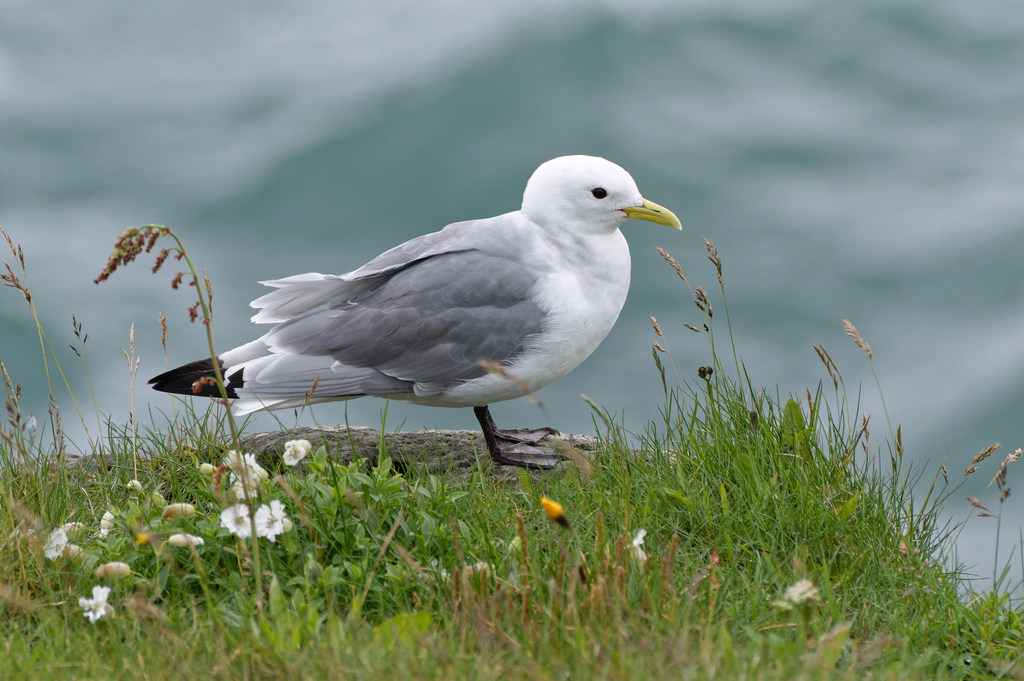
Gaviota tridáctila
Photo © Donald Davesne
Photo © Donald Davesne — CC BY 4.0 — Source: iNaturalist photo #150280970Identification
The black-legged kittiwake is a small gull measuring 37–41 cm in length with a wingspan of 91–105 cm. Adults are striking and unmistakable, with white heads and bodies, grey backs, and grey wings tipped solid black. Their most distinctive features are their black legs and bright yellow bills. The inside of their mouth is a characteristic rich red colour, which they flash to their partners during greeting displays—a behaviour linked to reproductive success. In winter, adults develop a dark grey smudge behind the eye and a grey hind-neck collar, while their bill turns dusky-olive.
Juveniles are quite different and can be confusing to novice birdwatchers. They display a bold black 'W' band across the wings, whiter secondary and primary feathers, a black hind-neck collar, and a black terminal band on the tail. Their bills are solid black initially. Young birds gradually acquire adult plumage over several years, reaching full maturity by age four. The species name "tridactyla" refers to their unusual anatomy: unlike most gulls, kittiwakes possess only three toes, with the hind toe either extremely reduced or completely absent.
Range & Habitat
Black-legged kittiwakes are coastal birds of the Arctic to subarctic regions, found across northern coasts of both the Atlantic and Pacific oceans. Two subspecies occupy different hemispheres: R. t. tridactyla inhabits the North Atlantic from Canada and Greenland through Iceland to northwest Europe and Siberia, while R. t. pollicaris occupies the North Pacific from Alaska to Siberia. During winter, their range extends considerably southward, reaching the coast of New Jersey in the Atlantic and including pelagic regions like the Sargasso Sea and waters off West Africa.
Kittiwakes are among the most pelagic of all gulls, spending most of their lives out at sea, far from human sight. They are rarely found inland, though occasional vagrants have been recorded well over a thousand kilometres from the coast. The exception to their marine lifestyle occurs during the breeding season from May to September, when they congregate on the sheerest sea cliffs to establish their colonies.
Behaviour & Diet
The black-legged kittiwake's English name is derived directly from its distinctive call—a shrill, repetitive 'kittee-wa-aaake, kitte-wa-aaake'—which is unmistakable once learned. During the breeding season, pairs engage in characteristic greeting displays where they open their mouths wide to flash their brilliant red mouth interiors to their partners while calling. This behaviour appears to be significant in pair bonding and reproductive success, as studies suggest that the intensity of red pigmentation in the mouth is associated with male reproductive fitness. The red coloration itself comes from carotenoid pigments and vitamin A acquired through their diet.
Like other gulls, kittiwakes follow an annual moult cycle consisting of one complete moult and one partial moult each year. The full moult from summer to winter plumage is notably protracted, beginning as early as late May or June and continuing until October or, rarely, the end of the year. A partial moult occurs in spring, typically from March to early April, affecting head and body feathers but not the wings and tail.
Best Time & Places to See It
The breeding season from May to September offers the best opportunities to see black-legged kittiwakes, particularly at their nesting colonies on dramatic sea cliffs throughout their range. In the Atlantic, key locations include the coasts of Greenland, Iceland, northwest Europe, and North America from the Canadian Arctic through Newfoundland. In the Pacific, look for them along the coasts of Alaska, the Aleutian Islands, Kamchatka Peninsula, and other northeastern regions.
Outside the breeding season, observing kittiwakes requires pelagic boat trips, as they spend most of their time far out at sea. Winter months extend their range further south, making sightings possible from lower latitudes during this period.
Photography Tips
Photographing black-legged kittiwakes is most rewarding during the breeding season when they are concentrated at cliff colonies. Their distinctive black-and-white plumage and bright yellow bills are highly photogenic. Capture close-ups of adults showing their characteristic red mouth interiors during greeting displays—this intimate behaviour provides compelling images. The contrast between their white bodies and grey-black wing tips creates striking compositional opportunities.
When photographing juveniles, pay attention to the diagnostic black 'W' marking across the wings and the black tail band, which make excellent identifying features for images. During the breeding season, dramatic sea cliff backgrounds enhance photographs significantly. Winter birds are more challenging to photograph due to their pelagic habits, requiring boat-based photography and patience in open-water conditions.
Cape Breton Highlands National Park
Cape Breton Highlands National Park, Canadá
+115 aves+23 mamíferos
Where the Cabot Trail winds through Nova Scotia’s northern reaches, weathered plateaus rise dramatically above the Atlantic, their cliff faces […]
VER PARQUE NACIONALSouth Spitsbergen National Park
Noruega
+19 aves+5 mamíferos
Towering peaks of dark basalt and pale marble thrust skyward across the Arctic archipelago, their flanks sculpted by ancient glaciers […]
VER PARQUE NACIONALNorthwest Spitsbergen National Park
Noruega
+26 aves+4 mamíferos
Where Arctic tundra surrenders to jagged peaks and tidewater glaciers, a landscape of raw grandeur unfolds across the northwestern reaches […]
VER PARQUE NACIONALNorthern Isfjorden National Park
Noruega
+22 aves+12 mamíferos
Granite peaks plunge into the fjord’s crystalline waters, their cliffs carved by ancient ice and crowned with Arctic tundra. This […]
VER PARQUE NACIONALHamburgisches Wattenmeer National Park
Hamburg, Alemania
+134 aves+21 mamíferos
Where the Elbe River surrenders to the North Sea, a vast tapestry of mud flats, salt marshes, and shallow tidal […]
VER PARQUE NACIONALSchleswig-Holsteinisches Wattenmeer National Park
Alemania
+130 aves+21 mamíferos
Twice daily, the North Sea withdraws from an immense stage of mud, sand, and salt marsh, revealing one of Europe’s […]
VER PARQUE NACIONALCaldera de Taburiente National Park
El Paso, España
+69 aves+4 mamíferos
Volcanic amphitheaters of rust-red stone rise nearly 2,400 meters from the island of La Palma, their ancient walls cradling a […]
VER PARQUE NACIONALPembrokeshire Coast National Park
Pembrokeshire, Gran Bretaña
+123 aves+28 mamíferos
Where jagged sea cliffs rise dramatically from churning Atlantic waters, one of Britain’s finest coastal wildernesses unfolds across southwest Wales. […]
VER PARQUE NACIONALEryri National Park
Gwynedd, Gran Bretaña
+122 aves+29 mamíferos
Where granite peaks pierce the Welsh sky, alpine meadows cascade into oak-clad valleys and windswept moorlands define the horizon. This […]
VER PARQUE NACIONALNorth York Moors National Park
North Yorkshire, Gran Bretaña
+128 aves+21 mamíferos
Heather moorlands roll across 554 square miles of the Yorkshire uplands, where rolling hills give way to deep valleys carved […]
VER PARQUE NACIONALL’Île-Bonaventure-Et-Du-Rocher-Percé National Park
Le Rocher-Percé, Canadá
+146 aves+3 mamíferos
Where the St. Lawrence River crashes against Quebec’s Gaspésie Peninsula, a pierced limestone monolith rises 88 metres from churning Atlantic […]
VER PARQUE NACIONALKenai Fjords National Park
Kenai Peninsula Borough, Estados Unidos
+27 aves
Where tidewater glaciers calve into emerald waters and temperate rainforest cloaks the coastal mountains, one of Alaska’s most dramatic wilderness […]
VER PARQUE NACIONALGlacier Bay National Park
Unorganized Borough, Estados Unidos
+12 aves+19 mamíferos
Tidewater glaciers calve thunderous bergs into pristine fjords where the Alaskan wilderness reaches its most dramatic expression. Spanning 26,400 square […]
VER PARQUE NACIONALRedwood National Park
Humboldt County, Estados Unidos
+126 aves+29 mamíferos
Where ancient titans pierce the California fog, the tallest trees on Earth create a primordial landscape unlike anywhere else. Spanning […]
VER PARQUE NACIONALWrangell-Saint Elias National Park
Unorganized Borough, Estados Unidos
+77 aves+19 mamíferos
Where granite peaks thrust skyward and tidewater glaciers calve into fjords, North America’s largest subpolar wilderness commands absolute attention. Spanning […]
VER PARQUE NACIONALGros Morne National Park
Canadá
+128 aves+19 mamíferos
Where granite peaks rise dramatically above fjord-carved valleys, one of Canada’s most geologically spectacular wilderness areas commands nearly 4,000 square […]
VER PARQUE NACIONALForillon National Park
Gaspé, Canadá
+131 aves+11 mamíferos
Where the Gaspé Peninsula meets the Gulf of Saint Lawrence, rugged cliffs plunge into churning Atlantic waters, sculpting a dramatic […]
VER PARQUE NACIONALSassen-Bünsow Land National Park
Soere, Noruega
+15 aves+2 mamíferos
Where Arctic tundra sprawls across glaciated plateaus in the remote Svalbard archipelago, a realm of raw geological drama unfolds. Sassen-Bünsow […]
VER PARQUE NACIONALForlandet National Park
Vera, Noruega
+24 aves+4 mamíferos
Windswept Arctic tundra meets jagged coastal cliffs where the Barents Sea crashes against Norway’s northernmost wilderness. This sliver of protected […]
VER PARQUE NACIONALVaranger National Park
Båtsfjord, Noruega
+70 aves+13 mamíferos
Where the Arctic tundra meets the Barents Sea, vast plateaus of birch woodland and dwarf shrub heath roll across northeastern […]
VER PARQUE NACIONALSt. Paul Island
Saint Paul, Estados Unidos
+131 aves+2 mamíferos
Windswept tundra rolls across this remote Pribilof island, where volcanic basalt cliffs plunge into the Bering Sea and fog rolls […]
VER PAISAJE PROTEGIDONalychevo National Park
Nalychevo, Rusia
+86 aves+10 mamíferos
Where volcanic peaks pierce the mist of Russia’s far northeast, a primordial landscape of steaming geothermal springs and pristine river […]
VER PARQUE NACIONALIlulissat Icefjord
Ilulissat, Groenlandia
+28 aves+4 mamíferos
Where the Arctic’s most dynamic glacier meets the sea, colossal icebergs calve with thunderous force into a fjord that transforms […]
VER PAISAJE PROTEGIDODisko Bay
Kitsissuarsuit, Groenlandia
+15 aves+5 mamíferos
Icebergs the size of cathedrals calve continuously from Greenland’s second-largest glacier into waters that pulse with Arctic vitality. Here, where […]
VER PAISAJE PROTEGIDOScoresby Sund
Vandreblok, Groenlandia
+14 aves+4 mamíferos
Where granite peaks pierce an Arctic sky and the world’s largest fjord system carves deep into northeastern Greenland, a primordial […]
VER PAISAJE PROTEGIDONuuk Fjord System
Nuuk, Groenlandia
+30 aves+5 mamíferos
Where granite peaks plunge directly into the Arctic Ocean, a labyrinth of deep fjords carves through Greenland’s southwestern coast, their […]
VER PAISAJE PROTEGIDOSkomer Island
Haverfordwest, Gran Bretaña
+74 aves+3 mamíferos
Where the Irish Sea crashes against the Welsh coast, wind-scoured cliffs rise dramatically from churning waters, creating one of Britain’s […]
VER ISLA Y ARCHIPIéLAGOAún no hay fotos de la comunidad. Inicia sesión para añadir la primera.
Aún no hay observaciones de la comunidad de esta especie.