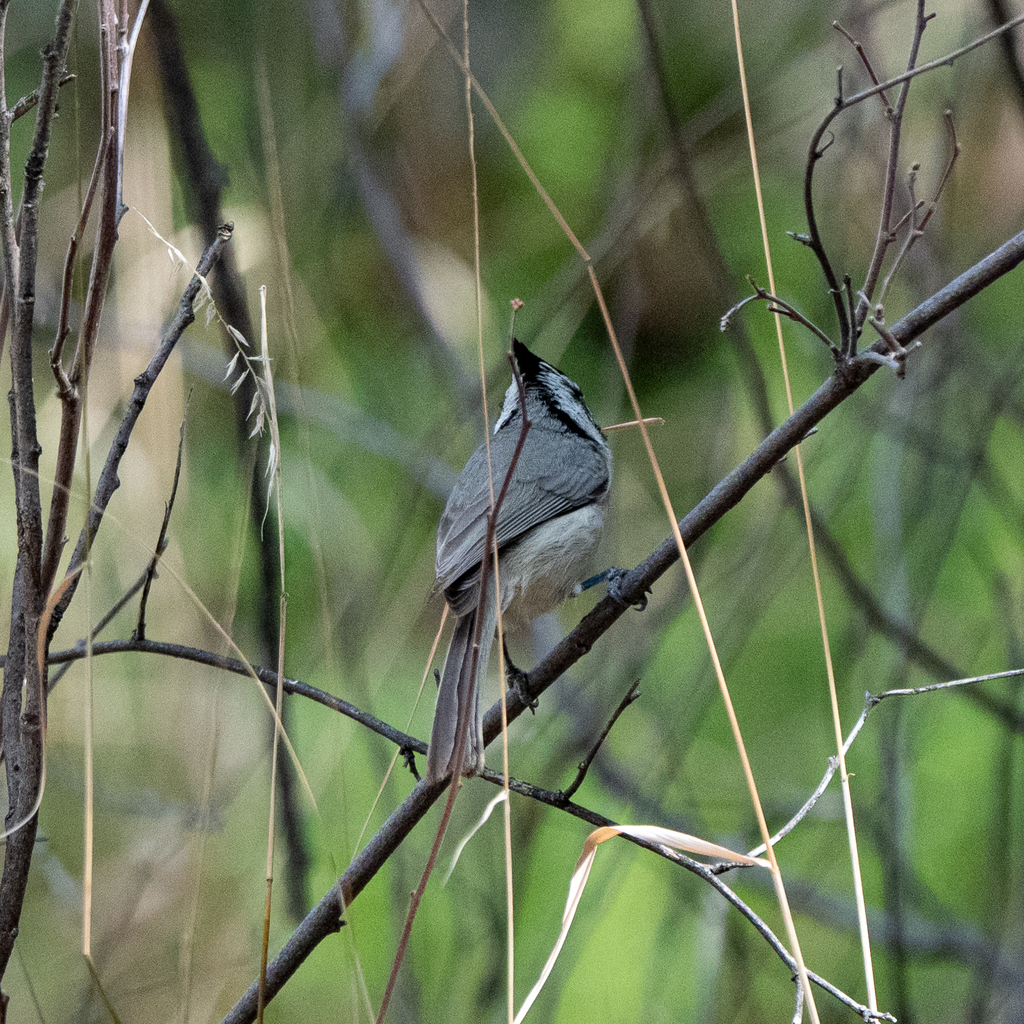
Herrerillo Embridado
Photo © Ron Bondy
Photo © Ron Bondy — CC BY-SA 4.0 — Source: iNaturalist #343426544The bridled titmouse (Baeolophus wollweberi) is a small passerine bird in the family Paridae, the tits and chickadees. It is found in Mexico and the United States. == Taxonomy and systematics == The bridled titmouse was originally described in 1850 as Lophanes wollweberi. It was later reassigned to its present genus Baeolophus that was erected in 1851. The bridled titmouse has these four subspecies: B. w. vandevenderi (Rea, 1986) B. w. phillipsi ([Van Rossem, 1947) B. w. wollweberi (Bonaparte, 1850) B. w. caliginosus (Van Rossem, 1947) == Description == The bridled titmouse is about 10 cm (3.9 in) long and weighs about 10 g (0.35 oz). It is a small bird with a distinct crest. The sexes have the same plumage. Adults of the nominate subspecies B. w. wollweberi have a black crown and crest with a large deep gray central patch. The have a black line through the eye that continues as an arc behind the ear coverts on an otherwise white face. The sides of their neck are white. Their chin and throat are black and just connect to the base of the black arc. Their upperparts, wings, and tail are deep olive gray with a thin black…
Saguaro National Park – Rincon Mountain District
Pima County, Estados Unidos
+131 aves+28 mamíferos
Dawn breaks over slopes where towering saguaro cacti puncture the Sonoran Desert sky like sentinels guarding an ancient realm. This […]
VER PARQUE NACIONALParque Nacional Grutas de Cacahuamilpa
Pilcaya, México
+141 aves+19 mamíferos
Where limestone cliffs plunge into shadowed canyons, the Río Río Grande carves its ancient passage through one of Mexico’s most […]
VER PARQUE NACIONALTutuaca
Tosanachi, México
+122 aves+22 mamíferos
Where copper canyons plunge deeper than the Grand Canyon itself, Mexico’s remote Sierra Madre Occidental unfolds in dramatic vertical relief. […]
VER PAISAJE PROTEGIDOAún no hay fotos de la comunidad. Inicia sesión para añadir la primera.
Aún no hay observaciones de la comunidad de esta especie.