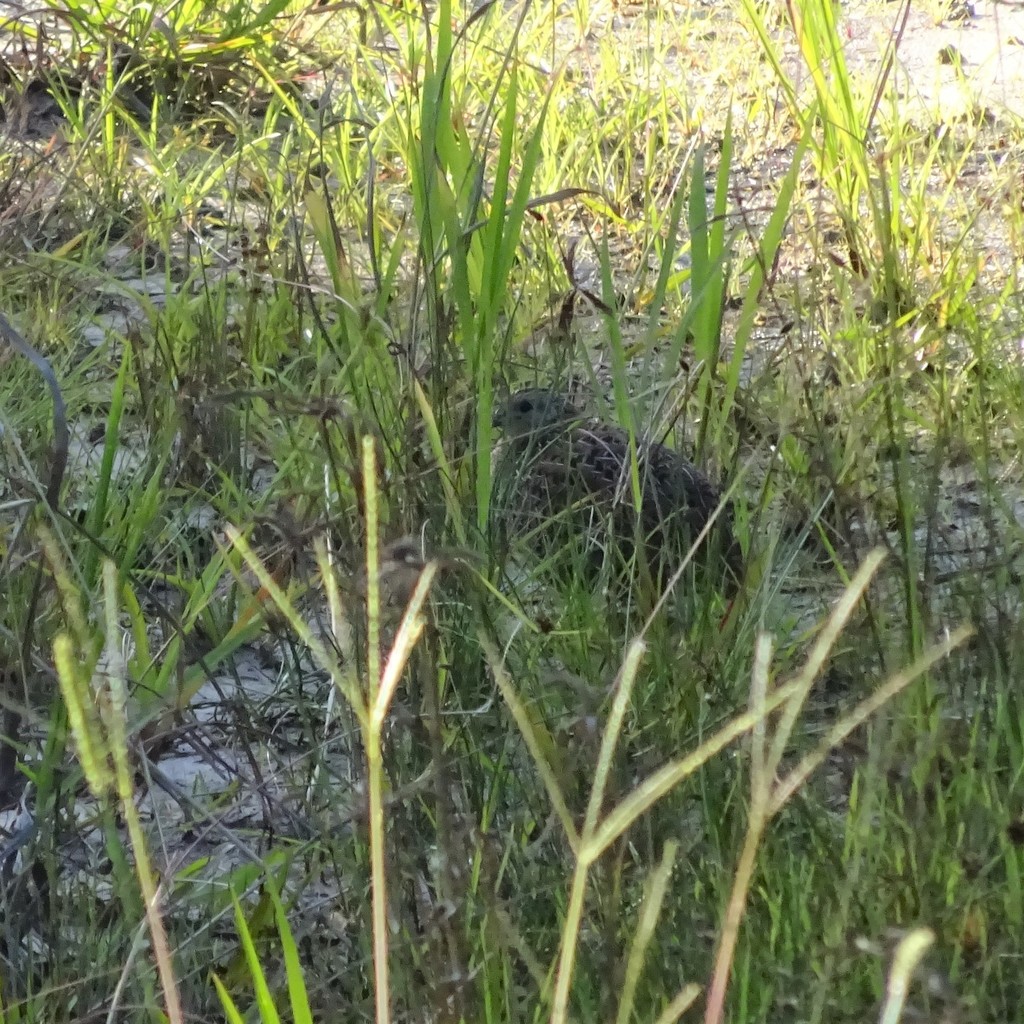
Codorniz de Tasmania
Photo © Gary Williams
Photo © Gary Williams — CC BY-SA 4.0 — Source: iNaturalist #116812500Identification
The brown quail is a small, plump, and stocky ground-dwelling bird measuring 17 to 22 centimetres in length and weighing 75 to 140 grams. Males are distinctive with reddish-brown plumage speckled with black on the head and upper neck, mainly reddish-brown on the back and wings, and underparts ranging from buff or rufous to brown, always marked with fine black chevron-shaped barring. The short tail is dark brown with yellowish barring. Females are similar but noticeably paler, with small black spots on the shoulder and dark chevron-shaped barring on the upperparts. The bird communicates through a variety of shrill calls, including a characteristic double whistle where the latter note ascends.
Range & Habitat
The brown quail is native to mainland Australia, Tasmania, and Papua New Guinea, with populations also found across the Lesser Sunda Islands and Tanimbar Islands. It has been introduced to New Zealand and Fiji. This widespread species favours agricultural areas, wet grasslands, shrublands, spinifex savannah, and freshwater wetlands, though it is notably absent from arid regions. In Australia, it is primarily a lowland species, but in New Zealand it ranges up to 1,000 metres elevation, and in New Guinea reaches elevations of up to 3,700 metres. The bird was introduced to New Zealand in the 1860s and 1870s and is now established in the North Island and certain offshore islands.
Behaviour & Diet
A ground-dwelling bird that prefers to hide or run rather than fly, the brown quail is found in small groups and feeds on grasses, seeds, shoots, and small invertebrates. When startled, the group takes flight and scatters by flying in different directions before regrouping once the danger has passed. Brown quails form breeding pairs in spring, with an extended breeding season during which females lay clutches of half a dozen or more eggs in shallow scraped nests lined with grasses and often concealed in grass tussocks or shrubby bushes. The female incubates the eggs for approximately three weeks, and the precocial chicks are cared for by both parents initially, with the male assuming full responsibility after two weeks to allow the female to begin the next clutch.
Best Time & Places to See It
The brown quail is common throughout much of its wide range and is classified as "least concern" by the International Union for Conservation of Nature. The best opportunities to encounter this species are in its preferred habitats of wet grasslands, freshwater wetlands, and shrublands across Australia and Tasmania during the spring breeding season, when birds are more active and vocal. Agricultural areas and grassland reserves in northern, eastern, south-eastern, and south-western Australia also offer good viewing opportunities.
Photography Tips
Photographing brown quails presents a challenge due to their preference for running and hiding rather than flying. Patience and a slow, cautious approach through suitable habitat—particularly wet grasslands and areas with dense vegetation—will yield the best results. Early morning visits when birds are most active may improve your chances of encountering them. Given their small size and cryptic nature, a telephoto lens is essential. Listen for their shrill calls and distinctive double whistle to locate birds moving through vegetation, and be prepared for sudden, rapid flight in different directions when startled.
Uluru-Kata Tjuta National Park
Petermann, Australia
+91 aves+10 mamíferos
Uluru-Kata Tjuta National Park is one of Australia’s most iconic protected areas, renowned for its breathtaking desert landscapes, extraordinary geological […]
VER PARQUE NACIONALBunya Mountains National Park
Australia
+77 aves+20 mamíferos
Where subtropical rainforest canopies rise above weathered volcanic peaks, Queensland’s Bunya Mountains hold some of Australia’s most ancient and biodiverse […]
VER PARQUE NACIONALLamington National Park
Australia
+122 aves+30 mamíferos
Where subtropical rainforest cloaks volcanic plateaus in Queensland’s Gold Coast hinterland, one of Australia’s oldest national parks unfolds across 541 […]
VER PARQUE NACIONALSydney Harbour National Park
Sydney, Australia
+131 aves+21 mamíferos
Crystalline waters lap against weathered sandstone headlands where native bushland clings to steep escarpments overlooking one of the world’s most […]
VER PARQUE NACIONALRoyal National Park
Sydney, Australia
+133 aves+24 mamíferos
Sandstone cliffs plunge toward the Tasman Sea along New South Wales’ southern coast, where Royal National Park unfolds across 343 […]
VER PARQUE NACIONALLincoln National Park
Australia
+103 aves+4 mamíferos
Where windswept coastlines meet ochre cliffs along South Australia’s Eyre Peninsula, nearly 2,700 square kilometers of wild country unfold in […]
VER PARQUE NACIONALLockyer National Park
Australia
+127 aves+30 mamíferos
Where volcanic ridges meet subtropical woodland, a mosaic of eucalypt forest and grassy woodland unfolds across southeastern Queensland’s hidden gem. […]
VER PARQUE NACIONALMorton National Park
Australia
+125 aves+27 mamíferos
Where sandstone cliffs plunge into temperate rainforest and eucalypt woodlands blanket the New South Wales highlands, Morton National Park sprawls […]
VER PARQUE NACIONALAún no hay fotos de la comunidad. Inicia sesión para añadir la primera.
Aún no hay observaciones de la comunidad de esta especie.