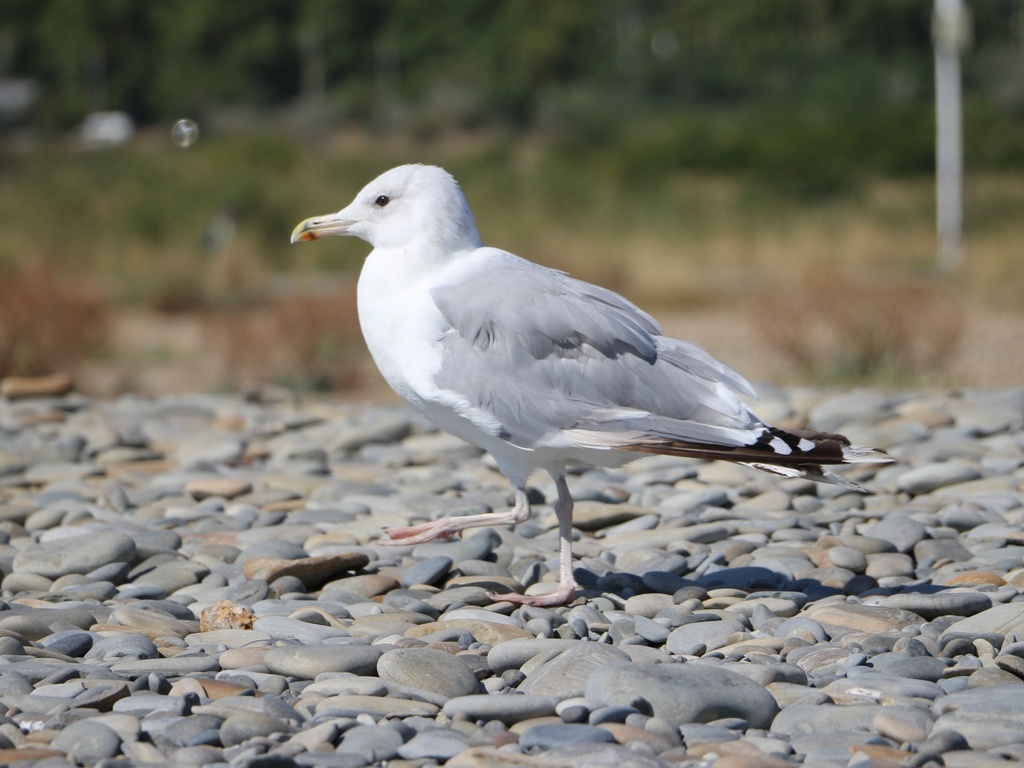
Gaviota del Caspio
Photo © Юрий Данилевский (Yuriy Danilevsky)
Photo © Юрий Данилевский (Yuriy Danilevsky) — CC BY 4.0 — Source: iNaturalist photo #554611565Identification
The Caspian gull is a large gull measuring 56–68 cm long with a wingspan of 137 to 155 cm. It is distinguished by its long, slender bill and sloping forehead, with proportionally longer legs, wings, and neck compared to the herring gull and yellow-legged gull. The back and wings are a slightly darker shade of grey than the herring gull but paler than the yellow-legged gull. The eye is characteristically small and often dark, while legs range from pale pink to pale yellowish. A key field mark is the outermost primary feather, which displays a large white tip and white tongue running up the inner web.
First-winter birds present a different appearance, featuring a pale head with dark streaking on the back of the neck, pale underparts, and a greyish back. Two pale lines across the wing are formed by whitish tips on the greater and median wing coverts, helping distinguish young birds from other gull species.
Range & Habitat
The Caspian gull breeds around the Black and Caspian Seas, extending eastwards across Central Asia to north-west China. In recent decades, the species has been spreading north and west throughout Europe, now breeding in Poland, eastern Germany, southern Russia, and year-round in Ukraine. Some populations migrate south as far as the Red Sea and Persian Gulf, while others disperse into Western Europe, including Sweden, Norway, Denmark, the Benelux countries, and northern France. The species is increasingly recorded in Britain, particularly in South-east England, East Anglia, and the Midlands.
During breeding season, Caspian gulls typically nest on flat, low-lying ground by water, a preference that distinguishes them from the cliff-nesting yellow-legged gull in areas where the two species overlap.
Behaviour & Diet
Caspian gulls are opportunistic scavengers and predators with a highly varied diet. During the breeding season, they frequently hunt rodents such as ground squirrels, often flying considerable distances into the steppes to find prey. This hunting behaviour demonstrates their adaptability to different food sources depending on availability and season.
Best Time & Places to See It
The breeding season begins in early April, making spring and early summer ideal for observing breeding birds around the Black and Caspian Seas and throughout Central Asia. In Europe, the species can be encountered year-round in Ukraine and increasingly throughout the continent. For birdwatchers in Britain, South-east England, East Anglia, and the Midlands offer the most regular opportunities to encounter this expanding species, with sightings becoming more frequent in recent years.
Photography Tips
Photographers should focus on capturing the diagnostic features: the slender bill, sloping forehead, and relatively long neck and legs compared to similar gulls. The white-tipped outermost primary feather is a key identifying mark worth capturing in flight shots. The small, dark eye is a subtle but useful detail for species confirmation in close-up portraits.
When photographing first-winter birds, emphasize the pale head with dark neck streaking and the characteristic pale wing bars formed by the wing covert markings. Ground-nesting birds during breeding season can be approached carefully near water habitats, though respectful distance should be maintained to avoid disturbing nesting colonies.
Stenshuvuds National Park
Skåne län, Suecia
+136 aves+18 mamíferos
Where windswept cliffs plunge toward the Baltic and ancient beech forests cling to limestone slopes, southern Sweden reveals one of […]
VER PARQUE NACIONALLower Oder Valley National Park
Schwedt/Oder, Alemania
+124 aves+30 mamíferos
Where two nations’ borders converge along the Oder River, a landscape of wetlands, floodplain forests and oxbow lakes unfolds across […]
VER PARQUE NACIONALJasmund National Park
Sassnitz, Alemania
+126 aves+26 mamíferos
Soaring white limestone cliffs plunge dramatically toward the Baltic Sea, their chalk faces sculpted by millennia of wind and wave […]
VER PARQUE NACIONALSaxon Switzerland National Park
Sebnitz, Alemania
+120 aves+30 mamíferos
Where sandstone cliffs soar vertically above the Elbe River, a landscape of extraordinary geological drama unfolds across the German-Czech borderlands. […]
VER PARQUE NACIONALBavarian Forest National Park
Alemania
+121 aves+30 mamíferos
Where beech and spruce embrace across ancient granite uplands, Central Europe’s wildest borderland unfolds. The Bavarian Forest straddles the German-Czech […]
VER PARQUE NACIONALDanube Delta Biosphere Reserve
Tulcea, Rumanía
+123 aves+30 mamíferos
Where Europe’s mightiest river dissolves into the Black Sea, a labyrinth of reed beds, shallow lagoons, and floating islands creates […]
VER PARQUE NACIONALHortobágy National Park
Hortobágy, Hungría
+132 aves+19 mamíferos
Where the Great Hungarian Plain stretches endlessly toward the horizon, vast wetlands and grasslands create one of Europe’s most dynamic […]
VER PARQUE NACIONALDuna-Ipoly National Park
Dömös, Hungría
+121 aves+30 mamíferos
Where the Danube carves its sinuous path through northern Hungary, limestone ridges rise abruptly from the river valley, their pale […]
VER PARQUE NACIONALTbilisi National Park
Tezami, Georgia
150+ aves
Where the Caucasus foothills descend toward Georgia’s capital, pristine river valleys and limestone cliffs create a remarkable patchwork of habitats […]
VER PARQUE NACIONALKolkheti National Park
Nigvziani, Georgia
+149 aves+6 mamíferos
Where the Caucasus descends to meet the Black Sea, a mosaic of wetlands, reed beds, and coastal lagoons creates one […]
VER PARQUE NACIONALTrialeti Planned National Park
Tbisi, Georgia
+130 aves+21 mamíferos
Where limestone plateaus rise above the Caucasian foothills, a mosaic of oak forests, alpine meadows, and beech woodlands creates one […]
VER PARQUE NACIONALMachakhela Planned National Park
Skurdidi, Georgia
+138 aves+12 mamíferos
Where the Lesser Caucasus mountains plunge toward the lowlands of southern Georgia, a landscape of dramatic contrasts unfolds. Steep limestone […]
VER PARQUE NACIONALNizhnyaya Kama National Park
Yelabuzhsky District, Rusia
+118 aves+9 mamíferos
Where the middle Volga River carves through the ancient steppes of Tatarstan, a sprawling 1,100-square-kilometre sanctuary unfolds across meadows, wetlands, […]
VER PARQUE NACIONALLosiny Ostrov National Park
Balashikhinsky District, Rusia
+120 aves+30 mamíferos
Ancient pine and birch forests sweep across undulating terrain where the Moskva River winds through Moscow’s northeastern reaches, creating a […]
VER PARQUE NACIONALPieniny National Park
Tylka, Polonia
+74 aves+5 mamíferos
Where granite gorge walls rise dramatically from the Dunajec River’s emerald waters, a ribbon of wilderness threads through Poland’s Pieniny […]
VER PARQUE NACIONALWielkopolska National Park
Trzebaw, Polonia
+81 aves+8 mamíferos
Where glacial lakes punctuate dense mixed forests, Poland’s greatest concentration of old-growth woodland creates one of Europe’s most ecologically intact […]
VER PARQUE NACIONALPolesie National Park
Michałów, Polonia
+96 aves+10 mamíferos
Where the Narew River winds through Poland’s eastern borderlands, pristine wetlands and ancient forests converge in one of Europe’s most […]
VER PARQUE NACIONALOjców National Park
Ojców, Polonia
+69 aves+9 mamíferos
Where limestone gorges knife through southern Poland’s Vistula Valley, a temperate landscape of remarkable ecological drama unfolds across 82 square […]
VER PARQUE NACIONALDrawa National Park
Strzelce-Drezdenko County, Polonia
+47 aves+7 mamíferos
Where pine forests slope toward crystalline waterways, one of Poland’s most compelling wilderness sanctuaries unfolds across 508 square kilometers of […]
VER PARQUE NACIONALWolin National Park
Kamień County, Polonia
+96 aves+17 mamíferos
Where the Baltic coastline fragments into a mosaic of pine forests, freshwater lakes, and windswept dunes, northwestern Poland harbors one […]
VER PARQUE NACIONALTatra National Park
Zakopane, Polonia
+93 aves+2 mamíferos
Where granite peaks slash through the clouds at over 2,600 metres, Poland’s only true alpine ecosystem unfolds across 507 square […]
VER PARQUE NACIONALRoztocze National Park
Obrocz, Polonia
+50 aves
Where rolling loess hills rise and fall across the Polish borderlands, a living frontier emerges between continental and Atlantic climates. […]
VER PARQUE NACIONALPieniny National Park
Sromowce Niżne, Polonia
+50 aves
Where granite gorges cut through densely forested ridges, the Dunajec River Gorge creates one of Central Europe’s most dramatic natural […]
VER PARQUE NACIONALGorce National Park
Szczawa, Polonia
+50 aves+8 mamíferos
Where beech forests embrace limestone ridges and alpine meadows sweep across weathered peaks, a 279-square-kilometre sanctuary unfolds in southern Poland’s […]
VER PARQUE NACIONALTable Mountains National Park
Karłów, Polonia
150+ aves+30 mamíferos
Where sandstone plateaus rise like ancient fortresses above forested valleys, Poland’s 108-square-kilometre wilderness unfolds across the Table Mountains. Vertical rock […]
VER PARQUE NACIONALKampinos National Park
Gurba, Polonia
+123 aves+30 mamíferos
Vast wetlands and ancient pine forests sprawl across the sandy plains just northwest of Warsaw, where Poland’s largest national park […]
VER PARQUE NACIONALBiebrza National Park
Goniądz, Polonia
+130 aves+25 mamíferos
Where wetland and water merge across northeastern Poland’s vast floodplain, one of Europe’s most pristine riverine ecosystems unfolds across nearly […]
VER PARQUE NACIONALOlympos National Park
Pieria Regional Unit, Grecia
+133 aves+17 mamíferos
Where the Thessalian plains meet the Mediterranean, granite peaks thrust skyward in defiant majesty, their slopes cloaked in a mosaic […]
VER PARQUE NACIONALAún no hay fotos de la comunidad. Inicia sesión para añadir la primera.
Aún no hay observaciones de la comunidad de esta especie.