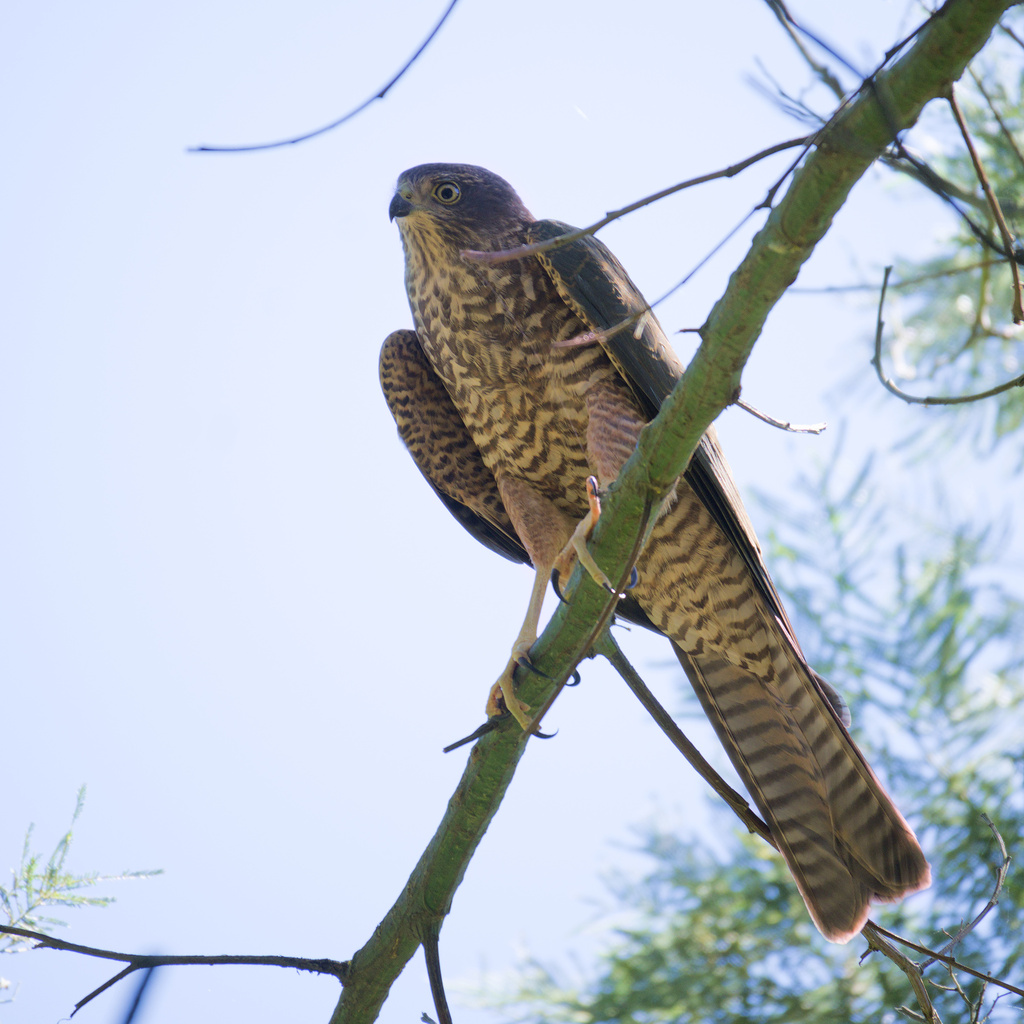
Gavilán acollarado
Photo © Thomas Jaeger
Photo © Thomas Jaeger — CC BY 4.0 — Source: iNaturalist #199403025Identification
The collared sparrowhawk is a small, fierce and finely built bird of prey, measuring 29–38 cm in length with a wingspan of 55–78 cm. Males average 126 g while females weigh around 218 g. The species is characterised by its rounded wings, long square tail, and distinctive slender feet—notably, the last segment of the middle toe projects beyond the claws of other toes. Adults display slate-grey upper parts, sometimes with a brown wash, and a distinctive chestnut half collar. The underparts are finely barred in rufous and white, while under wings and tail show delicate barring. The cere ranges from cream to olive-yellow, with bright yellow eyes and yellow legs and feet.
Juveniles are noticeably different, with brown upper parts and pale streaks on the head and nape. Their feathers show fine rufous edges, while underparts are white with heavy brown streaks on the breast and coarse brown barring on the belly. The sexes are similar in appearance, though males are notably smaller than females, and juveniles possess a cream to greenish-yellow cere with brown to pale yellow eyes.
Range & Habitat
The collared sparrowhawk is widespread throughout mainland Australia, Tasmania, and New Guinea, as well as nearby smaller islands. The species is found in all habitats except the driest deserts, and can occasionally be spotted in urban areas and even cities. Although widespread across its range, the bird is generally uncommon, though it may be more common in forests in the tropics and subtropics. The species is generally resident, though it may be partly migratory; however, its movements remain poorly understood.
Behaviour & Diet
The collared sparrowhawk is a specialist hunter of small birds, relying on stealth and surprise to catch its prey. The crested pigeon and spotted bowerbird represent the largest birds recorded as prey. Beyond birds, the species also catches insects, lizards, and small mammals including small bats. Most prey weighs less than 100 g, though occasional items may exceed 200 g. The sparrowhawk hunts through short-stay perch hunting from concealed positions in foliage, punctuated by short, often undulating flights between trees, or alternatively through low, fast flight and hedge hopping. Prey is seized either in direct flying attacks or via stealthy glides.
Breeding occurs from July to December, with pairs nesting solitarily in stick platforms measuring 27–32 cm across and 12–15 cm deep, typically lined with green leaves and positioned 4–39 m above ground in the forks of living trees. Clutches usually contain three or four eggs, ranging from two to five. Incubation lasts 35 days with a nesting period of about 28–33 days, followed by up to 6 weeks of dependence after fledging before young disperse. Sexual maturity is reached at one year, and birds may breed in juvenile plumage.
Best Time & Places to See It
The collared sparrowhawk is present year-round across its range, making it potentially observable in any season, though viewing opportunities are challenging due to the species' secretive nature and generally uncommon status. The bird is most likely to be encountered in forested habitats, particularly in tropical and subtropical regions where it may be more common. Urban and suburban areas with suitable vegetation patches occasionally host these birds, offering unexpected opportunities for attentive observers.
Photography Tips
Photographing the collared sparrowhawk requires patience and stealth, as the species is secretive and alert. Watch for the bird perching motionless in dense foliage before launching hunting flights—these moments of action offer the best photographic opportunities. The bird's bright yellow eyes, chestnut collar, and finely barred plumage are distinctive features worth capturing. Early morning and late afternoon often provide the best light and highest activity levels. Positioning yourself quietly near suitable habitat and remaining patient will increase your chances of documenting this elegant and elusive raptor.
Uluru-Kata Tjuta National Park
Petermann, Australia
+91 aves+10 mamíferos
Uluru-Kata Tjuta National Park is one of Australia’s most iconic protected areas, renowned for its breathtaking desert landscapes, extraordinary geological […]
VER PARQUE NACIONALGreater Bendigo National Park
Bendigo, Australia
+135 aves+16 mamíferos
Where granite tors pierce the undulating woodlands of central Victoria, a landscape of surprising ecological complexity unfolds across nearly 1,100 […]
VER PARQUE NACIONALChiltern-Mt Pilot National Park
Australia
+135 aves+17 mamíferos
Where granite peaks rise sharply above undulating eucalypt woodlands, the landscape reveals a mosaic of ecological treasures spanning nearly 870 […]
VER PARQUE NACIONALIkara-Flinders Ranges National Park
Australia
+83 aves+9 mamíferos
Where ancient ridges rise in rust-red waves across South Australia’s heartland, one of the continent’s most dramatic mountain ranges unfolds […]
VER PARQUE NACIONALKinglake National Park
Australia
+106 aves+22 mamíferos
Where eucalyptus-clad ridges rise above fern-filled gullies, the landscape unfolds in a patchwork of wet forest, dry sclerophyll woodland, and […]
VER PARQUE NACIONALSpringbrook National Park
Australia
+131 aves+30 mamíferos
Where subtropical rainforest cascades down steep volcanic escarpments and mist clings to ancient tree ferns, one of Australia’s most biodiverse […]
VER PARQUE NACIONALLamington National Park
Australia
+122 aves+30 mamíferos
Where subtropical rainforest cloaks volcanic plateaus in Queensland’s Gold Coast hinterland, one of Australia’s oldest national parks unfolds across 541 […]
VER PARQUE NACIONALSydney Harbour National Park
Sydney, Australia
+131 aves+21 mamíferos
Crystalline waters lap against weathered sandstone headlands where native bushland clings to steep escarpments overlooking one of the world’s most […]
VER PARQUE NACIONALLittle Desert National Park
Australia
+107 aves+7 mamíferos
Where red sand dunes roll beneath a vast Australian sky, mallee scrubland stretches across 2,609 square kilometres of northwestern Victoria. […]
VER PARQUE NACIONALBelair National Park
Adelaide, Australia
+132 aves+19 mamíferos
Where the Adelaide Hills rise dramatically from the surrounding plains, eucalyptus woodlands of remarkable diversity cloak a landscape sculpted by […]
VER PARQUE NACIONALLincoln National Park
Australia
+103 aves+4 mamíferos
Where windswept coastlines meet ochre cliffs along South Australia’s Eyre Peninsula, nearly 2,700 square kilometers of wild country unfold in […]
VER PARQUE NACIONALOnkaparinga River National Park
Adelaide, Australia
+84 aves+9 mamíferos
Where the Onkaparinga River carves through South Australian scrubland, eucalypt woodlands and mallee heath converge in a landscape sculpted by […]
VER PARQUE NACIONALDhilba Guuranda-Innes National Park
Australia
+77 aves+6 mamíferos
Where granite outcrops pierce the red earth of South Australia’s Mid Murray region, a mosaic of mallee scrub and open […]
VER PARQUE NACIONALKulla National Park
Coen, Australia
+52 aves+4 mamíferos
Granite peaks thrust dramatically from dense tropical rainforest across this vast wilderness of Cape York Peninsula, where ancient weathered ranges […]
VER PARQUE NACIONALBald Rock National Park
Australia
+123 aves+26 mamíferos
Where granite peaks thrust skyward across the New England Tablelands, weathered stone and eucalypt woodland meet in a landscape of […]
VER PARQUE NACIONALGirraween National Park
Australia
+121 aves+22 mamíferos
Where granite boulders the size of cathedrals rise from eucalypt woodland, Queensland’s Southern Downs reveal one of Australia’s most geologically […]
VER PARQUE NACIONALMorton National Park
Australia
+125 aves+27 mamíferos
Where sandstone cliffs plunge into temperate rainforest and eucalypt woodlands blanket the New South Wales highlands, Morton National Park sprawls […]
VER PARQUE NACIONALAún no hay fotos de la comunidad. Inicia sesión para añadir la primera.
Aún no hay observaciones de la comunidad de esta especie.