Diamante de Bicheno
Photo © pimelea
Photo © pimelea — CC BY 4.0 — Source: iNaturalist #206910161Identification
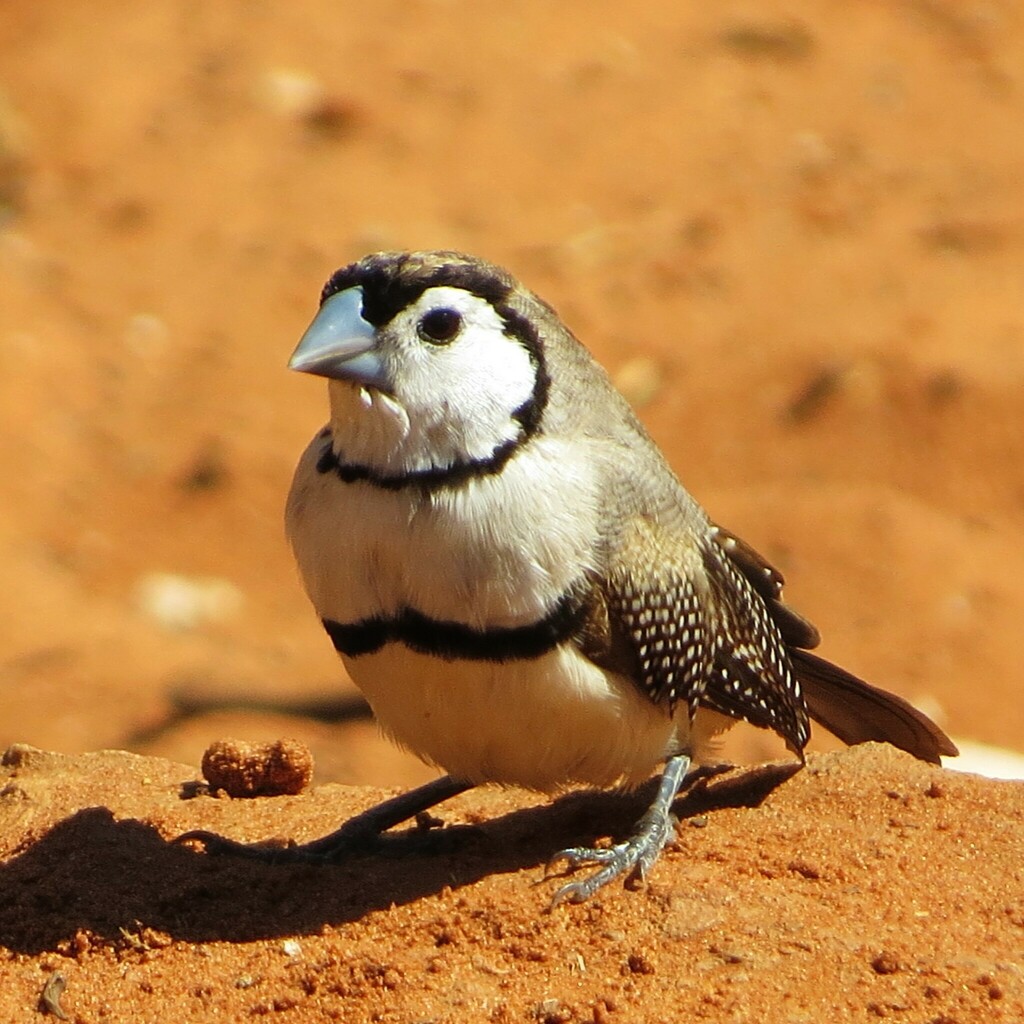
The double-barred finch is a small finch measuring 10–11 cm in length, with distinctive facial markings that explain one of its common names, the "owl finch." It features a striking white face bordered with black, creating a dark ring of feathers around the face that resembles an owl's facial disc. The bird's upperparts and throat are brown, while the underparts are white, with another bold black line separating the throat from the belly—giving rise to the species name "double-barred." The wings display a patterned mix of brown and white. The sexes are similar in appearance, though juveniles are noticeably duller and browner overall. The two recognized subspecies differ subtly: S. b. annulosa from northwestern Australia and the Northern Territory has a black rump, while the nominate subspecies S. b. bichenovii from Queensland to southeastern New South Wales displays a white rump.
Range & Habitat
The double-barred finch is endemic to Australia, occurring across northern and eastern regions where it occupies dry savannah, tropical lowland dry grassland, and shrubland habitats. The species is found in two main populations: S. b. annulosa inhabits northwest and northern Australia, while S. b. bichenovii ranges from north Queensland south to southeast New South Wales. Within these areas, the bird favors open, arid, and semi-arid environments with scattered vegetation.
Behaviour & Diet
The double-barred finch is a granivorous species, feeding primarily on seeds. It is highly gregarious and often encountered in flocks, particularly in suitable habitat. The species builds its nests in grass, bushes, or low trees, typically laying four to six eggs per clutch. Its vocalizations include a soft call described as "tet" and a louder "peew," with the song being a soft fluting that resembles the song of the zebra finch.
Best Time & Places to See It
To locate the double-barred finch, focus on dry savannah and tropical dry grassland habitats in northern and eastern Australia. The subspecies S. b. annulosa can be found in northwest and northern Australia, while S. b. bichenovii is encountered from north Queensland southward to southeast New South Wales. Look for this bird in open, sparsely vegetated areas where it often occurs in small flocks.
Photography Tips
The double-barred finch's distinctive facial markings and contrasting plumage make it a rewarding photographic subject. Its small size and gregarious nature mean that patient observers may encounter flocks, providing opportunities for behavioral documentation. The bold black-and-white face pattern is striking and photographs well in good light, so aim to position the sun to illuminate the head markings clearly. Early morning in open grassland habitats offers the best conditions for spotting and photographing this finch.
Carnarvon National Park
Philadelphia, Australia
+93 aves+21 mamíferos
Where granite gorges slice through Queensland’s semi-arid interior, ancient sandstone walls tower above crystalline waterhole oases in an landscape that […]
VER PARQUE NACIONALMount Coolum National Park
Sunshine Coast, Australia
+75 aves+5 mamíferos
Steep volcanic ridges rise abruptly from Queensland’s coastal plain, their weathered slopes cloaked in open eucalyptus woodland and heathland that […]
VER PARQUE NACIONALWickham National Park
Brisbane, Australia
+123 aves+30 mamíferos
Rugged sandstone plateaus rise dramatically across this compact yet ecologically rich corner of Western Australia’s Kimberley region, where ancient weathered […]
VER PARQUE NACIONALKakadu National Park
Kakadu, Australia
+130 aves+20 mamíferos
Kakadu National Park is Australia’s largest national park and one of the world’s most remarkable protected areas, covering nearly 20,000 […]
VER PARQUE NACIONALLockyer National Park
Australia
+127 aves+30 mamíferos
Where volcanic ridges meet subtropical woodland, a mosaic of eucalypt forest and grassy woodland unfolds across southeastern Queensland’s hidden gem. […]
VER PARQUE NACIONALSundown National Park
Australia
+88 aves+11 mamíferos
Where the Queensland borderlands rise into sandstone plateaux and eucalyptus woodland, rugged gorges slice through 305 square kilometres of some […]
VER PARQUE NACIONALRinyirru National Park
Lakefield, Australia
+141 aves+6 mamíferos
Where granite outcrops pierce windswept savanna and seasonal floodplains stretch toward the horizon, Australia’s northeastern extremity harbors one of the […]
VER PARQUE NACIONALKulla National Park
Coen, Australia
+52 aves+4 mamíferos
Granite peaks thrust dramatically from dense tropical rainforest across this vast wilderness of Cape York Peninsula, where ancient weathered ranges […]
VER PARQUE NACIONALBald Rock National Park
Australia
+123 aves+26 mamíferos
Where granite peaks thrust skyward across the New England Tablelands, weathered stone and eucalypt woodland meet in a landscape of […]
VER PARQUE NACIONALGirraween National Park
Australia
+121 aves+22 mamíferos
Where granite boulders the size of cathedrals rise from eucalypt woodland, Queensland’s Southern Downs reveal one of Australia’s most geologically […]
VER PARQUE NACIONALAún no hay fotos de la comunidad. Inicia sesión para añadir la primera.
Aún no hay observaciones de la comunidad de esta especie.