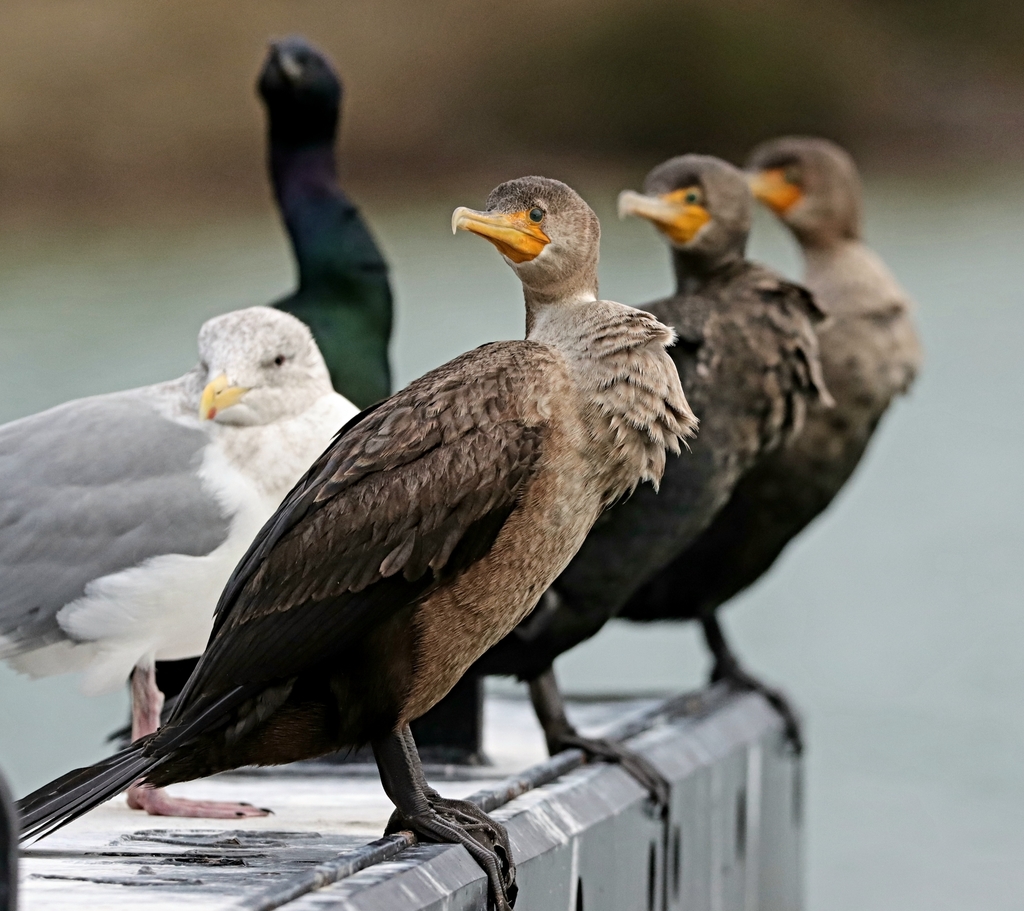
Cormorán orejudo
Photo © Kristin M. Tolle
Photo © Kristin M. Tolle — CC BY 4.0 — Source: iNaturalist photo #174712326Identification
The double-crested cormorant is a large waterbird measuring 70–90 cm in length, with a stocky body, long neck, medium-sized tail, and a medium-sized hooked bill. Its plumage is entirely dark, with distinctive bare patches of orange-yellow or yellow facial skin. Males and females are identical in appearance. During the breeding season, the bird develops its characteristic nuptial crests—either white, black, or a mixture of both—located just above the eyes, with the bare facial skin becoming distinctly orange. Non-breeding adults lack these crests and display more yellowish facial skin. The bird's bill is dark-colored. In regions where ranges overlap, the double-crested cormorant can be distinguished from the similar great cormorant by its more yellow throat coloring and bill characteristics, and from the neotropic cormorant by subtle plumage differences.
Range & Habitat
This species is widely distributed across North America, ranging from the Aleutian Islands in Alaska south to Florida and Mexico. Five subspecies are recognized, each occupying distinct regions: the nominate subspecies has the largest population, ranging from the Great Basin and Rocky Mountains eastward through central and eastern North America, including the Canadian prairies and Great Lakes. The Pacific coast subspecies breeds from British Columbia south to Mexico, while the Alaskan subspecies inhabits the southern coast of Alaska and Aleutian Islands. The Florida subspecies occurs from Texas east to the Atlantic and south to Florida, and the Bahamian subspecies is restricted to mangrove areas around interior lakes of San Salvador. The bird is found near rivers and lakes as well as in coastal areas.
Behaviour & Diet
Double-crested cormorants are accomplished hunters that mainly eat fish, pursuing their prey by swimming and diving underwater. A notable characteristic of this species is that its feathers, like those of all cormorants, are not waterproof. After spending time in the water, the bird must dry out its plumage—a familiar sight as cormorants perch with wings spread open. Once threatened by widespread DDT pesticide use, the population of this species has increased markedly in recent years, representing a significant conservation success story.
Best Time & Places to See It
The breeding season is the best time to observe these birds, when they develop their distinctive double crests and vibrant orange facial skin. They can be found year-round in many parts of their range, particularly in the Great Lakes region, along both Pacific and Atlantic coasts, and throughout Florida. Look for them near any body of water—lakes, rivers, and coastal bays—where fish are abundant.
Photography Tips
Photograph breeding adults when their nuptial crests and bright orange facial skin are most prominent. The birds' habit of perching with spread wings to dry their plumage offers excellent photographic opportunities to capture their distinctive silhouette and dark plumage. Capture them diving or surfacing to document their hunting behavior, and position yourself near shorelines or jetties where they rest between dives for optimal viewing and shooting angles.
Gulf Islands National Park Reserve
Southern Gulf Islands Electoral Area, Canadá
+130 aves+24 mamíferos
Where the Pacific Northwest’s temperate rainforest meets the Salish Sea, an archipelago of over 15 islands and numerous islets creates […]
VER PARQUE NACIONALCape Breton Highlands National Park
Cape Breton Highlands National Park, Canadá
+115 aves+23 mamíferos
Where the Cabot Trail winds through Nova Scotia’s northern reaches, weathered plateaus rise dramatically above the Atlantic, their cliff faces […]
VER PARQUE NACIONALFrontenac National Park
Sainte-Praxède, Canadá
+126 aves+26 mamíferos
Granite cliffs rise abruptly from crystalline lakes, their weathered faces painted in rust and lichen, while boreal forest sweeps across […]
VER PARQUE NACIONALL’Île-Bonaventure-Et-Du-Rocher-Percé National Park
Le Rocher-Percé, Canadá
+146 aves+3 mamíferos
Where the St. Lawrence River crashes against Quebec’s Gaspésie Peninsula, a pierced limestone monolith rises 88 metres from churning Atlantic […]
VER PARQUE NACIONALMont-Saint-Bruno National Park
Saint-Bruno-de-Montarville, Canadá
+121 aves+30 mamíferos
Where the Saint Lawrence lowlands rise into unexpected prominence, a modest but ecologically rich mountain dome commands attention across Quebec’s […]
VER PARQUE NACIONALPointe-Taillon National Park
Lac-Saint-Jean-Est, Canadá
+135 aves+24 mamíferos
Where the St. Lawrence River widens into the Gulf, a slender peninsula of boreal forest and wetland emerges from the […]
VER PARQUE NACIONALMauricie National Park
Shawinigan, Canadá
+120 aves+30 mamíferos
Where granite ridges rise above boreal forest and pristine waterways carve through the Canadian Shield, a wilderness of rare ecological […]
VER PARQUE NACIONALNew River Gorge National Park
Fayette County, Estados Unidos
+118 aves+23 mamíferos
Where sandstone cliffs plunge nearly 900 feet into a churning ribbon of whitewater, one of North America’s most dramatic river […]
VER PARQUE NACIONALKenai Fjords National Park
Kenai Peninsula Borough, Estados Unidos
+27 aves
Where tidewater glaciers calve into emerald waters and temperate rainforest cloaks the coastal mountains, one of Alaska’s most dramatic wilderness […]
VER PARQUE NACIONALSaguaro National Park
Tucson, Estados Unidos
+126 aves+28 mamíferos
Towering sentinels of the Sonoran Desert rise across nearly two thousand square kilometers of Arizona’s most iconic terrain. These magnificent […]
VER PARQUE NACIONALLassen Volcanic National Park
Shasta County, Estados Unidos
+114 aves+25 mamíferos
Steaming vents pierce a landscape sculpted by volcanic fury, where obsidian flows meet alpine meadows across nearly 550 square kilometers […]
VER PARQUE NACIONALEverglades National Park
Monroe County, Estados Unidos
+123 aves+27 mamíferos
Where sawgrass prairie stretches endlessly beneath subtropical skies, a vast wetland wilderness pulses with primordial energy. Spanning over 13,000 square […]
VER PARQUE NACIONALGreat Smoky Mountains National Park
Sevier County, Estados Unidos
+122 aves+30 mamíferos
Where ancient mountains meet temperate rainforest, a landscape of astonishing biological richness unfolds across 4,212 square kilometers of protected wilderness. […]
VER PARQUE NACIONALGrand Teton National Park
Teton County, Estados Unidos
+123 aves+30 mamíferos
Where granite peaks pierce the Wyoming sky, a landscape of raw geological drama unfolds across 2,550 square kilometers of pristine […]
VER PARQUE NACIONALYellowstone National Park
Park County, Estados Unidos
+120 aves+31 mamíferos
Geothermal plumes rise from an alien landscape where boiling springs feed crystalline pools and geysers erupt with clockwork precision across […]
VER PARQUE NACIONALRocky Mountain National Park
Larimer County, Estados Unidos
+121 aves+31 mamíferos
Where granite peaks pierce the Colorado sky above 12,000 feet, alpine tundra sprawls across windswept plateaus alongside dense subalpine forests […]
VER PARQUE NACIONALRedwood National Park
Humboldt County, Estados Unidos
+126 aves+29 mamíferos
Where ancient titans pierce the California fog, the tallest trees on Earth create a primordial landscape unlike anywhere else. Spanning […]
VER PARQUE NACIONALOlympic National Park
Jefferson County, Estados Unidos
+122 aves+29 mamíferos
Where temperate rainforest meets alpine meadow and windswept coastline, a remarkable wilderness unfolds across Washington’s Olympic Peninsula. This 10,765-square-kilometre sanctuary […]
VER PARQUE NACIONALLac-Témiscouata National Park
Témiscouata, Canadá
+55 aves+10 mamíferos
Where the Appalachian highlands meet the boreal forest, a pristine wilderness of over 500 square kilometres unfolds across eastern Quebec. […]
VER PARQUE NACIONALFundy National Park of Canada
Alma Parish, Canadá
+131 aves+27 mamíferos
Where the Bay of Fundy’s tidal rhythms sculpt the Maritime landscape, a compact wilderness of 345 square kilometres unfolds across […]
VER PARQUE NACIONALMont-Tremblant National Park
Lac-des-Dix-Milles, Canadá
+110 aves+23 mamíferos
Where granite ridges rise above boreal forest and crystalline lakes mirror the Quebec sky, one of eastern Canada’s most dynamic […]
VER PARQUE NACIONALÎles-De-Boucherville National Park
Boucherville, Canadá
+104 aves+10 mamíferos
Dawn breaks over a labyrinth of forested islands rising from the St. Lawrence River, where 18 square kilometres of protected […]
VER PARQUE NACIONALGros Morne National Park
Canadá
+128 aves+19 mamíferos
Where granite peaks rise dramatically above fjord-carved valleys, one of Canada’s most geologically spectacular wilderness areas commands nearly 4,000 square […]
VER PARQUE NACIONALBic National Park
Rimouski, Canadá
+119 aves+17 mamíferos
Granite cliffs plunge toward the churning Saint Lawrence River, where salt marshes and boreal forest converge in an explosive collision […]
VER PARQUE NACIONALKouchibouguac National Park of Canada
Carleton Parish, Canadá
+114 aves+16 mamíferos
Salt marshes melting into Acadian forest meet the Bay of Fundy’s restless tides along New Brunswick’s hidden gem. This 591-square-kilometre […]
VER PARQUE NACIONALForillon National Park
Gaspé, Canadá
+131 aves+11 mamíferos
Where the Gaspé Peninsula meets the Gulf of Saint Lawrence, rugged cliffs plunge into churning Atlantic waters, sculpting a dramatic […]
VER PARQUE NACIONALPoint Pelee National Park
Leamington, Canadá
+125 aves+28 mamíferos
Where Lake Erie’s waters meet a sandy finger of Ontario’s shoreline, one of North America’s most vital migratory corridors pulses […]
VER PARQUE NACIONALLoch Lomond & the Trossachs National Park
Duchray, Gran Bretaña
+91 aves+18 mamíferos
Where ancient woodlands rise from glassy lochs and rugged Highland peaks pierce the lowland horizon, Scotland’s most biodiverse landscape unfolds […]
VER PARQUE NACIONALSt. Paul Island
Saint Paul, Estados Unidos
+131 aves+2 mamíferos
Windswept tundra rolls across this remote Pribilof island, where volcanic basalt cliffs plunge into the Bering Sea and fog rolls […]
VER PAISAJE PROTEGIDOSian Ka’an
Chunyaxché, México
+115 aves
Where mangrove labyrinths dissolve into turquoise shallows and jungle canopy meets pristine Caribbean shoreline, one of Mexico’s most biodiverse reserves […]
VER RESERVA DE LA BIOSFERAEl Vizcaíno
Laguna San Ignacio, México
+101 aves+15 mamíferos
Where the Baja California peninsula thins into a tapestry of salt lagoons and coastal desert, one of Mexico’s most biodiverse […]
VER RESERVA DE LA BIOSFERAAún no hay fotos de la comunidad. Inicia sesión para añadir la primera.
Aún no hay observaciones de la comunidad de esta especie.