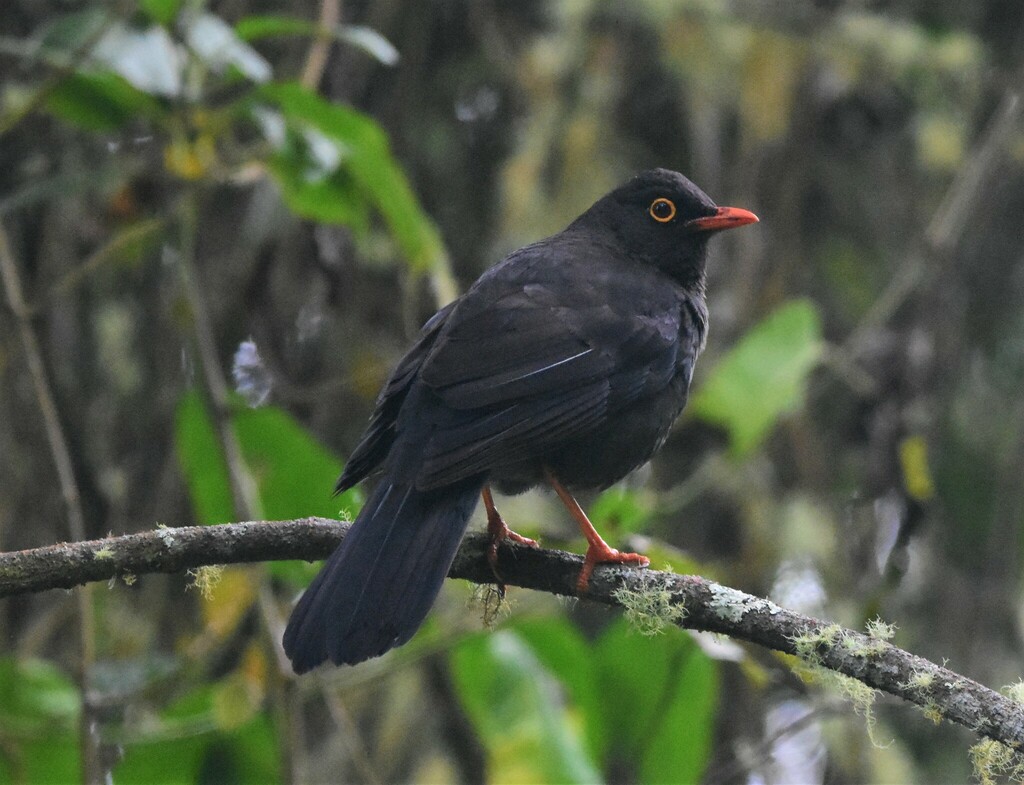
Mirlo Serrano
Photo © Zac Peterson
Photo © Zac Peterson — CC BY 4.0 — Source: iNaturalist #127053936The glossy-black thrush (Turdus serranus) is a species of bird in the family Turdidae. It is found from Venezuela to Argentina. == Taxonomy and systematics == The glossy-black thrush was originally described with its current binomial Turdus serranus. Its further taxonomy is unsettled. The IOC, AviList, and the Clements taxonomy assign it these five subspecies: T. s. cumanensis (Hellmayr, 1919) T. s. atrosericeus (Lafresnaye, 1848) T. s. fuscobrunneus (Chapman, 1912) T. s. serranus Tschudi, 1844 T. s. continoi Fraga & Dickinson, 2008 However, as of late 2025, BirdLife International's Handbook of the Birds of the World did not recognize T. s. continoi, including it within T. s. serranus. Subspecies T. s. continoi had originally been named T. s. unicolor in 1970. Because T. unicolor had been previously assigned to Tickell's thrush, by the principle of priority Fraga and Dickinson proposed its current subspecific epithet. What is now the black thrush (T. infuscatus) was previously treated as another subspecies of T. serranus, but molecular studies in the early 2000s determined that they are separate species and not closely related. This article follows the five-subspecies model. == Description == The glossy-black thrush is 23 to 25 cm (9.1 to 9.8 in) long…
Antisana National Park
Quijos, Ecuador
+141 aves+21 mamíferos
Where the Andes spine rises above 4,700 meters, volcanic peaks pierce perpetual cloud forests in Ecuador’s eastern cordillera. This sprawling […]
VER PARQUE NACIONALCajas National Park
Cuenca, Ecuador
+100 aves+10 mamíferos
Where granite peaks pierce the Andean cloud forest between 3,150 and 4,450 meters, more than 270 glacial lakes catch the […]
VER PARQUE NACIONALYanachaga–chemillén National Park
Palcazu, Perú
+141 aves+14 mamíferos
Where the eastern slopes of the Peruvian Andes plunge into the Amazon basin, montane cloud forest clings to precipitous terrain […]
VER PARQUE NACIONALAún no hay fotos de la comunidad. Inicia sesión para añadir la primera.
Aún no hay observaciones de la comunidad de esta especie.