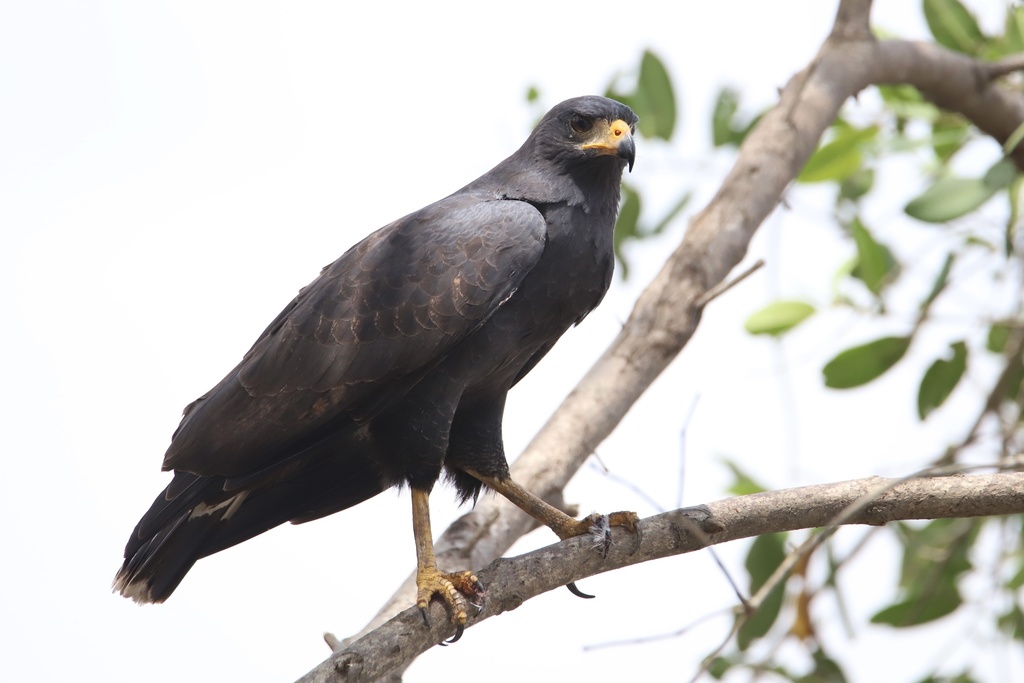
busardo-negro urubitinga
Photo © Aitor
Photo © Aitor — CC BY 4.0 — Source: iNaturalist photo #191448183El gavilán cangrejero grande o urubitinga (Buteogallus urubitinga) es una especie de ave accipitriforme de la familia Accipitridae ampliamente distribuida por la región Neotropical (Iberoamérica), donde es posible su observación desde México hasta Argentina pasando por Centroamérica y buena parte de Sudamérica.
Yasuní National Park
Aguarico, Ecuador
+132 aves+30 mamíferos
Where the Napo and Curaray rivers carve through Ecuador’s vast Amazonian lowlands, one of Earth’s most biodiverse terrestrial ecosystems sprawls […]
VER PARQUE NACIONALAmacayacu National Park
Leticia, Colombia
+133 aves+29 mamíferos
Where the Amazon’s dark waters merge with flooded forest and terra firme upland, five thousand square kilometres of pristine wilderness […]
VER PARQUE NACIONALViruá National Park
Brasil
+103 aves+14 mamíferos
Where granite inselbergs rise dramatically from the Amazon’s northern fringe, a 3,651-square-kilometre wilderness unfolds across Roraima State. This Category II […]
VER PARQUE NACIONALPantanal Matogrossense National Park
Brasil
+139 aves+21 mamíferos
Where water and grassland merge in the heart of Brazil’s Mato Grosso do Sul, one of South America’s most biodiverse […]
VER PARQUE NACIONALMapinguari National Park
Brasil
+120 aves+30 mamíferos
Where the Amazon’s southwestern frontier meets the Xingu Basin, vast tracts of pristine tropical forest rise and fall across nearly […]
VER PARQUE NACIONALSerra Geral National Park
Brasil
+124 aves+14 mamíferos
Where granite escarpments rise abruptly from the Atlantic Forest canopy, a landscape of dramatic canyons and windswept plateaus defines one […]
VER PARQUE NACIONALAnavilhanas National Park
Brasil
+132 aves+30 mamíferos
Where the Rio Negro braids into a labyrinth of islands and waterways, one of the Amazon’s most pristine archipelagos unfolds […]
VER PARQUE NACIONALManu National Park
Manu, Perú
+131 aves+30 mamíferos
Where the Andes plunge into the Amazon basin, a wilderness of uncompromising scale unfolds across 1.5 million hectares. Spanning three […]
VER PARQUE NACIONALBahuaja Sonene National Park
San Pedro de Putina Punco, Perú
+132 aves+30 mamíferos
Where granite ridges rise above the confluence of Peru’s Río Heath and Río Tambopata, one of the Amazon’s most pristine […]
VER PARQUE NACIONALSarigua National Park
Parita, Panamá
+69 aves+3 mamíferos
Where the Pacific’s tidal rhythms sculpt Panama’s coastline, a mosaic of mangrove forests, deciduous woodlands, and seasonally flooded wetlands creates […]
VER PARQUE NACIONALEl Palmar National Park
Distrito Sexto, Argentina
+132 aves+21 mamíferos
Where the Paraná River winds through northern Argentina, vast groves of yatay palms rise from rolling grassland like a botanical […]
VER PARQUE NACIONALRío Pilcomayo National Park
Argentina
150+ aves+10 mamíferos
Where wetlands sprawl across the Argentine Chaco, the Pilcomayo River carves a vital ribbon of life through one of South […]
VER PARQUE NACIONALEl Rey National Park
Municipio de Las Lajitas, Argentina
+59 aves+8 mamíferos
Where subtropical mountain forests merge with humid lowland savannas, northwestern Argentina guards one of South America’s most biodiverse yet underexplored […]
VER PARQUE NACIONALBaritú National Park
Argentina
+35 aves+5 mamíferos
Where the Andes descend into northwestern Argentina’s Misiones Province, steep forested ravines plunge toward the Río Baritú, their gorges carved […]
VER PARQUE NACIONALChaco National Park
Municipio de Presidencia de la Plaza, Argentina
+142 aves+20 mamíferos
Where the Gran Chaco’s thornforests meet wetland mosaics, a landscape of profound ecological contrast unfolds across northwestern Argentina. This 151-square-kilometre […]
VER PARQUE NACIONALParque Nacional Grutas de Cacahuamilpa
Pilcaya, México
+141 aves+19 mamíferos
Where limestone cliffs plunge into shadowed canyons, the Río Río Grande carves its ancient passage through one of Mexico’s most […]
VER PARQUE NACIONALAún no hay fotos de la comunidad. Inicia sesión para añadir la primera.
Aún no hay observaciones de la comunidad de esta especie.