Críalo europeo
Photo © Christoph Moning
Photo © Christoph Moning — CC BY 4.0 — Source: iNaturalist photo #479230245Identification
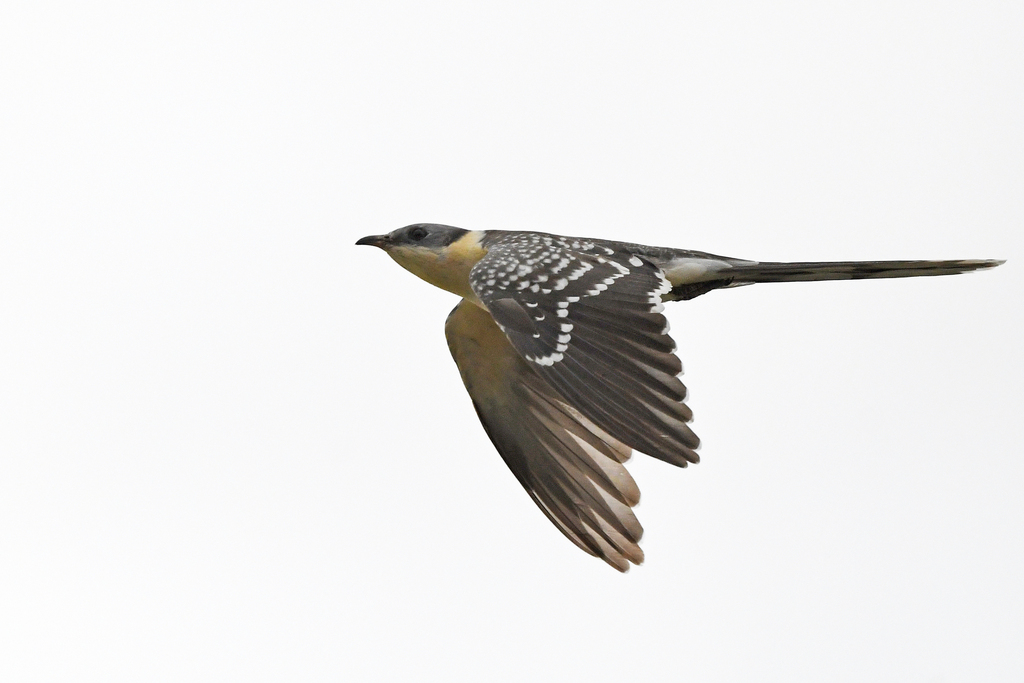
The great spotted cuckoo is slightly larger than the common cuckoo, measuring 35–39 cm in length, but appears considerably more imposing in flight thanks to its broad wings and long narrow tail. Adults are grey above with a slender body, grey cap, and grey wings, contrasting with a yellowish face and upper breast and white underparts. Both sexes are similar in appearance. Juveniles are distinctly different, displaying blackish upperparts and cap with chestnut primary wing feathers. In flight, this species exhibits a characteristic magpie-like movement that can aid identification.
Range & Habitat
The great spotted cuckoo is widely distributed throughout Africa and the Mediterranean Basin. It inhabits warm, open country with scattered trees, making it a bird of semi-arid and Mediterranean landscapes where suitable vegetation provides both hunting grounds and host nests.
Behaviour & Diet
As a brood parasite, the great spotted cuckoo lays its eggs in the nests of corvids, particularly the Eurasian magpie, exploiting these birds to raise its young. Unlike the common cuckoo, neither the hen nor the hatched chick evicts the host's eggs, though young magpies often perish through competition for food with the growing cuckoo chick.
The species feeds on insects, spiders, small reptiles, and notably hairy caterpillars—food items distasteful to many other birds but within its specialised diet. Intriguingly, great spotted cuckoo chicks secrete a repellent scent when predators threaten, protecting themselves and sometimes benefiting host chicks by deterring attacks from birds of prey and feral cats. The bird announces itself with a loud, distinctive call described as cher-cher-kri-kri and its variations.
Best Time & Places to See It
Look for this species in warm, open habitats with scattered trees throughout Africa and the Mediterranean Basin. The presence of corvid populations, particularly magpies, indicates suitable habitat where great spotted cuckoos are most likely to be found.
Photography Tips
The bird's striking appearance—grey and yellow adult plumage or blackish and chestnut juvenile plumage—photographs well in good light. Its magpie-like flight pattern offers dynamic shooting opportunities. Patient observers watching corvid nests during breeding season may capture the interesting interactions between cuckoo chicks and their hosts, though ethical photography practices should always be observed around active nests.
Monfragüe National Park
Torrejón el Rubio, España
+118 aves+11 mamíferos
Where granite gorges slice through the heart of Extremadura, ancient Mediterranean scrubland meets a landscape sculpted by the Tagus River. […]
VER PARQUE NACIONALMapungubwe National Park
Musina Local Municipality, Botsuana
+132 aves+30 mamíferos
Where the Limpopo River carves a boundary between nations, ancient sandstone cliffs rise in sculptured isolation above riverine woodland and […]
VER PARQUE NACIONALDoñana National Park
Hinojos, España
+146 aves+12 mamíferos
Where the Guadalquivir River spills into the Atlantic, Spain’s southwestern corner erupts into one of Europe’s most biodiverse wetlands. Vast […]
VER PARQUE NACIONALTablas de Daimiel National Park
Daimiel, España
+137 aves+14 mamíferos
Where two rivers converge across a vast, flat plain in central Spain, shallow wetlands stretch toward an endless horizon—a landscape […]
VER PARQUE NACIONALSierra de Tejeda, Almijara y Alhama Nature Park
Frigiliana, España
+127 aves+24 mamíferos
Where limestone peaks thrust skyward between the Costa del Sol and the Axarquia plain, dramatic gorges and cascading waterfalls carve […]
VER PARQUE NATURALCabo de Gata-Níjar Nature Park
San José, España
+131 aves+21 mamíferos
Where arid mountains plunge toward an impossibly blue Mediterranean, Spain’s southeastern corner harbors one of Europe’s most dramatically understated wilderness […]
VER PARQUE NATURALParque-Reserva Natural de las Quinientas
Berlanga, España
+134 aves+23 mamíferos
Where limestone cliffs rise dramatically above emerald valleys, a tapestry of Mediterranean ecosystems unfolds across one of Spain’s most biodiverse […]
VER RESERVA NATURALCap de Creus Nature Park
Roses, España
+148 aves+14 mamíferos
Where granite cliffs plunge into crystalline Mediterranean waters, the easternmost reaches of the Iberian Peninsula reveal a landscape sculpted by […]
VER PARQUE NATURALCabañeros National Park
Retuerta del Bullaque, España
+57 aves+9 mamíferos
Cabañeros National Park is one of Spain’s finest wildlife destinations and one of the best-preserved examples of Mediterranean forest and […]
VER PARQUE NACIONALSierra de Andújar Nature Park
Our Lady of Cabeza, España
+105 aves+20 mamíferos
Where granite gorges slice through Mediterranean scrubland and cork forests cascade down Andalusian hillsides, one of Spain’s most pristine wilderness […]
VER PARQUE NATURALMount Parnitha National Park
Municipal Unit of Acharnes, Grecia
+135 aves+15 mamíferos
Where granite ridges rise dramatically above the Athenian sprawl, a remarkable wilderness unfolds across nearly 38,000 hectares of Mediterranean terrain. […]
VER PARQUE NACIONALSounio National Park
Municipal Unit of Ayios Konstantinos, Grecia
+135 aves+15 mamíferos
Where the Athenian coast fractures into dramatic rocky promontories, ancient marble cliffs plunge toward the Aegean in a landscape that […]
VER PARQUE NACIONALOlympos National Park
Pieria Regional Unit, Grecia
+133 aves+17 mamíferos
Where the Thessalian plains meet the Mediterranean, granite peaks thrust skyward in defiant majesty, their slopes cloaked in a mosaic […]
VER PARQUE NACIONALAún no hay fotos de la comunidad. Inicia sesión para añadir la primera.
Aún no hay observaciones de la comunidad de esta especie.