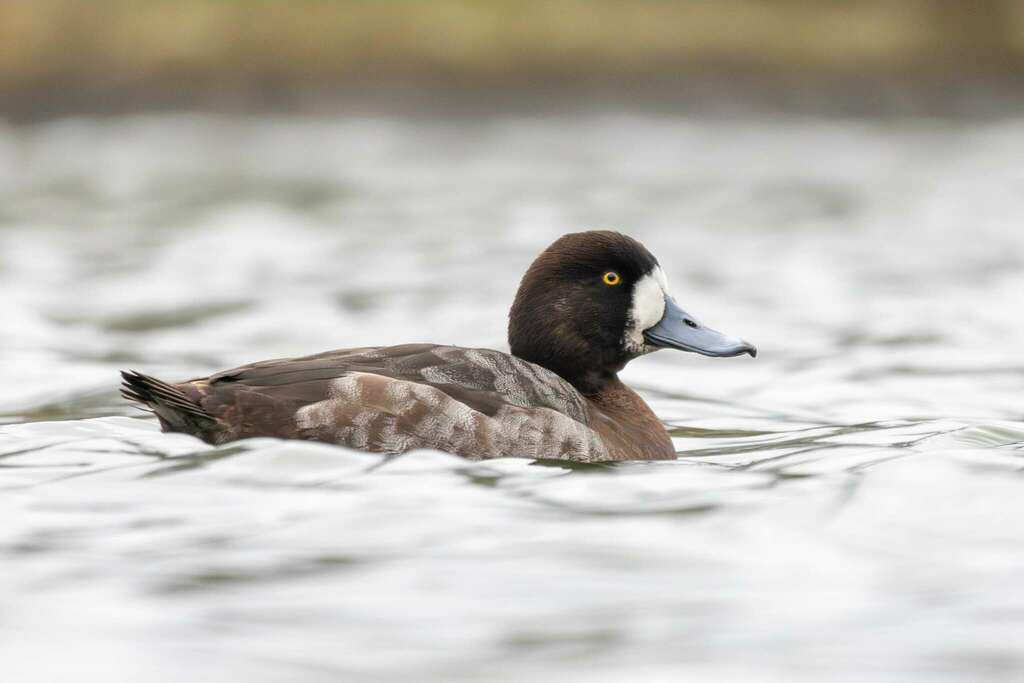
Porrón bastardo
Photo © Alexis Lours
Photo © Alexis Lours — CC BY 4.0 — Source: iNaturalist photo #349669464Identification
The greater scaup is a mid-sized diving duck, larger than its closely related cousins the lesser scaup and tufted duck. Males are noticeably striking: they sport a dark head with a green to purple iridescent gloss (depending on the angle of light), a black breast, and bright white underside and flanks. Their light blue-grey bill and yellow eyes are distinctive features. Females are altogether more subdued, presenting a mostly brown body and head with a characteristic white patch on the face and a duller blue bill. Both sexes display a strong white stripe on the wing—a key identifying feature.
Males average slightly larger than females but with considerable overlap in size. In the field, distinguishing greater scaups from the similar lesser scaup can be challenging, but the greater scaup's more rounded head, more extensive white wing stripe, and larger, wider bill with a slightly larger black nail at the tip are helpful clues. North American birds tend to have a higher forehead and reduced white on the wings compared to their European counterparts.
Range & habitat
The greater scaup boasts a circumpolar distribution, breeding within the Arctic Circle across both the Old World and North America. Summer breeding grounds span from Iceland eastward across Scandinavia, northern Russia, and Siberia, as well as Alaska and northern Canada. Though mostly migratory, small populations remain year-round in Iceland and the Aleutian Islands. During winter, birds migrate south to coastal regions of Europe, eastern Asia, and North America.
For breeding, greater scaups nest near water, typically on islands in northern lakes or on floating mats of vegetation. This preference for remote northern wetlands and their subsequent migration to coastal wintering grounds makes them birds of both freshwater and marine environments.
Behaviour & diet
Greater scaups are highly gregarious birds, often forming enormous groups called "rafts" that can number in the thousands. As diving ducks, they forage by diving underwater to depths of 0.5 to 6 metres, occasionally reaching 10 metres in search of food. Their diet consists primarily of aquatic molluscs, plants, and insects. They breed at age two, and females lay clutches of six to nine olive-buff-coloured eggs that hatch within 24 to 28 days. The downy ducklings are precocial and can follow their mother to feed immediately after hatching.
Drakes engage in complex courtship displays that occur during the return migration to breeding grounds, ultimately resulting in the formation of monogamous pairs. Beyond natural predation from owls, skunks, raccoons, foxes, and coyotes, the species faces threats from human development. Populations have declined since the 1980s, though the species remains listed as of least concern by the IUCN.
Best time & places to see it
Winter is the optimal season for observing greater scaups, when they congregate in large numbers along the coasts of Europe, eastern Asia, and North America. The coastal habitats they favour during this period make them more accessible to observers than during their dispersed breeding season in remote Arctic regions. Their habit of forming vast rafts means that when you do locate them, sightings can be spectacular and rewarding.
Photography tips
The greater scaup's striking plumage makes it a rewarding subject, particularly males with their glossy dark heads and crisp white underparts. Photograph in good light to capture the subtle green to purple iridescence of the male's head. Coastal winter locations offer opportunities to photograph large flocks, while the white wing stripe is best revealed when birds are in flight or stretching their wings. The contrast between male and female plumage provides excellent compositional opportunities for comparison shots. Patient observation of rafts may reward you with behavioural sequences including diving, courtship displays, or wing-flapping displays.
Abisko National Park
Norrbottens län, Suecia
+78 aves+13 mamíferos
Where Arctic tundra meets boreal forest beneath Sweden’s northernmost sky, one of Europe’s most pristine wilderness reserves unfolds across the […]
VER PARQUE NACIONALVadvetjåkka National Park
Norrbottens län, Suecia
+77 aves+14 mamíferos
Where raw granite peaks thrust through blankets of boreal forest, the Swedish mountain wilderness reveals itself in its most untamed […]
VER PARQUE NACIONALKosterhavets National Park
Västra Götalands län, Suecia
+133 aves+17 mamíferos
Where the Skagerrak’s cold currents lap against Sweden’s western coast, a labyrinth of granite islands and skerries emerges from the […]
VER PARQUE NACIONALDovrefjell-Sunndalsfjella National Park
Trøndelag, Noruega
+81 aves+12 mamíferos
Where alpine plateaus meet ancient mountain ranges, a vast wilderness of windswept ridges and deep valleys unfolds across central Norway. […]
VER PARQUE NACIONALHamburgisches Wattenmeer National Park
Hamburg, Alemania
+134 aves+21 mamíferos
Where the Elbe River surrenders to the North Sea, a vast tapestry of mud flats, salt marshes, and shallow tidal […]
VER PARQUE NACIONALJasmund National Park
Sassnitz, Alemania
+126 aves+26 mamíferos
Soaring white limestone cliffs plunge dramatically toward the Baltic Sea, their chalk faces sculpted by millennia of wind and wave […]
VER PARQUE NACIONALVorpommersche Boddenlandschaft National Park
Küstengewässer einschließlich Anteil am Festlandso, Alemania
+131 aves+20 mamíferos
Shallow lagoons merge imperceptibly with reed-fringed marshes where the Baltic coast dissolves into a maze of brackish waters and low-lying […]
VER PARQUE NACIONALPointe-Taillon National Park
Lac-Saint-Jean-Est, Canadá
+135 aves+24 mamíferos
Where the St. Lawrence River widens into the Gulf, a slender peninsula of boreal forest and wetland emerges from the […]
VER PARQUE NACIONALDenali National Park
Denali Borough, Estados Unidos
+102 aves+22 mamíferos
Where subarctic wilderness sprawls across nearly 31,000 square kilometres of interior Alaska, six million acres of raw, untrammelled landscape define […]
VER PARQUE NACIONALYellowstone National Park
Park County, Estados Unidos
+120 aves+31 mamíferos
Geothermal plumes rise from an alien landscape where boiling springs feed crystalline pools and geysers erupt with clockwork precision across […]
VER PARQUE NACIONALRedwood National Park
Humboldt County, Estados Unidos
+126 aves+29 mamíferos
Where ancient titans pierce the California fog, the tallest trees on Earth create a primordial landscape unlike anywhere else. Spanning […]
VER PARQUE NACIONALWrangell-Saint Elias National Park
Unorganized Borough, Estados Unidos
+77 aves+19 mamíferos
Where granite peaks thrust skyward and tidewater glaciers calve into fjords, North America’s largest subpolar wilderness commands absolute attention. Spanning […]
VER PARQUE NACIONALPadjelanta
Norrbotten County, Suecia
+25 aves+1 mamíferos
Where subarctic mountains dissolve into vast plateau moorlands, Sweden’s largest national park unfolds across 3,435 square kilometers of raw Nordic […]
VER PARQUE NACIONALMont-Tremblant National Park
Lac-des-Dix-Milles, Canadá
+110 aves+23 mamíferos
Where granite ridges rise above boreal forest and crystalline lakes mirror the Quebec sky, one of eastern Canada’s most dynamic […]
VER PARQUE NACIONALUrdaibai Biosphere Reserve
Txatxarramendi, España
+113 aves+11 mamíferos
Where the Pyrenean foothills surrender to the Bay of Biscay, tidal estuaries carve through Basque limestone, creating one of Europe’s […]
VER RESERVA DE LA BIOSFERAVaranger National Park
Båtsfjord, Noruega
+70 aves+13 mamíferos
Where the Arctic tundra meets the Barents Sea, vast plateaus of birch woodland and dwarf shrub heath roll across northeastern […]
VER PARQUE NACIONALSt. Paul Island
Saint Paul, Estados Unidos
+131 aves+2 mamíferos
Windswept tundra rolls across this remote Pribilof island, where volcanic basalt cliffs plunge into the Bering Sea and fog rolls […]
VER PAISAJE PROTEGIDOValdaysky National Park
Валдайский муниципальный округ, Rusia
+122 aves+13 mamíferos
Where glacial lakes pierce a landscape of boreal forest and ancient hills, Russia’s Valdai region unfolds as one of Eastern […]
VER PARQUE NACIONALNalychevo National Park
Nalychevo, Rusia
+86 aves+10 mamíferos
Where volcanic peaks pierce the mist of Russia’s far northeast, a primordial landscape of steaming geothermal springs and pristine river […]
VER PARQUE NACIONALWolin National Park
Kamień County, Polonia
+96 aves+17 mamíferos
Where the Baltic coastline fragments into a mosaic of pine forests, freshwater lakes, and windswept dunes, northwestern Poland harbors one […]
VER PARQUE NACIONALTombstone Territorial Park
Dawson City, Canadá
+86 aves+17 mamíferos
Where granite peaks pierce the Yukon sky and tundra stretches endlessly toward the Arctic horizon, the Tombstone Range commands attention […]
VER RESERVA NATURALAún no hay fotos de la comunidad. Inicia sesión para añadir la primera.
Aún no hay observaciones de la comunidad de esta especie.