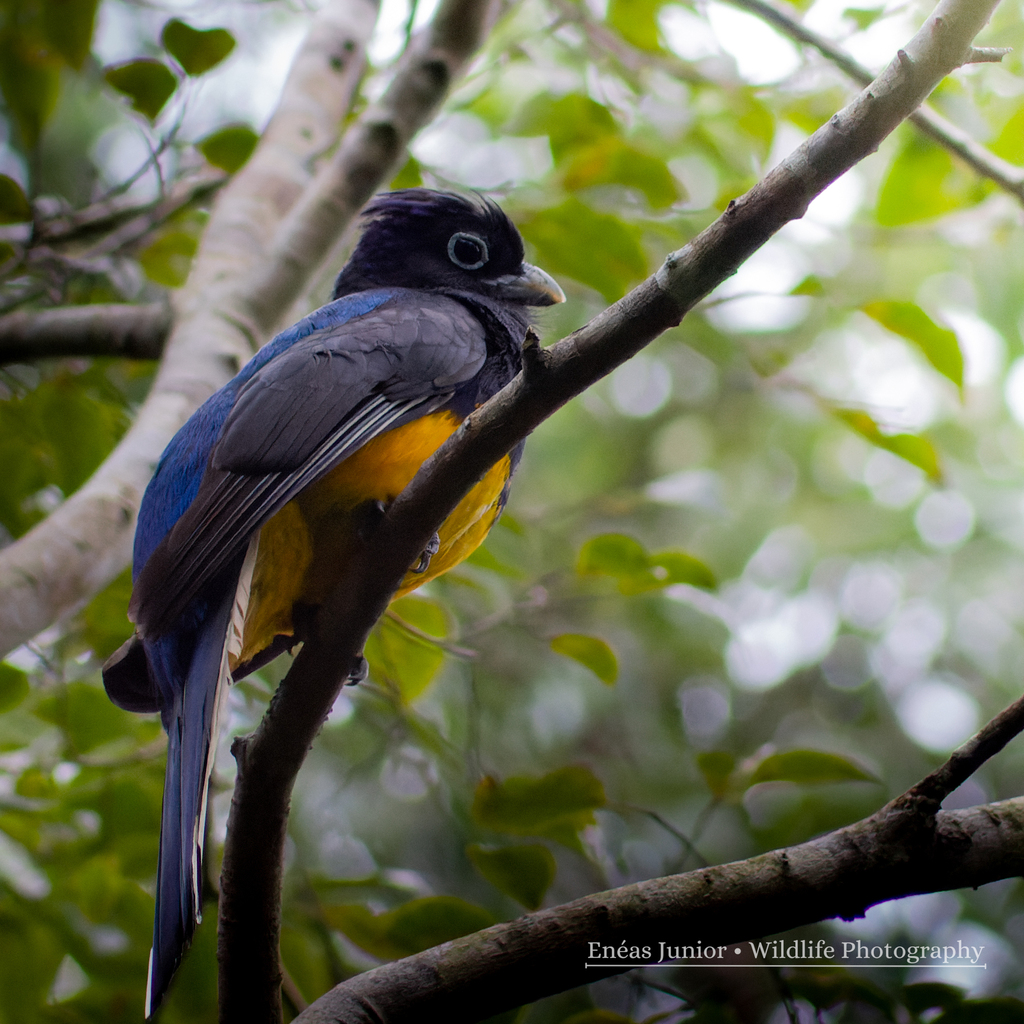
Trogón dorsiverde
Photo © Enéas V. Gouvêa Junior
Photo © Enéas V. Gouvêa Junior — CC BY-SA 4.0 — Source: iNaturalist #190103475Identification
The green-backed trogon is a relatively large trogon, measuring 28 to 30 centimetres in length. Like all trogons, it is strongly sexually dimorphic, making identification straightforward once you observe a bird clearly. Males are unmistakable: they display a dark blue head and upper breast, a vibrant green back, and a distinctive yellow-orange lower belly. The wings are black with fine white vermiculation, while the undertail is boldly patterned black and white, with each feather showing a broad black base and broad white tip. A pale bluish eye-ring completes the striking male plumage. Females are considerably duller, with a grey head, grey back, and grey breast, along with black-and-white barring on the outer webs of the tail feathers. The similar white-tailed trogon can be distinguished by its undertail pattern: the male white-tailed has only a very narrow black base to each tail feather (appearing almost entirely white), while females show barring mainly on inner webs.
Range & Habitat
The green-backed trogon is widely distributed across South America, including the Amazon basin, the Guiana Shield, Trinidad, and the Atlantic Forest in eastern Brazil. It inhabits tropical humid forests and is typically the commonest trogon throughout its range. This preference for humid forest makes it a reliable species to encounter in appropriate habitat across much of the Amazon region.
Behaviour & Diet
Green-backed trogons are characteristically sedentary birds, typically perching upright and motionless for extended periods. Despite possessing fast flight, they are reluctant to travel any significant distance, preferring to remain in their chosen perches. Their broad bills and weak legs are well-adapted to their primarily frugivorous diet. They feed mainly on small fruits, supplemented by arthropods and lizards, with invertebrates becoming more important during the dry season when fruit is scarce. Notably, they are among the most frugivorous of all trogons in their range and consequently join mixed-species feeding flocks less frequently than other trogon species.
Best Time & Places to See It
The green-backed trogon can be found throughout the year in tropical humid forests across the Amazon, Guiana Shield, and Atlantic Forest regions. The nesting season appears to occur mainly during the summer months (June–August). Its abundance throughout its range and preference for humid forest habitat make it a realistic target for travellers visiting the Amazon region, where it is the commonest trogon species available to see.
Photography Tips
The green-backed trogon's characteristic habit of perching upright and motionless works to the photographer's advantage, allowing ample opportunity for well-composed shots once a bird is located. The dramatic sexual dimorphism means you should aim to photograph both males and females to capture the full range of plumage variation. The male's brilliant yellow-orange belly and bold undertail pattern are particularly striking photographic subjects. Early morning sessions are recommended, as the distinctive song—consisting of about 20 accelerating cow notes—can help locate birds. The pale bluish orbital ring is a subtle but diagnostic feature worth capturing in close-ups of males.
Yasuní National Park
Aguarico, Ecuador
+132 aves+30 mamíferos
Where the Napo and Curaray rivers carve through Ecuador’s vast Amazonian lowlands, one of Earth’s most biodiverse terrestrial ecosystems sprawls […]
VER PARQUE NACIONALSumaco Napo-Galeras National Park
Loreto, Ecuador
+113 aves+19 mamíferos
Where the eastern Andean slopes plunge into Amazonian lowlands, pristine cloud forests and montane rainforests cloak the volcanic Sumaco massif […]
VER PARQUE NACIONALNatural Sierra de Chiribiquete National Park
Solano, Colombia
+130 aves+23 mamíferos
Where tabletop mountains rise abruptly from the Colombian Amazon, a landscape of almost alien majesty unfolds across nearly 87,000 square […]
VER PARQUE NACIONALNatural Serranía de los Churumbelos National Park
Santa Rosa, Colombia
+145 aves+15 mamíferos
Where the Andes’ western cordillera surrenders to the Pacific watershed, a fortress of granite peaks and cloud-draped valleys rises across […]
VER PARQUE NACIONALAmacayacu National Park
Leticia, Colombia
+133 aves+29 mamíferos
Where the Amazon’s dark waters merge with flooded forest and terra firme upland, five thousand square kilometres of pristine wilderness […]
VER PARQUE NACIONALSuperagui National Park
Brasil
+43 aves+1 mamíferos
Where the Atlantic rainforest meets the subtropical coast of southern Brazil, a labyrinth of islands, mangrove channels, and pristine beaches […]
VER PARQUE NACIONALSaint-Hilaire/Lange National Park
Brasil
+13 aves+11 mamíferos
Where Atlantic Forest transitions into open cerrado grassland, granite escarpments rise dramatically above the São Paulo state plateau, their weathered […]
VER PARQUE NACIONALSerra da Bocaina National Park
Brasil
+132 aves+30 mamíferos
Where Atlantic rainforest meets coastal escarpment, a landscape of dramatic elevation transforms within mere kilometers from sea level to peaks […]
VER PARQUE NACIONALViruá National Park
Brasil
+103 aves+14 mamíferos
Where granite inselbergs rise dramatically from the Amazon’s northern fringe, a 3,651-square-kilometre wilderness unfolds across Roraima State. This Category II […]
VER PARQUE NACIONALGuaricana National Park
Brasil
+34 aves+5 mamíferos
Where crystalline streams cascade through Atlantic Forest canopy and sandstone plateaus rise dramatically above the lowlands, Brazil’s Guaricana unfolds across […]
VER PARQUE NACIONALPau Brasil National Park
Brasil
+27 aves+5 mamíferos
Where Atlantic forest remnants cling to Brazil’s northeastern plateau, a landscape of dramatic escarpments and seasonal waterfalls reveals one of […]
VER PARQUE NACIONALAmazônia National Park
Brasil
+74 aves+8 mamíferos
Dawn breaks over a realm where the Rio Tapajós cuts through the heart of the Brazilian Amazon, its dark waters […]
VER PARQUE NACIONALMapinguari National Park
Brasil
+120 aves+30 mamíferos
Where the Amazon’s southwestern frontier meets the Xingu Basin, vast tracts of pristine tropical forest rise and fall across nearly […]
VER PARQUE NACIONALAnavilhanas National Park
Brasil
+132 aves+30 mamíferos
Where the Rio Negro braids into a labyrinth of islands and waterways, one of the Amazon’s most pristine archipelagos unfolds […]
VER PARQUE NACIONALCampos Amazónicos National Park
Amazonas, Brasil
+88 aves+21 mamíferos
Where open grasslands merge unexpectedly with dense Amazon rainforest, an ecological mosaic of rare brilliance unfolds across this 27,263-square-kilometre sanctuary […]
VER PARQUE NACIONALSerra do Divisor National Park
Brasil
+132 aves+30 mamíferos
Where the Ucayali River carves its ancient path through northwestern Brazil, rainforest canopy rises in unbroken waves across nearly 27,000 […]
VER PARQUE NACIONALAún no hay fotos de la comunidad. Inicia sesión para añadir la primera.
Aún no hay observaciones de la comunidad de esta especie.