Pigarguillo común
Photo © Tim
Photo © Tim — CC BY 4.0 — Source: iNaturalist #326944289Identification
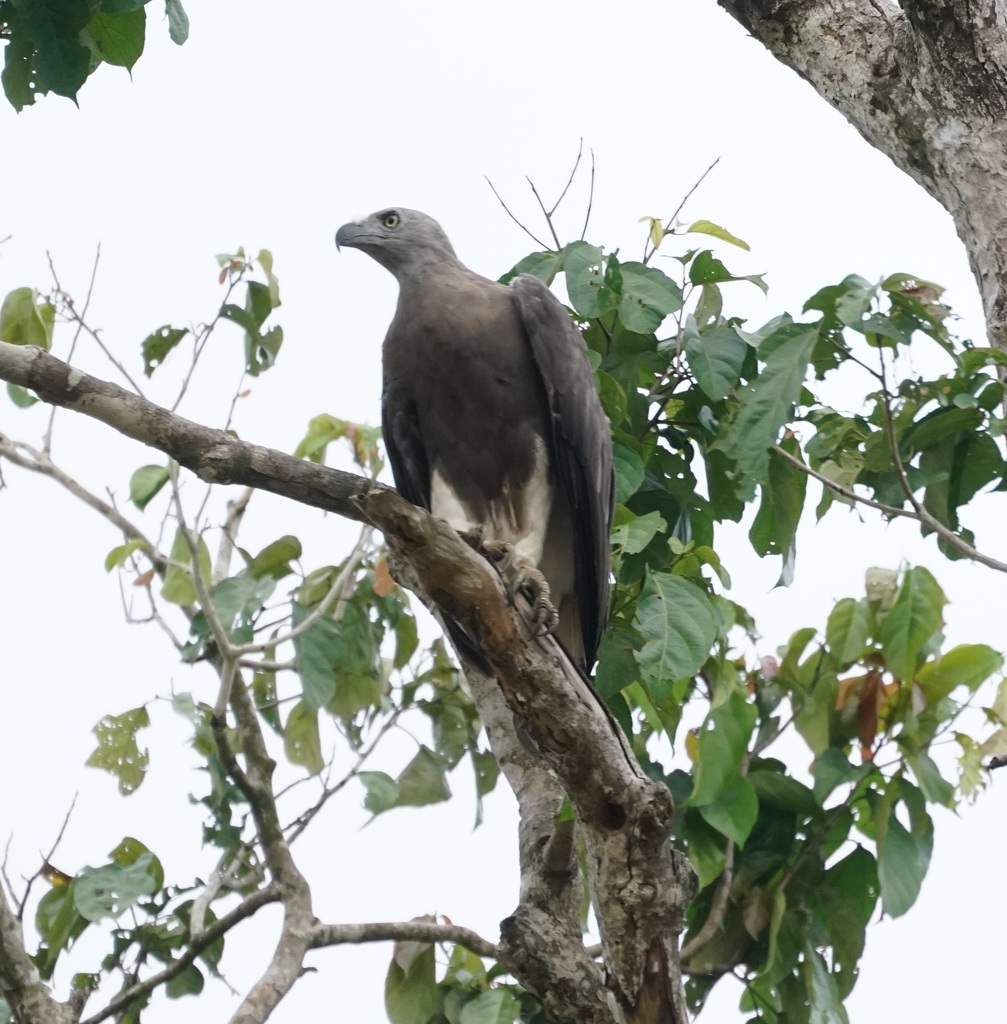
The grey-headed fish eagle is a smallish to medium-sized but quite bulky fish eagle with a distinctive appearance. Adults display dark brown upper body plumage contrasted with a pale grey head, white belly and tail, and characteristic white legs. The tail features a broad black subterminal band. Juveniles are paler overall with darker streaking on the head and neck, and a marbled black-and-white tail. The species has a small bill, small head on a long neck, rounded tail, and short legs with long talons. Wings are not very long, with wingtips reaching less than halfway down the tail. Females are notably heavier than males, weighing 2.3–2.7 kg compared to males at 1.6 kg, with a body length of 61–75 cm and wingspan of 155–170 cm.
This species is often confused with the smaller lesser fish eagle, which shares similar plumage, and the larger Pallas's fish eagle, which has longer wings and darker underparts. In Sri Lanka, it is colloquially known as the "tank eagle" due to its fondness for irrigation tanks.
Range & Habitat
The grey-headed fish eagle has a wide distribution across Southeast Asia, ranging from India through to Malaysia, western Indonesia, and the Philippines. It occurs in Indian states including Rajasthan, Uttar Pradesh, Bihar and Assam, and is found throughout the region from North and East Sri Lanka to Nepal and Bangladesh, with populations in Thailand, Laos, Vietnam, Cambodia, and Borneo. It is generally uncommon, though it can be rare or local in many areas, with particularly sparse populations in Java, Sulawesi, and the Philippines.
This eagle inhabits lowland forests up to 1,500 metres elevation and shows a strong preference for proximity to water. It builds nests close to slow-moving rivers and streams, lakes, lagoons, reservoirs, marshes, swamps, coastal lagoons, and estuaries. In Sri Lanka, it frequently uses irrigation tanks as hunting grounds.
Behaviour & Diet
The grey-headed fish eagle is sedentary and non-migratory, occurring either solitarily or in pairs. Adults spend much of their time perched upright on bare branches over water bodies, occasionally diving to catch fish. Flight is characterised as heavy-looking with sharp, full wing-beats on flattish wings. Juveniles disperse from breeding areas, presumably in search of mates or new food sources.
As a specialist piscivore, this eagle feeds primarily on live fish, though it also scavenges dead fish and occasionally takes reptiles, terrestrial birds, and small mammals. In protected areas such as Prek Toal on the Tonlé Sap, the endangered Tonlé Sap water snake appears in their diet, though whether this is a primary prey item or seasonal occurrence remains unclear. Breeding typically occurs between November and May across mainland populations, with regional variations. Pairs build enormous stick nests up to 2 metres deep in tall trees near water sources, laying two unmarked white eggs per clutch. Both parents share incubation duties for 45–50 days and fledgling care for approximately 70 days.
Best Time & Places to See It
The grey-headed fish eagle is best sought in wetland habitats near bodies of water, particularly lowland forests, river systems, and protected wetland reserves. The Prek Toal protected area of the Tonlé Sap in Cambodia is a notable location for viewing this species. In Sri Lanka, irrigation tanks offer accessible viewing opportunities. Breeding season varies by region: November to May across mainland Southeast Asia, December to March in Sri Lanka, and November to January in India. The species' sedentary nature and habit of perching openly on branches over water make it relatively approachable compared to other raptors, though its generally uncommon status means patient observation is often required.
Photography Tips
Photographers should position themselves near water bodies where these eagles regularly hunt, as they spend considerable time perched on bare branches awaiting prey. The birds' habit of hunting from exposed perches makes them relatively accessible to photograph, compared to more secretive raptor species. Early morning light is ideal for capturing the subtle grey tones of the head and the contrasting dark brown upperparts and white underparts that characterise the species. Look for the distinctive white legs and pale iris when photographing adults, as these features aid identification. Given that females are heavier than males and may appear bulkier, patience in observing multiple individuals will yield diverse compositional opportunities.
Lunugamvehera National Park
Sri Lanka
+129 aves+30 mamíferos
Where scrubland meets open water beneath the dry zone sky, one of Sri Lanka’s most underrated wilderness sanctuaries reveals itself […]
VER PARQUE NACIONALMinneriya National Park
Sri Lanka
+123 aves+30 mamíferos
Dawn breaks over a sprawling tapestry of dry deciduous woodland and freshwater marshland where ancient granite outcrops punctuate the landscape […]
VER PARQUE NACIONALWasgamuwa National Park
Sri Lanka
+122 aves+30 mamíferos
Dawn breaks over a landscape where ancient riverine forests meet sprawling grasslands, carved through by the Mahaweli River’s serpentine passage […]
VER PARQUE NACIONALAngamedilla National Park
Polonnaruwa, Sri Lanka
+122 aves+30 mamíferos
Where granite outcrops rise dramatically from dry deciduous forest, Sri Lanka’s central highlands reveal one of the island’s most rugged […]
VER PARQUE NACIONALMaduru Oya National Park
Sri Lanka
+123 aves+30 mamíferos
Granite monoliths rise abruptly from dense dry lowland forest in Sri Lanka’s eastern interior, creating a mosaic of rocky outcrops, […]
VER PARQUE NACIONALOrang National Park
Rangagarapathar, India
+147 aves+15 mamíferos
Dawn breaks across the floodplains of Assam, where the Brahmaputra River sprawls into a mosaic of grasslands, riverine forests, and […]
VER PARQUE NACIONALValmiki National Park
Ramnagar, India
+128 aves+30 mamíferos
Where the Himalayan foothills soften into the Ganges plains, dense sal forests rise above meandering rivers and grassland mosaics that […]
VER PARQUE NACIONALKanha Tiger Reserve
Kanha Kisli F.V., India
+126 aves+29 mamíferos
Where sal forests give way to emerald meadows and crystalline streams carve through ancient valleys, one of India’s finest wilderness […]
VER PARQUE NACIONALTadoba National Park
Palasgaon Singru, India
+133 aves+25 mamíferos
Where sal forests meet open grasslands and rocky outcrops rise from red laterite soil, central India’s landscape unfolds in raw, […]
VER PARQUE NACIONALPanna National Park
Badgadi Kalan, India
+136 aves+27 mamíferos
Where granite gorges slice through central India’s Vindhyan plateau, a landscape of stark beauty unfolds across nearly six hundred square […]
VER PARQUE NACIONALKaziranga National Park
Kohora, India
+129 aves+30 mamíferos
Dawn breaks over the floodplains of the Brahmaputra, where tall grasslands stretch endlessly beneath monsoon-heavy skies. This sprawling wilderness of […]
VER PARQUE NACIONALBandipur National Park
Hirehalli, India
+135 aves+30 mamíferos
Where the Western Ghats descend into the Deccan plateau, ancient deciduous forests blanket a landscape carved by the Nugu River. […]
VER PARQUE NACIONALNagarahole Tiger Reserve
Nalkeri Forest, India
+120 aves+30 mamíferos
Where granite escarpments rise above dense deciduous forests and the Kabini River carves through pristine wilderness, one of India’s most […]
VER PARQUE NACIONALTaman Negara Bukit Lambir National Park
Miri, Malasia
+137 aves+15 mamíferos
Rainforest cascades down sandstone ridges where crystal streams carve through ancient geology, creating a landscape of profound biological richness in […]
VER PARQUE NACIONALSembilang National Park
Banyuasin, Indonesia
+48 aves+3 mamíferos
Mangrove forests stretch endlessly across South Sumatra’s coastal lowlands, their gnarled root systems anchoring a labyrinth of tidal channels and […]
VER PARQUE NACIONALWay Kambas National Park
Lampung Timur, Indonesia
+148 aves+28 mamíferos
Swamps and dipterocarp forests interweave across Sumatra’s southeastern lowlands, creating a mosaic of habitats that few conservation areas in Southeast […]
VER PARQUE NACIONALAún no hay fotos de la comunidad. Inicia sesión para añadir la primera.
Aún no hay observaciones de la comunidad de esta especie.